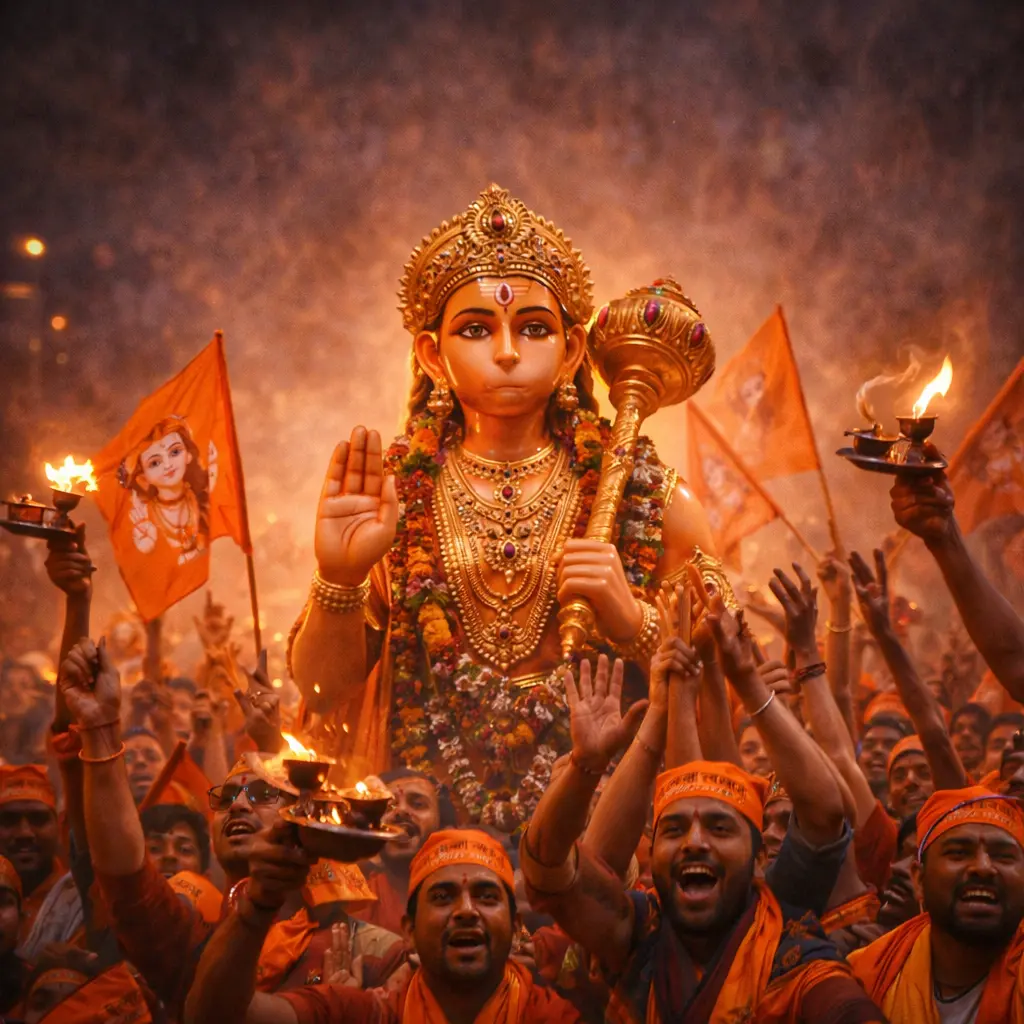
There is something quietly powerful about the way India celebrates Hanuman Jayanti. Before the sun has properly risen, before the day’s noise and rush has begun, millions of people are already on their feet — bathed, dressed, and walking toward their nearest temple with flowers in their hands and prayers on their lips. Today, April 2, 2026, that familiar, beautiful picture repeated itself across the length and breadth of the country.
Hanuman Jayanti is being celebrated today, on April 2, 2026 — one of the most auspicious Hindu festivals devoted to honoring Lord Hanuman, marking his birth anniversary on the Purnima tithi of Shukla Paksha in the month of Chaitra. Google From the lanes of Ayodhya to the streets of Mumbai, from remote village temples in Rajasthan to bustling urban mandirs in Delhi and Hyderabad, the festival arrived today with its usual sense of devotion, color, and communal warmth.
A Festival Born of Faith, Lived Through Generations
Ask any devotee why Hanuman Jayanti matters so deeply, and you will rarely get a theological lecture. What you’ll receive is something more intimate: a narrative of hardship, a prayer fulfilled, a sense of safety during a moment of dread.
That is the real reason this Hindu festival endures so powerfully across centuries.
Hanuman is revered as a symbol of strength, an ardent devotee of Rama widely known for his unflinching devotion. His followers venerate him as a god, a figure capable of triumphing over malevolence and offering sanctuary. During this festival, they pray for his bravery, his lack of fear, and his favor.
Wikipedia In a country as vast and varied as India, it is remarkable that one deity — one idea of selfless service and unshakeable faith — can command such universal love. Lord Hanuman, or Bajrangbali as he is affectionately called, bridges every boundary of caste, region, and language.
He was born to mother Anjani and father Kesari during the Treta Yuga, when Lord Shri Ram incarnated on earth as a human. Google That ancient story — of a devoted son, a loyal warrior, a humble servant of the divine — still resonates with millions of Indians today as vividly as ever.
Dawn at the Temples: A Scene That Never Gets Old
The most striking thing about Hanuman Jayanti is how early it begins. Long before most of the country stirs, the temple gates are open, the diyas are lit, and the air carries the mingled scent of marigold garlands, incense, and sindhoor.
In a Hanuman temple, spiritual discourses begin at dawn since Hanuman is believed to have been born during sunrise. During the time frame of birth, the discourses are halted and prasadam is distributed to everyone. Wikipedia This tradition, observed with remarkable consistency across temples nationwide, gives the morning a very particular quality — a pause in the middle of prayer, a communal moment of stillness, before the celebrations resume.
Devotees wake up early, take a holy bath, and many perform puja at home by placing an idol of Lord Hanuman on a wooden plank, lighting a diya with desi ghee or sesame oil, adorning the idol with flowers or garlands, and offering homemade bhog prasad. Google Major temples were decorated with flowers and lights well before sunrise, and the queues of devotees — families, elderly pilgrims, young men and women — began forming from the first light of morning, stretching far beyond the temple gates in many cities.
The Hanuman Chalisa: A Prayer That Unites Millions
If there is one thread that runs through every Hanuman Jayanti celebration in every corner of India, it is the recitation of the Hanuman Chalisa. Those forty verses, composed centuries ago by the poet Tulsidas in praise of Lord Hanuman, are perhaps the most widely memorized religious text in the Hindu tradition.
The Hanuman Chalisa — “Jai Hanuman Gyaan Gun Sagar, Jai Kapis Teehun Lok Ujagar” — is sung every day by Hanuman devotees, and it is recited with particular devotion on Hanuman Jayanti. Drikpanchang Today, that recitation echoed from temple speakers, from home courtyards, from processions winding through market streets. There is a reason the Chalisa has survived generations: it is not just a prayer. For millions of people, it is a source of calm in anxiety, courage in fear, and hope in hardship.
A Festival That Looks Different Everywhere — and Means the Same Thing Everywhere
One of the most fascinating things about Hanuman Jayanti 2026 is how differently it is observed across India while somehow carrying the same essential spirit. In Telangana and Andhra Pradesh, Hanuman Jayanti is celebrated for 41 days, beginning on Chaitra Purnima. In Maharashtra, it is celebrated on the full moon day of Chaitra. In Tamil Nadu and Kerala, the festival falls on the new moon day in the month of Margali.
Each region brings its own customs, its own foods, its own music. In some places, grand processions wind through the streets with decorated chariots. In others, Akhand Ramayana paths — continuous readings of the Ramayana — run through the night. Community langars and bhandaras feed hundreds or even thousands of people, because generosity, after all, is considered one of the highest ways to honor the Lord.
More Than a Festival — A Way of Life
What Hanuman Jayanti ultimately celebrates is not just a birthday. It is a set of values that Lord Hanuman embodies so completely — devotion without expectation, strength without arrogance, service without ego. Hanuman Jayanti is not just about rituals. It is about learning from the life of Lord Hanuman and applying his qualities in daily life: his strength, devotion, humility, and courage that inspire us to become better individuals.
In a world that often feels uncertain and noisy, there is something deeply comforting about the sight of millions of ordinary people pausing their lives today — if only for an hour, if only for the time it takes to recite the Chalisa and offer a flower — to connect with something greater than themselves.
Jai Bajrangbali. Jai Hanuman.
Jai Bajrangbali: India Wakes Up Early and Celebrates Hanuman Jayanti 2026 with Open Hearts