
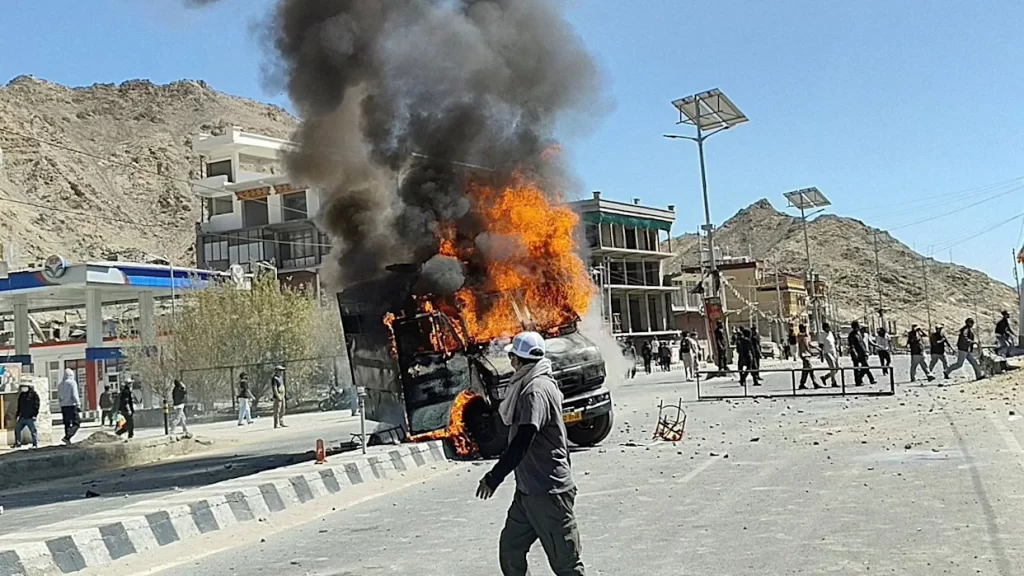
At least four people were killed and dozens injured after violent clashes broke out in Leh on September 24 during ongoing protests demanding statehood for Ladakh and greater constitutional protections. Authorities imposed a curfew across the district, blaming environmental activist Sonam Wangchuk for inciting the unrest, though he has denied the allegations.
According to police officials, the violence began when a large crowd gathered to press for statehood, inclusion under the Sixth Schedule of the Constitution, and stronger safeguards for land, jobs, and the fragile Himalayan ecology. What started as a peaceful demonstration soon turned chaotic as sections of the crowd targeted government property, setting fire to the local BJP office and a police vehicle. Security forces responded with baton charges, tear gas, and, in some areas, live rounds to disperse demonstrators.
Officials confirmed that four protesters died in the clashes, while more than 40 others, including police personnel, sustained injuries. Over 50 people were detained, and prohibitory orders under Section 163 of the Bharatiya Nagarik Suraksha Sanhita (BNSS) were enforced. Streets in Leh remained deserted on Thursday as heavily armed patrols monitored the region and shops, schools, and offices stayed closed.
The Ministry of Home Affairs released a statement accusing Sonam Wangchuk of “provocative speeches” that allegedly triggered the violence. Wangchuk, however, distanced himself from the clashes, stressing that his movement had always advocated non-violent methods. He announced the end of his 15-day hunger strike, declaring he did not want the agitation to “cause further bloodshed or instability.”
The protests reflect simmering anger in Ladakh since the 2019 reorganisation of Jammu and Kashmir, which granted Union Territory status to the region but left it without a legislative assembly. Local groups, including the Leh Apex Body (LAB) and the Kargil Democratic Alliance (KDA), have consistently demanded full-fledged statehood, political representation, and constitutional safeguards. Both groups expressed shock at the violence, urging the government to initiate dialogue rather than resort to heavy-handed measures.
Opposition parties at the national level criticised the central government for ignoring Ladakh’s grievances. They argued that the unrest could have been avoided had authorities engaged in meaningful talks with local representatives. Civil society and environmental groups also voiced concern, warning that unchecked development without legal protection could endanger Ladakh’s unique cultural identity and fragile ecosystem.
Residents described scenes of panic as clashes unfolded. Eyewitnesses reported that security forces used excessive force, while police maintained that officers acted in self-defence after being attacked with stones and incendiary materials. Internet services in several parts of Leh were suspended to prevent the spread of rumours.
Political analysts believe the violence has brought Ladakh’s demands for statehood into sharp national focus. With the region under curfew and security tightened, the central government faces mounting pressure to find a peaceful resolution. The deaths of protesters may further galvanise local sentiment, raising fears of prolonged unrest if the demands remain unaddressed.
As of Thursday evening, Leh remained under strict curfew, with the administration urging residents to remain indoors. Whether the tragedy leads to renewed dialogue or deeper divisions remains uncertain, but the events of September 24 are likely to mark a turning point in Ladakh’s long struggle for political autonomy.

