Region: Uttar Pradesh, India
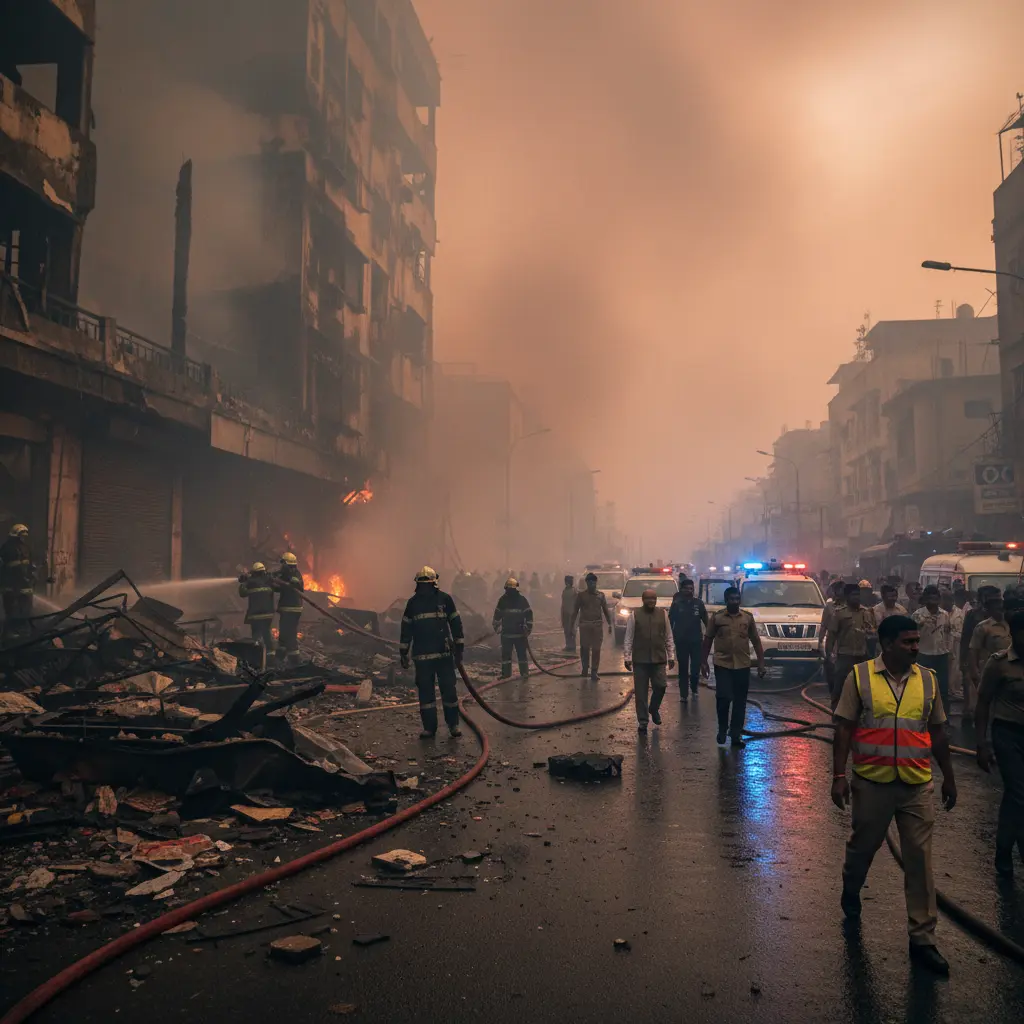
A fire at a coaching centre in Lucknow’s Aliganj area has plunged the city into mourning and triggered a swift top-level emergency response from the state government. The incident, which took place at a commercial building on Usha Mehta Marg on a busy Monday afternoon, has once again thrown the spotlight on fire safety standards in India’s densely populated urban areas, making it one of the most heartrending stories in latest India news this week.
The fire was reported to have engulfed a three-storey building housing a coaching institute and a computer training and animation centre, fire officials said. Within minutes thick smoke engulfed the premises trapping several young people inside. In the ensuing chaos, some students reportedly tried to jump off upper floors or use makeshift means to climb down, only adding to the toll of injuries. By the time rescue teams were able to gain full access to the building, the death count had gone up to 15, with several others being rushed to King George’s Medical University for treatment.
A State in Action
When news of the fire reached him, Chief Minister Yogi Adityanath was in Aligarh for an inauguration event. He cancelled his remaining engagements on the spot and returned to Lucknow immediately, directing the Director General of Police and the Additional Chief Secretary (Home) to reach the site without delay and report back on the situation. This kind of rapid mobilisation has become a defining feature of how Uttar Pradesh has handled the unfolding crisis, reflecting the broader push toward faster emergency response whenever such tragedies strike.
Prior to heading to the hospital to meet the injured and review their treatment, the Chief Minister visited the affected building in Lucknow. Deputy Chief Minister Brajesh Pathak, visibly shaken after seeing the scale of the loss first hand, also visited the site and hospital, later telling reporters that survivors described the fire spreading with frightening speed, leaving them with little time or means to escape safely.
The state government announced an ex-gratia payment of Rs 5 lakh for the family of each person killed in the tragedy, along with Rs 50,000 for those injured, while also assuring all necessary medical support for victims still under treatment. In another statement, Prime Minister Narendra Modi mourned the loss of lives and declared financial aid from the Prime Minister’s National Relief Fund for the families of the deceased and the injured. President Droupadi Murmu also offered condolences to the bereaved families, highlighting how the tragedy reverberated far beyond the borders of Uttar Pradesh.
Why This Tragedy Feels So Familiar The incident has a chilling sense of déjà vu for many following the news from Uttar Pradesh. Fires in coaching centres, computer institutes and other such commercial set-ups have occurred before in various parts of the country, often highlighting the same gaps: buildings converted for cramped educational use without sufficient fire exits, a lack of working sprinkler systems and limited staircases that become bottlenecks in an emergency. Survivors of the Lucknow fire have reportedly said that escape routes were severely limited once smoke spread, something that will surely feature heavily in the investigation that follows.
A detailed probe is now underway to understand exactly how the fire started and why it spread so quickly, authorities have confirmed. Officials are expected to look at whether the building had a valid fire safety no-objection certificate, whether regular safety inspections were conducted and whether the institute operating inside was compliant with occupancy and structural norms. Early signs suggest accountability will be a central theme of this investigation, with the Deputy Chief Minister himself describing the incident as a heavy lesson for the state going forward.
A New Push for Fire Safety
Apart from the immediate work of relief and rescue, this tragedy has opened up a larger debate on fire safety that India needs to take more seriously, especially in respect of commercial buildings housing coaching centres, libraries and training institutes. These spaces often see large numbers of young people gathered for hours at a stretch, yet they frequently operate inside buildings that were never originally designed for such footfall.
State officials have indicated that the government intends to use this incident as a trigger point for a wider review of fire safety compliance across similar institutions in Lucknow and potentially the rest of Uttar Pradesh. Checking of existing fire NOCs, verification of functional fire-fighting equipments and ensuring that the buildings used for coaching and training purpose have more than one usable evacuation route is expected to be part of the same.
And now, as the city of Lucknow mourns the loss, the question is what can be done to ensure that rescue and relief efforts give way to accountability and safety reforms that prevent such a recurrence. Families have lost their loved ones, many of them young students who were just beginning their academic and professional journeys, and no amount of compensation will bring them back. What happens next, in terms of the investigation’s findings and the state’s follow through on safety reforms, will determine whether this tragedy marks a true watershed moment or just another notch in a pattern India has witnessed all too often before.
Lucknow coaching centre fire raises questions of emergency response, safety.