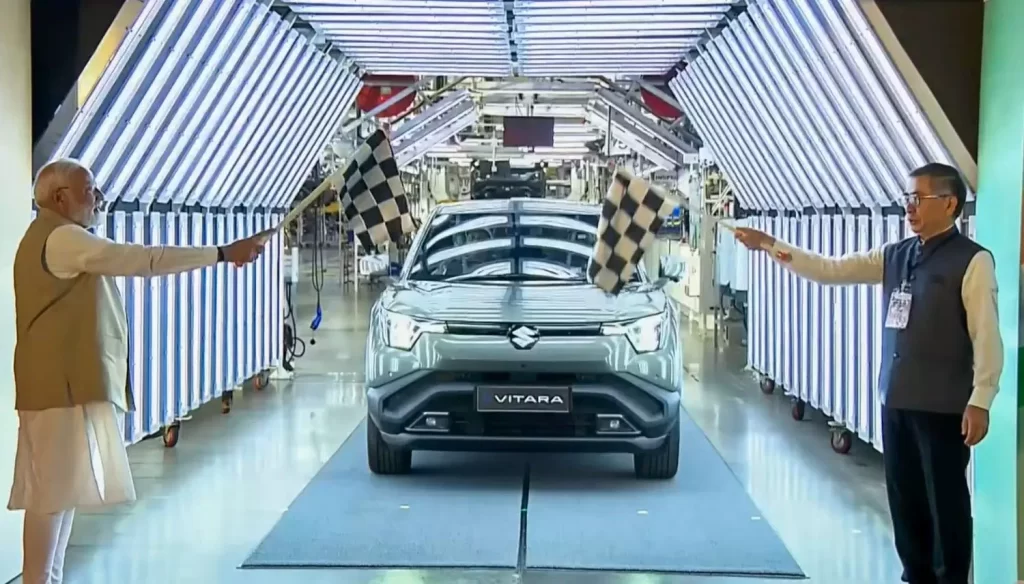
August 26,2025: Prime Minister Narendra Modi today flagged off Maruti Suzuki’s first fully electric global model, the e-Vitara, marking a significant step in India’s bid to become a major hub for electric mobility. The launch, under the banner of “Make in India, Make for World”, signals the country’s intent to export battery electric vehicles to over 100 nations.
The ceremony, held in the national capital, was attended by senior government officials, executives of Maruti Suzuki, and representatives from Suzuki Motor Corporation. The Prime Minister hailed the development as a milestone in India’s journey towards clean energy and global competitiveness.
The e-Vitara, positioned as Maruti Suzuki’s flagship electric vehicle, is designed for international markets as well as domestic buyers. Company executives confirmed that initial shipments will begin later this year, with destinations spread across Asia, Europe, Africa, and Latin America.
Industry experts noted that the event comes at a time when India is seeking to establish itself as a manufacturing centre for advanced technology vehicles. The government has been pressing for deeper localisation of components, including battery packs and critical electronics, in order to reduce import dependence.
Suzuki Motor Corporation, Maruti Suzuki’s parent company, has already committed an investment of nearly $8 billion in India to support electric vehicle production, battery manufacturing, and research facilities. The e-Vitara will be the first model to roll out under this investment plan.
Speaking on the occasion, Mr. Modi said that the e-Vitara reflects India’s capability to deliver world-class products. He added that the initiative will not only generate employment but also strengthen India’s export profile in the automotive sector.
The company highlighted that the vehicle has been engineered to meet global safety and emission standards. With a driving range suited for urban and semi-urban use, the e-Vitara will compete with established electric SUV models in international markets.
Analysts observed that while the launch is a positive development, challenges remain. The global shortage of rare earth minerals, required for EV batteries, has raised concerns about long-term supply chains. Nonetheless, industry insiders expressed confidence that India’s position as a low-cost, high-quality manufacturing base will give the e-Vitara a competitive edge abroad.
The flagging off of the e-Vitara is being seen as both a symbolic and practical milestone. Symbolically, it reflects India’s commitment to sustainable mobility. Practically, it marks the country’s entry into the global electric vehicle supply chain, at a scale not previously achieved.
With exports expected to reach more than 100 countries, the e-Vitara will carry India’s manufacturing credentials to the world stage. Observers remarked that the development could pave the way for other domestic automakers to follow suit, expanding the nation’s footprint in the international EV market.