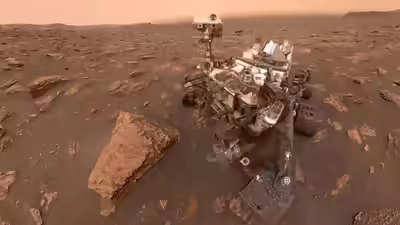
NASA’s rovers have found strong evidence that Mars used to have rivers, lakes, and maybe even seas. This changes our view of the planet from a dry desert to a place that could have been livable billions of years ago. These finds show that there was more water in the past, which might have supported microbial life.
A Wetter Mars: An Introduction
Mars used to be a very different place. It was full of liquid water that carved rivers and filled lakes all over the surface. NASA’s Perseverance and Curiosity rovers have found evidence of old river deltas and lakebeds, which shows that the planet wasn’t always dry. This new data changes everything we know about planetary science and suggests that Mars had conditions that were good for life for a lot longer than we thought.
Important Finds from the Perseverance Rover
NASA’s Perseverance rover landed at Jezero Crater in February 2021 and has given us some of the most direct evidence of Mars’ wet past. The western edge of Jezero Crater has a fan-shaped delta that shows that it used to have a lake fed by rivers. Rover photos show sloping layers that show deltas moving into a body of water that is already there. Later, these layers become boulder-strewn conglomerates from high-energy floods.
In September 2025, Perseverance took a sample called “Sapphire Canyon” from clay-rich mudstones in Neretva Vallis, an old river valley that flowed into Jezero Crater more than three billion years ago. These minerals provide significant evidence of possible ancient life because they keep biological residues in places that used to be full of water. Recent discoveries by the rover in 2026 also revealed beaches and rocks shaped like waves and rocks changed by water below the surface, suggesting that lake systems are always changing.
Perseverance has been on Mars for more than 1,000 days, charting the delta and taking 23 samples that show how water affects Jezero’s geology. The size of the boulders and the layers of rock show that constant river flows changed to floods that happened from time to time when Mars dried out. Clay minerals in the samples point to long-lasting interactions between water and rock that could support life.
These data establish Jezero as an excellent location for habitability investigations, characterized by enduring complicated water cycles.
What Curiosity Learned About Gale Crater
NASA’s Curiosity rover has been exploring Gale Crater since 2012. It has ascended the strata of Mount Sharp, which tell the story of how Mars went from wet to dry. Researchers from NYU Abu Dhabi looked at data from Curiosity that came from ancient sand dunes in Gale Crater in late 2025. They found evidence of water seeping beneath billions of years ago. Water from adjacent mountains seeped into the dunes, turning sand into rock and trapping any biological matter that could have been there.
This flow of water below the surface made the area more livable after the surface dried out, giving bacteria safe places to live. Curiosity’s recent trip through the Gediz Vallis channel reveals that water comes back late in the dry season, as shown by boulders from Mount Sharp’s heights. The layers of sulfate-rich material show that water bodies are drying up, while the clay layers below show that there used to be a lot of liquid.
Experts like Ashwin Vasavada, a scientist on the Curiosity team, say that these results suggest “fairly late in the story of Mount Sharp, water came back in a big way.” This kind of proof shows that Mars has had hydrological activity for a long time.
Proof of Old Oceans and Bigger Water Systems
Besides craters, satellite data and rover ground truthing show that Mars’ northern hemisphere was covered by ocean-sized amounts of water about 3.7 to 3 billion years ago. Sculpted flow deposits in Valles Marineris seem like river mouths that led to ancient oceans, and they are all at the same height, which suggests a huge shoreline.
A study from 2026 found that these were the greatest and deepest signs of an old ocean. They date back to the Late Hesperian to Early Amazonian epochs, when surface water was at its highest. In 2025, China’s Zhurong rover found subsurface beach deposits that were perpendicular to ancient shorelines. This suggested that there were ice-free oceans supplied by rivers full of silt.
Mars orbiters have taken pictures of river deltas that look like Earth’s. This shows that sediment was deposited into standing water bodies roughly 3 billion years ago. These “blue planet” features show that there is a lot of hydrological activity going on that brings in water, sediment, and nutrients.
Mars’ varied watery past is shown by its major water features. The river deltas in Jezero Crater are roughly 3.5 billion years old and have sloping layers and boulder conglomerates. Gypsum-filled dunes and sulfate layers at Gale Crater show that there was water below there 3 to 3.7 billion years ago. Ocean shorelines along Valles Marineris and the northern plains, which are similarly 3 to 3.7 billion years old, have homogeneous elevation flow deposits and beach remnants. Gediz Vallis has boulders in flood channels on Mount Sharp that date back to the Late Hesperian.
What this means for finding life and making places livable
Mars’ old rivers, lakes, and oceans made places where there was liquid water, important chemicals, and energy sources—three things that are necessary for life. Subsurface persistence, like in Gale Crater, shows that bacteria may have survived losing their surface. Samples like Sapphire Canyon give us the best biosignature clues so far. Clays keep organics safe from wet times.
Perseverance’s stash is waiting to return to Earth on the Mars Sample Return mission, which could confirm the presence of life. Recent observations of repeating slope lineae, which are related to salty flows today, suggest that there is still water activity above freezing temperatures. These results broaden habitability windows, contesting rapid drying models.
Problems: What Made Mars Dry Up?
Mars went from being wet to dry because it lost its atmosphere, probably because solar wind stripped it away after its magnetic field deteriorated 4 billion years ago. The oceans were able to survive early warmth from a thicker CO2 atmosphere and volcanic activity, but they froze or evaporated when it got colder. Late floods suggest sporadic returns, either from aquifers or effects.
Comparative planetology with Earth indicates that Mars lacked plate tectonics to recycle volatiles, accelerating desiccation. Knowing this helps us figure out if exoplanets can support life.
Future Missions and Discoveries
NASA’s rovers make it possible for more advanced probes. Mars Sample Return, which is planned to launch in the 2030s, will look for biosignatures in samples from Jezero. Future missions, such as ESCAPADE, will look into how the atmosphere escapes, which will help explain how water is lost. Under President Trump’s fresh focus, human exploration could speed up, based on these aquatic discoveries.
Because of international initiatives, including China’s, the hunt is increasing bigger.Ground-penetrating radar and sample returns will help us learn more about reservoirs that are below the surface.
Scientists are excited about the idea that Mars used to be a world with rivers, lakes, and oceans where people could live. These discoveries not only change what we know about the past of planets, but they also spark the search for life beyond Earth, which could have effects on the future of Earth as the climate changes. Mars is still the best place to look for habitable worlds beyond our own as rovers continue to discover layers of its dramatic history.
NASA’s rovers have found proof that Mars used to have rivers and lakes that made it possible for life to live there.