Bangladesh is witnessing one of its most intense periods of civil unrest in recent history following the death of Sharif Osman Hadi, a charismatic youth leader and spokesman for the radical political platform Inqilab Mancha. His death late on December 18 triggered widespread violent protests, reflecting deep-seated political tensions in the country.
Hadi, 32, who played a central role in the 2024 pro-democracy uprising, succumbed to his injuries in a Singapore hospital after being shot in the head during an election campaign event in Dhaka on December 12. He was flown abroad for advanced medical care but did not recover.
Escalation of Unrest
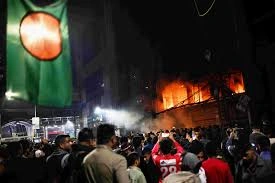
The announcement of his death acted as a catalyst for violent demonstrations late on Thursday night and continued into Friday across major cities including Dhaka, Khulna, Sylhet, and Barisal. Thousands of protesters took to the streets, with many congregating at Dhaka University’s Shahbagh intersection and outside Baitul Mukarram Mosque after Friday prayers.
Protesters demanded justice for Hadi’s murder, the immediate arrest of those responsible, and condemned what they describe as a failure of the interim government to protect political activists. Crowds blocked key junctions, ignited roadblocks with burning tires, and erected barricades that disrupted traffic and daily life.
Targeted Vandalism and Attacks
The demonstrations quickly turned destructive and volatile, with enraged crowds storming and vandalizing institutions perceived as symbols of the establishment:
- Media offices, including the leading newspapers Prothom Alo and The Daily Star, were attacked and set on fire, forcing journalists to seek safety and prompting emergency evacuations.
- In Dhanmondi, the historic home associated with Bangladesh’s founding figures was targeted, and cultural institutions like Chhayanaut faced significant damage from roaming mobs.
- Multiple universities including Dhaka University, Shahjalal University, and Jahangirnagar University saw student-led protest marches, with participants shouting slogans emphasizing resistance and national sovereignty.
Political and Social Implications
The unrest underscores the fragile state of Bangladesh’s political landscape. Hadi, known for his strong anti-India rhetoric and opposition to former Prime Minister Sheikh Hasina, had become a polarizing figure. His assassination has not only stoked anger toward the interim administration led by Muhammad Yunus but also intensified anti-India sentiments among demonstrators.
In response to the crisis, the interim government declared a national day of mourning, ordering flags to fly at half-mast and promising a thorough investigation into Hadi’s shooting. Authorities have pledged to apprehend those responsible and ensure accountability.
Security Measures and Future Outlook
Security forces have been deployed nationwide to contain the unrest, with checkpoints and police presence increased around key public areas. Despite these efforts, tensions remain high as protesters show no signs of dispersing, and clashes with law enforcement have been increasingly reported.
As Bangladesh prepares for upcoming elections in February 2026, the implications of Hadi’s death could resonate deeply within the country’s political discourse, potentially reshaping party allegiances, student activism, and public trust in state institutions.
Key Developments at a Glance
- Sharif Osman Hadi dies in Singapore hospital after being shot during campaigning.
- Nationwide protests erupt, notably in Dhaka’s Shahbagh and university campuses.
- Media houses vandalized and set ablaze in violent demonstrations.
- National day of mourning declared by interim government.
- Anti-India and anti-establishment slogans mark protests, reflecting broader political discontent.
As Bangladesh navigates through this turbulent moment, the nation’s youth movements, political factions, and governance structures face significant tests that could shape the country’s democratic evolution in the critical months ahead.