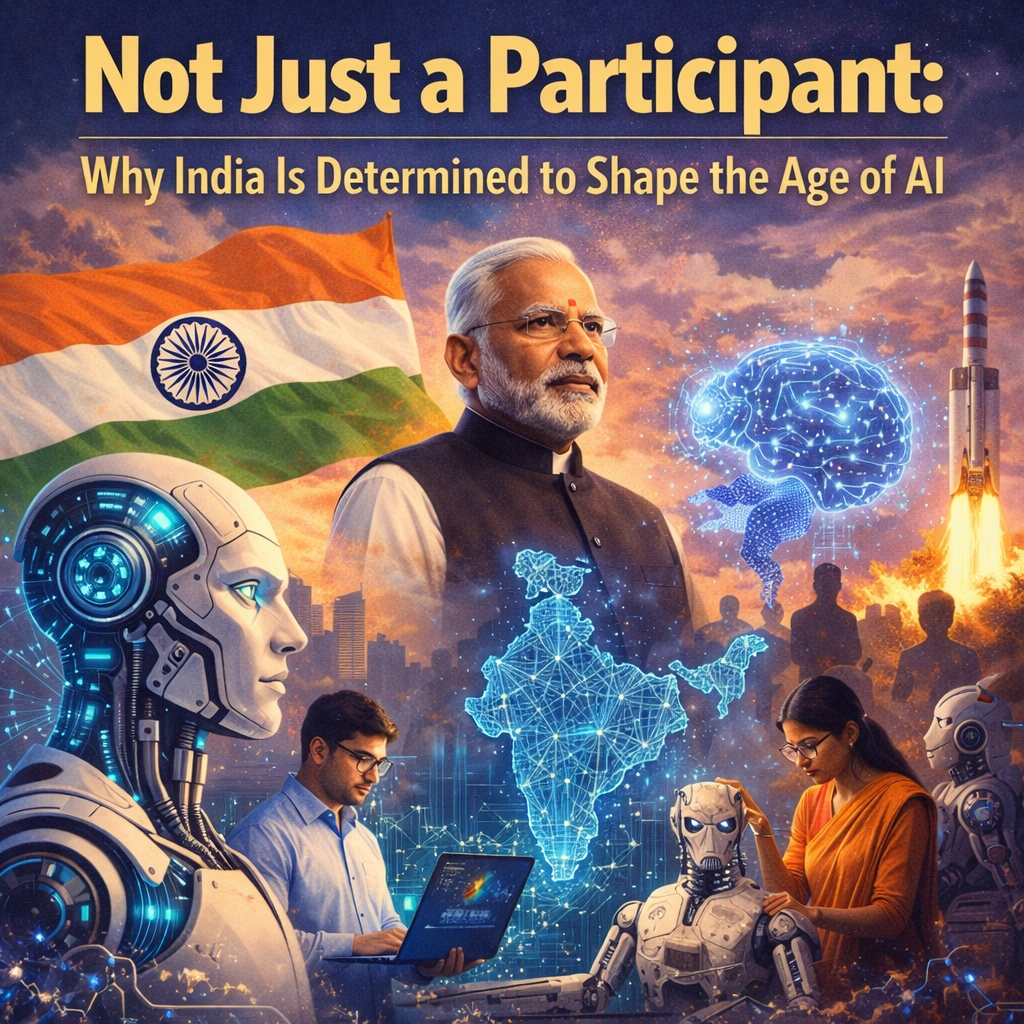
The AI Impact Summit in New Delhi was more than a gathering of technologists and policymakers. It was a declaration — that India intends to be at the table where the rules of artificial intelligence are written.
There is a moment in every country’s relationship with a transformative technology when it has to make a choice: absorb it on someone else’s terms, or help define what those terms are. India has clearly decided it wants to do the latter with artificial intelligence. The AI Impact Summit held in New Delhi brought that ambition into sharp, public focus — drawing policymakers, researchers, entrepreneurs, and international delegations into a conversation about not just what AI India can build, but what kind of AI world India wants to help create.
It would be easy to read the tech summit as a prestige exercise, the kind of grand conference that generates impressive headlines and carefully worded communiqués before everyone flies home. But that reading would miss something important about where India actually stands in the global artificial intelligence landscape. India is not arriving late to this race. It has a mature base of technical talent, a vast domestic market that creates real incentives for AI adoption, and a growing cluster of homegrown startups that are already building products used across the world. The summit was less about announcing a new beginning and more about acknowledging that a substantial journey is already underway.
“India is not arriving late to the AI race. It has talent, scale, and something rarer still — the motivation to build AI for populations that the rest of the world has historically underserved.”
What made the New Delhi gathering particularly significant was its explicit focus on innovation policy as a strategic instrument. For much of the past decade, discussions about AI governance tended to happen in a small number of capitals — Washington, Brussels, Beijing — with the rest of the world largely reacting to decisions made elsewhere. India, through the summit and through its broader engagement with multilateral forums on digital governance, is pushing back against that asymmetry. The argument India is making is not simply that it deserves a seat at the table, but that the global tech community genuinely needs perspectives from countries navigating AI deployment at scale in diverse, complex societies. That is a harder point to dismiss than mere national ambition.
The summit’s policy discussions clearly acknowledged this dual responsibility: India needs to ensure responsible AI regulation within its borders while also playing a role in defining international standards.
Domestic proposals covering data governance, algorithmic accountability, and the use of AI in public services were debated alongside questions about how India might contribute to global standards bodies, bilateral research partnerships, and multilateral agreements on frontier AI development. The simultaneous nature of both discussions, each charged with a sense of immediacy, hinted at a level of sophistication in India’s strategy that frequently gets overlooked in reports fixated on specific declarations or product unveilings.
It is also worth pausing on what the word “innovation” means in the Indian context, because it does not always mean what observers from richer countries might assume. Some of the most consequential AI work happening in India is not about building the next large language model or competing at the frontier of compute-intensive research. It is about applying existing AI capabilities to genuinely hard problems at scale — agricultural advisory systems that reach smallholder farmers via voice interfaces in regional languages, diagnostic tools that extend the reach of an overstretched healthcare system, and financial products that bring millions of people into the formal economy for the first time. This is artificial intelligence shaped by constraint and necessity, and it produces innovations that are often more durable and more relevant to most of the world’s population than the headline technologies that dominate global tech coverage.
“Some of India’s most important AI work is not about competing at the frontier — it is about solving real problems for real people at a scale that few countries can match.”
The collaboration opportunities highlighted at the summit pointed toward a model of engagement that India seems increasingly comfortable with: neither dependence on Western technology platforms nor the kind of closed, state-directed approach associated with some other large AI powers. India seems to be leaning toward a strategy of strategic openness. This means encouraging foreign investment and collaboration, but also emphasizing the importance of developing its own capabilities, maintaining control over its data, and having a real say in the technologies it chooses to use. Achieving this balance is no easy task, and not every decision will be perfect. Still, the overall direction is noteworthy.
What remains to be seen is whether the ambitions articulated in New Delhi translate into the sustained institutional investment and political will that turning a tech summit into lasting AI leadership actually requires. Good conferences are easy. Building the research institutions, the regulatory capacity, the computing infrastructure, and the startup ecosystem that genuine leadership demands takes years of unglamorous work. India has done that kind of patient, structural building before — in software services, in space technology, in pharmaceuticals. The question is whether it can do it again, this time in a technology that is moving faster, attracting more geopolitical competition, and carrying higher stakes than anything that came before. The summit said the intention is there. The work of proving it is just beginning.
Not Just a Participant: Why India Is Determined to Shape the Age of AI.