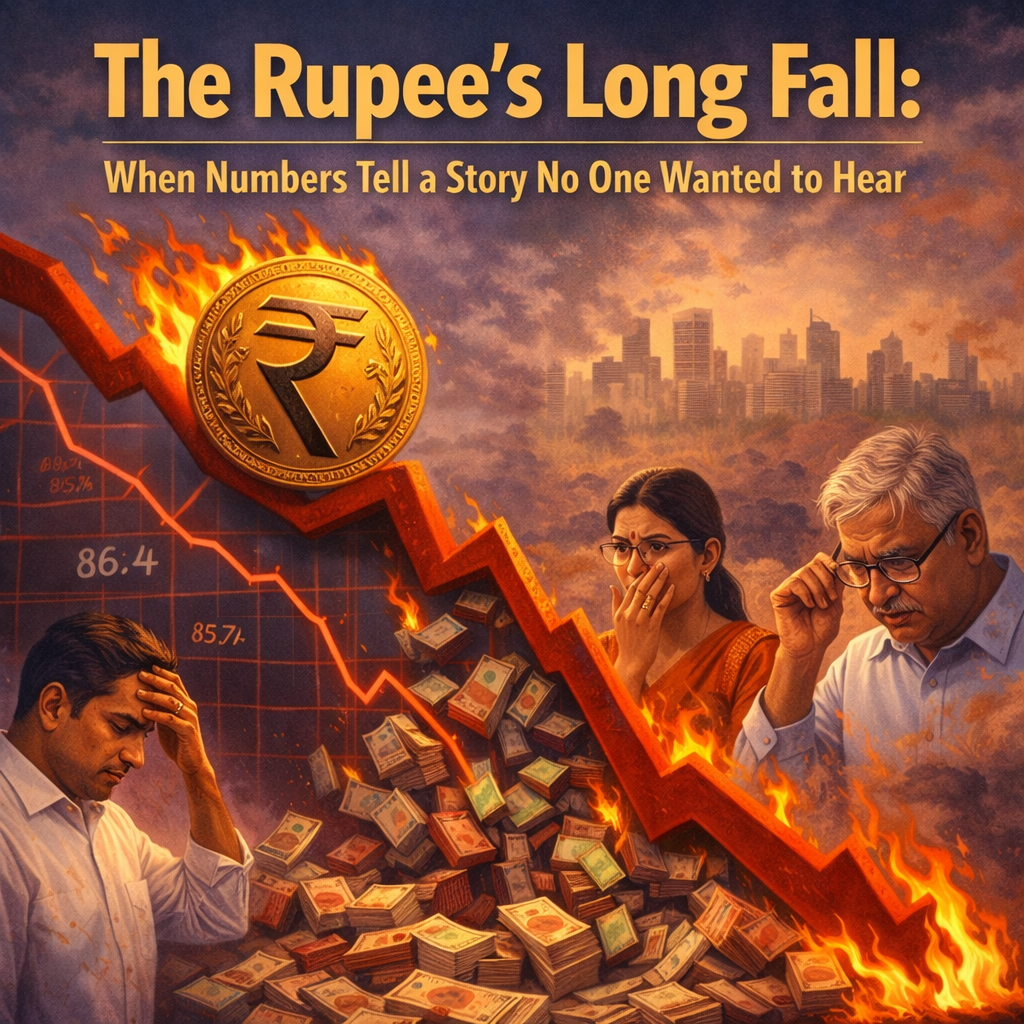
The Indian rupee’s sharpest decline in over a decade is not merely a currency story — it is a window into the fault lines running beneath India’s economic moment.
urrency markets have a cruel habit of making abstract numbers feel very personal, very fast. When the Indian rupee slips against the US dollar — not by a fraction, not briefly, but steadily, month after month — the consequences ripple outward in ways that most people only notice once they are already paying for them. Higher fuel prices. More expensive imported goods. A shrinking sense that things are under control. The Indian rupee’s fall to its weakest level against the dollar in over a decade is one such moment, and understanding it requires looking beyond the forex market ticker into the messier reality of global pressures, domestic vulnerabilities, and the hard choices that lie ahead.
At its core, the Indian rupee fall is a story about demand and supply — specifically, about far more dollars flowing out of India than flowing in. Foreign portfolio investors, spooked by a combination of global uncertainty, a resilient US dollar, and better yields elsewhere, have been pulling capital out of Indian equity and debt markets at a pace that puts sustained pressure on the currency. When large institutional investors sell Indian assets, they receive rupees, convert them to dollars, and repatriate the funds — and each such transaction nudges the exchange rate a little further in the wrong direction. Enough of these transactions, sustained over months, become a trend that is difficult to reverse through market intervention alone.
“When investors exit in numbers and oil refuses to get cheaper, the rupee doesn’t just fall — it signals something deeper about where confidence is standing.”
The oil prices impact compounds this pressure in a way that is uniquely painful for India. As one of the world’s largest importers of crude oil, India must buy petroleum in dollars regardless of what the rupee is doing. When oil prices remain elevated — as they have through much of the recent period, driven by supply constraints and geopolitical disruptions — the country’s import bill swells, the current account deficit widens, and the forex market faces even greater demand for dollars. It is a double bind: a weaker rupee makes oil more expensive in domestic terms, which feeds into inflation, which in turn can suppress consumption and investment. The economy India hoped to project as a growth story starts to look a little more complicated from the outside.
Then there is the broader context of the global economy India, along with most emerging markets, must navigate. The US Federal Reserve’s extended period of higher interest rates has made dollar-denominated assets relatively more attractive, pulling capital toward American shores and away from markets like India. Geopolitical tensions — from ongoing conflicts to trade fragmentation — have added another layer of uncertainty that makes investors cautious. In this environment, even fundamentally sound economies can see their currencies weaken simply because risk appetite globally has contracted. The rupee is not alone in facing this pressure, but its particular vulnerabilities — high oil dependence, sensitivity to capital flows — make it more exposed than some peers.
The Reserve Bank of India has not stood idle. Intervention in the forex market, drawing down foreign exchange reserves to defend the currency from a sharper free-fall, has been a consistent part of the response. But central bank intervention can only do so much. It buys time and reduces volatility, but it cannot reverse the underlying forces driving the currency crisis without broader support from the real economy — stronger exports, a narrowing trade deficit, renewed foreign direct investment, and a global environment that is more forgiving of emerging market risk.
“The Reserve Bank can intervene in the market, but it cannot intervene in the geopolitics or the oil fields that are driving this pressure.”
For ordinary Indians, the human texture of this story lives in import-dependent sectors — electronics, edible oils, pharmaceuticals, and aviation, all of which carry dollar-linked costs. Businesses that borrowed in foreign currency face higher repayment burdens. Students studying overseas are seeing their remittances lose purchasing power. The dream of traveling internationally, too, is subtly becoming pricier. Currency depreciation isn’t usually a sudden, jarring event; it’s a gradual, pervasive force that slowly alters the cost of living.
The future is contingent on a number of factors that India cannot fully dictate.
If geopolitical tensions ease and global oil supply stabilises, the rupee could find firmer ground relatively quickly. If capital flows reverse as investors price in India’s long-term growth potential, the picture improves. But if the current conditions persist — elevated oil prices, a strong dollar, continued portfolio outflows — analysts are right to warn that further depreciation remains a genuine possibility. The economy India has been building is resilient, but resilience is not immunity. The rupee’s difficult year is a reminder that no growth story is entirely insulated from the world it is growing in.
The Rupee’s Long Fall: When Numbers Tell a Story No One Wanted to Hear.