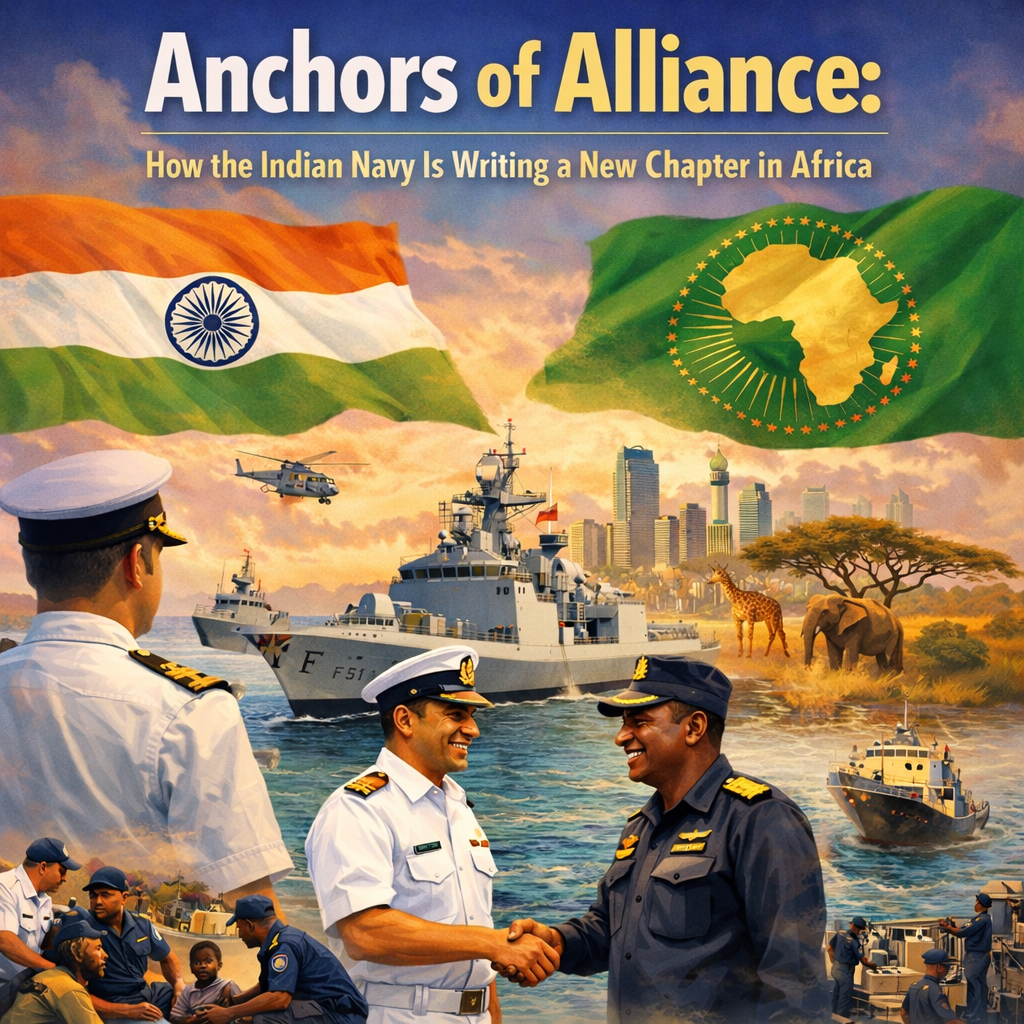
When INS Trikand sailed into Tanzanian waters, it carried more than sailors and equipment — it brought a vision of India as a credible maritime partner across the Indian Ocean world.
here is something quietly powerful about a warship docking in a foreign port in peace. No shots fired, no territory contested — just the steady, deliberate act of showing up. When INS Trikand, one of the Indian Navy’s frontline Talwar-class frigates, docked at a Tanzanian port as part of India’s expanding program of maritime diplomacy, it was precisely this kind of power that was on display. Understated, purposeful, and rooted in a long-term vision of what the Indian Ocean region could look like.
India’s relationship with East Africa is not new. Centuries of trade winds, dhow routes, and cultural exchange have woven the two regions together in ways that no political map can fully capture. What is new, however, is the scale and seriousness with which New Delhi is approaching its role as a maritime security partner in the region. The docking of INS Trikand in Tanzania is one visible manifestation of a much larger strategic shift.
“A port call is never just a port call. It is a handshake, a conversation, and sometimes the beginning of a long friendship between navies.”
India–Tanzania relations have historically been warm, built on shared postcolonial experience and non-aligned traditions. But the nature of that warmth is evolving. What was once primarily a diplomatic and economic relationship is now acquiring a meaningful defense dimension. Joint exercises, crew exchanges, equipment familiarization programs, and shared maritime domain awareness are slowly becoming the new vocabulary of how the two countries speak to each other. INS Trikand’s visit is part of that vocabulary — a sentence in a longer conversation about maritime security and regional stability.
The Indian Ocean is not a quiet body of water. It handles nearly a third of the world’s bulk cargo, over half of its container traffic, and the vast majority of global oil shipments. But it’s also a region rife with competing interests, non-state players, and lawless waters where piracy, illegal fishing, and trafficking are still problems. For Tanzania, a nation with a long coastline and a heavy dependence on maritime trade, the security of its waters is more than just a far-off geopolitical consideration. It’s a daily economic reality.
India gets this, which is why the Indian Navy has been steadily increasing its presence in the Western Indian Ocean and along the East African coast. The SAGAR doctrine – Security and Growth for All in the Region – sums up India’s approach: that maritime security isn’t a competition, but a shared obligation.
In this framing, helping Tanzania patrol its exclusive economic zone, training its coast guard, or sharing real-time information about suspicious vessels is not charity. It is the architecture of a mutual security arrangement.
“The Indian Ocean is not a quiet body of water — and for nations like Tanzania, its security is an everyday economic reality, not an abstraction.”
Defense diplomacy of this kind also carries a subtle but important message to the broader international community. Africa is now a battleground for influence, with various external powers vying for strategic partnerships, each bringing its own values and strategies to the table. India’s approach, which emphasizes building capacity, conducting joint patrols, and creating lasting institutional relationships, offers a different model.
Whether this model will endure, however, is still uncertain. The recent arrival of the INS Trikand in Tanzania, however, provides a tangible, observable footprint.
Furthermore, the symbolism of a naval visit in a region where India has a significant diaspora, cultural ties, and historical connections is noteworthy.
The Indian Navy isn’t making a first appearance in Tanzania.
It is, in some ways, returning to a space that Indian merchants, sailors, and communities have inhabited for generations. That continuity gives India’s maritime diplomacy in East Africa a different texture than the engagements of powers with no such historical footprint in the region.
INS Trikand will sail again, no doubt. The conversations it initiates, the connections it builds, and the signals it sends to friends and foes will outlast its current deployment. That’s the essence of maritime diplomacy: a steady, reliable process that requires patience to bear fruit.
India appears to be pursuing a long-term strategy in the Indian Ocean. Tanzania, for the time being, serves as a significant stopover in that broader undertaking.
Anchors of Alliance: How the Indian Navy Is Writing a New Chapter in Africa.