
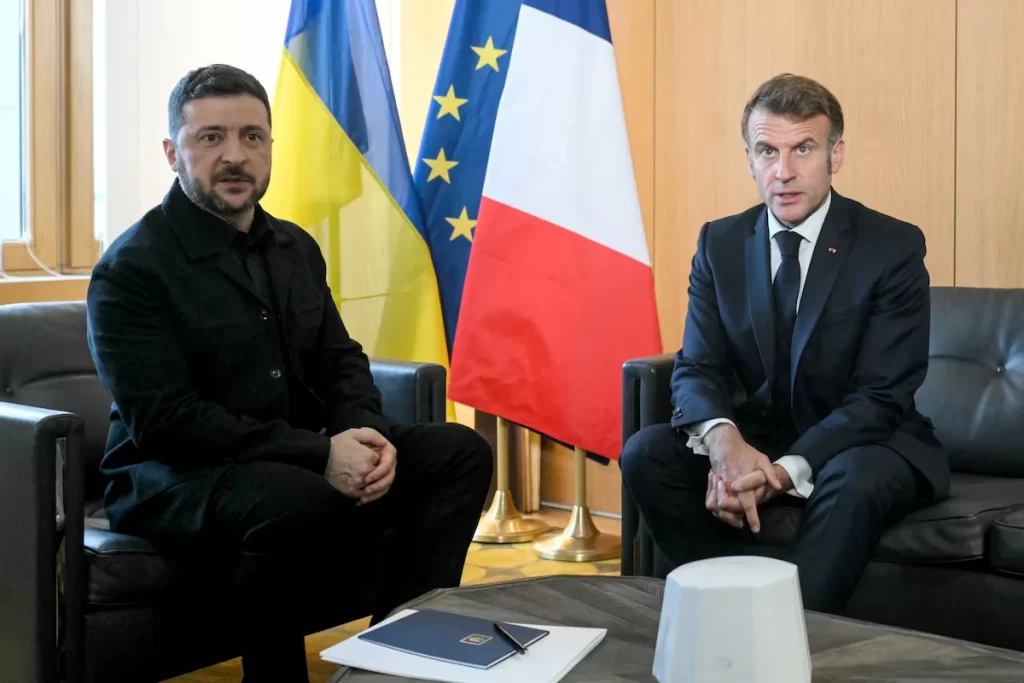
France and Ukraine have announced a landmark defence cooperation pact following a high-level meeting between French President Emmanuel Macron and Ukrainian President Volodymyr Zelenskyy in Paris. The two leaders signed a letter of intent outlining Ukraine’s plan to purchase a significant volume of French military equipment, including up to 100 Rafale multirole fighter jets, in what both sides described as a “historic deal.”
A Decisive Step Toward Strengthening Ukraine’s Air Power
During discussions at the Élysée Palace and Villacoublay Air Base, President Zelenskyy emphasized the importance of modernizing Ukraine’s defence capabilities amid ongoing security threats. He described the agreement as “strategic and essential for the regeneration of the Ukrainian army.”
Macron reiterated France’s long-term commitment to Kyiv, calling the defence pact a major step forward in bilateral cooperation and European collective security.
Under the agreement, Ukraine is expected to integrate Rafale F4 fighter jets into its air fleet over the next decade. The planned procurement also includes next-generation SAMP/T air-defence systems, radars, air-to-air missiles, precision-guided bombs, and expanded cooperation on drone development.
Key Elements of the France–Ukraine Defence Pact
| Category | Details |
|---|---|
| Fighter Jets | Up to 100 Rafale F4 aircraft projected for delivery by 2035 |
| Air-Defense Systems | Eight SAMP/T systems with multiple launchers |
| Ammunition | Air-to-air missiles and guided AASM Hammer bombs |
| Technology | Modern radar systems and surveillance equipment |
| Drone Collaboration | Joint development of interceptor drones and enhanced technology partnerships |
Industrial Cooperation and Long-Term Strategic Planning
Beyond military procurement, the declaration includes provisions for industrial co-production, technology transfer, and deeper collaboration between French and Ukrainian defence manufacturers. These elements are designed to support Ukraine’s long-term national security strategy and encourage domestic defence production.
Zelenskyy highlighted that the programs established under the pact form a 10-year strategic roadmap, meant to strengthen Ukraine regardless of future developments in the conflict with Russia. France confirmed that Ukraine will receive newly developed air-defence systems as soon as production schedules allow.
Financing and Production Challenges
While the pact has been hailed as historic, its financing mechanisms remain under discussion. Ukraine has proposed utilizing frozen Russian assets, while France and other European partners are considering additional financial instruments to support the initiative.
On the industrial front, scaling up production to meet Ukraine’s timeline—especially for advanced Rafale jets—poses logistical and manufacturing challenges. European defence industries are expected to expand output capacity to fulfill long-term commitments.
Regional and Geopolitical Significance
The deal carries far-reaching implications for European security and Ukraine’s defence posture:
- Enhanced Deterrence: The integration of Rafale jets and advanced air-defence systems will significantly strengthen Ukraine’s air capabilities.
- European Defence Integration: Technology sharing and co-production reflect deeper alignment between Ukrainian and European defence industries.
- Strategic Signal to Russia: The scale of the agreement underscores sustained Western support for Ukraine and sends a strong message regarding Europe’s commitment to regional stability.
Outlook
Although the signed letter of intent is not yet a binding contract, it represents one of the most ambitious defence commitments made to Ukraine since the start of the conflict. If fully realized, the pact could redefine Ukraine’s air power and serve as a cornerstone of its long-term national defence strategy.
As both countries work toward finalizing detailed contracts and production schedules, the Paris agreement stands as a significant milestone in European defence cooperation and Ukraine’s path toward a modernized, resilient military force.

