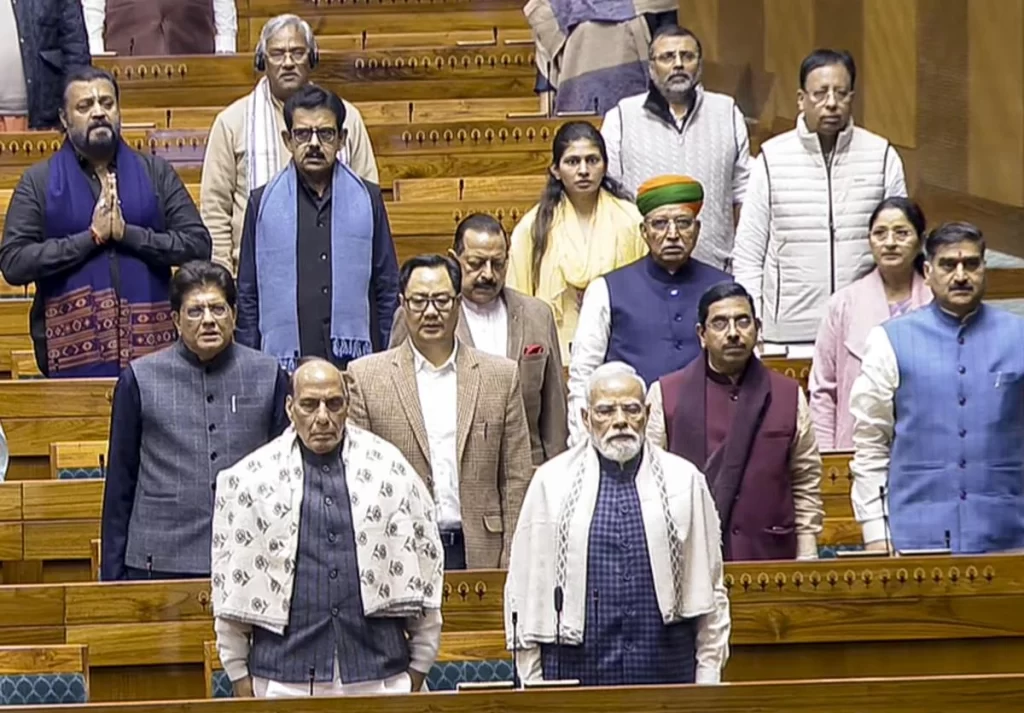
The Winter Session of Parliament 2025 concluded on December 19 with both the Lok Sabha and the Rajya Sabha adjourned sine die, bringing to a close a politically charged yet notably productive legislative period. Spanning 19 days and 15 sittings, the session stood out for its record productivity levels, even as sharp political confrontations, protests, and disruptions dominated proceedings at several points.
Despite the frequent adjournments triggered by opposition protests and heated debates, parliamentary business advanced at an unprecedented pace. According to official data presented at the conclusion of the session, both Houses exceeded their average productivity benchmarks, underscoring the government’s legislative push and Parliament’s institutional resilience.
High Legislative Output Despite Disruptions
The Winter Session 2025 witnessed the passage and discussion of several key legislative measures, reflecting the government’s focus on governance reforms, economic policy, and administrative efficiency. The Lok Sabha recorded productivity levels well above its historical average, while the Rajya Sabha also demonstrated improved efficiency compared to recent sessions.
Key highlights of the Winter Session 2025 include:
- Passage of multiple government bills with significant policy implications
- Extended debates on economic growth, internal security, and federal relations
- Frequent opposition protests on issues of accountability and transparency
- Repeated adjournments, yet sustained legislative momentum
Parliamentary Affairs officials emphasized that the session’s outcome demonstrated how structured scheduling and focused floor management can deliver results even in a polarized political environment.
Political Confrontations Shape the Session
Political confrontations remained a defining feature of the Winter Session of Parliament. Opposition parties staged coordinated protests on a range of national issues, leading to several disruptions in both Houses. Walkouts, slogan-shouting, and demands for detailed discussions marked the early days of the session.
However, senior parliamentarians from across party lines acknowledged that intense debate is intrinsic to a functioning democracy. While disruptions impacted the smooth conduct of proceedings, they did not significantly derail the legislative agenda.
Snapshot of the Winter Session 2025
| Aspect | Details |
|---|---|
| Total duration | 19 days |
| Number of sittings | 15 |
| Conclusion date | December 19, 2025 |
| Overall productivity | Among the highest in recent years |
| Political climate | Contentious but outcome-driven |
Institutional Significance
The conclusion of the Winter Session 2025 reinforces Parliament’s central role in balancing political contestation with legislative responsibility. Analysts note that the session demonstrated a growing emphasis on output-driven governance, even as democratic dissent played out on the floor of the House.
The government highlighted the session as evidence of its commitment to legislative reforms, while opposition leaders reiterated the importance of robust scrutiny and debate. Together, these dynamics underscored the evolving nature of parliamentary democracy in India.
Looking Ahead
As Parliament adjourns sine die, attention now shifts to the implementation of the laws passed and the political strategies that will shape upcoming sessions. The Winter Session 2025 will be remembered not only for its confrontational tone but also for its record productivity—setting a benchmark for future parliamentary sittings.
In an era of heightened political polarization, the session offered a clear message: even amid protests and political clashes, legislative institutions can deliver decisively when governance remains the priority.