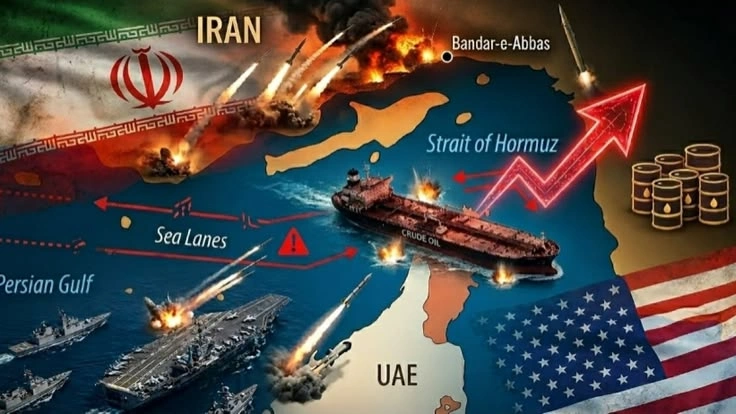
The Strait of Hormuz, the narrow passage between Iran and Oman that handles a fifth of the planet’s oil, has seen its share of upheaval. Yet, as April 2026 dawns, the waterway remains partially obstructed. This is creating significant disruptions in energy supply chains globally.
Iranian naval troops have set up a “security corridor” that has cut tanker traffic in half, saying they are worried about threats from the U.S. and Israeli navies. Tankers are avoiding the area or being delayed, and the price of crude oil has gone up 12% in a week to above $95 a barrel. This isn’t just a theory for people in Mumbai and Manchester; it’s what makes gas and grocery costs go up overnight. Why is this chokepoint so important, and how long can the world hold its breath?
The Spark: Iran’s Brave Move to Block the Strait of Hormuz
It began quietly last month. Iran said it would hold “defensive exercises” in the strait, which is 21 miles wide at its narrowest point and is important for 21 million barrels of oil a day, or nearly 20% of the world’s oil use. Partial limitations went into effect on April 8. Non-Iranian tankers need special approvals, which are enforced by Revolutionary Guard speedboats and drones. Satellite pictures show more than 30 boats sitting offshore, and insured traffic has dropped by 40%.
This isn’t Iran’s first time doing this. They took tankers in 2019 because of U.S. sanctions. Now, they say it’s because of Israeli attacks on Iranian assets in Syria. People in Tehran insist it’s only for a short time, but doubters refer to previous comments by Supreme Leader Khamenei in which he promised to “defend Persian Gulf sovereignty.” What happened? A partial blockade that isn’t complete anarchy yet, but it’s enough to shake up the markets.
In numbers, it’s clear:
Daily oil shipments went from 21 million barrels to about 12 million barrels.
Shipments of LNG, which are very important for Europe and Asia, are delayed by up to 72 hours.
Insurance costs for crossing the strait have up by 300%, making it too expensive for smaller companies.
Energy experts call it a “controlled squeeze.” Iran is sending its own oil through the Goreh-Jask pipeline to avoid the uproar, but it’s hurting everyone else.
Global Energy Supply Chains on the Edge
The disturbance hits hard when you zoom out. The Strait of Hormuz restriction is a huge blow to global oil supply lines that are already struggling because of the consequences from Russia’s actions in Ukraine and the Houthi attacks in the Red Sea. This is where 80% of Saudi Arabia, the UAE, Iraq, and Kuwait’s oil comes from. Even Qatar’s LNG, which India needs to fuel its power plants, comes through here.
It hurts India a lot. As importers in Pune rush to get their goods, fuel costs have gone up by 5 rupees per liter in Maharashtra alone. Refineries that depend on Gulf crude, including Reliance Jamnagar, say their stockpiles are going down. Europe’s race for U.S. LNG is getting more expensive around the world, and China’s manufacturers are running out of supplies. Brent crude’s rise to $95 is similar to its heights in 2022, and Goldman Sachs says it may reach $110 if limitations stay in place after May.
Think about your morning commute or arranging your Diwali trip. Every barrel counts. What happens when airlines raise the price of jet fuel? Or when there aren’t enough petrochemicals to make plastics?
Iran’s Playbook: Power, Politics, and Oil
If you look more closely, you’ll see that Iran’s reasons are a mix of revenge and strategy. Since the U.S. left the JCPOA in 2018, sanctions have cut exports from 2.5 million barrels a day to less than 1.5 million. The partial blockade of the Strait of Hormuz changes things: Tehran controls the flow and puts pressure on Biden’s successor, whoever he is after the 2024 elections, to lift the sanctions.
It’s not just talk. Iran has more than 100 fast-attack boats and anti-ship missiles that can hit targets up to 300 kilometers away. They are willing to escalate, as shown by past events like the 2021 Mercer Street drone strike that Iran was accused for. Allies like the Houthis, who have attacked more than 50 ships in the Red Sea since 2023, make things even worse. Some people think they are signaling each other.
But Iran has a lot of risks too. A full shutdown may lead to U.S. action under Operation Earnest Will 2.0, and allies like China, which uses 11 million barrels a day, aren’t happy about it. Beijing’s recent demand for mediation shows this: they need the oil to stay constant.
Voices from the Frontlines: Sailors, Traders, and Governments
Things are tense on the ground. Captains of VLCCs (very large crude carriers) say they have been harassed with warning shots and boarding maneuvers. An unidentified Indian sailor told contacts, “We’re going around Africa, which will add 10 days and $1 million in fuel.” Brokers in Dubai’s markets are riveted to their screens and hedging like crazy.
Governments always act the same way. The U.S. sent the USS Abraham Lincoln carrier group to the area, promising “freedom of navigation.” Oman, which is neutral, hosts talks, and India uses its “multi-alignment” diplomacy to press for de-escalation. Last week, Foreign Minister Jaishankar labeled it a “red line for energy security.” The EU is pushing for more diverse imports, especially crude oil from Guyana and Brazil.
But there isn’t much hope. OPEC+ will meet online tomorrow. Saudi Arabia has more than 3 million barrels of idle capacity, so expect production to go up. But as one merchant in the Gulf said, “Band-Aids don’t treat a knife wound.”
Ripple Effects: From Gas Prices to Political Stalemates
The Middle East oil crisis changes everything, not just the price of oil. Yesterday, stock markets around the world fell by 2%. Energy companies like Exxon went up, but airlines like IndiGo went down by 4%. Inflation watchdogs are worried that a long-term restriction in the Strait of Hormuz might raise the world CPI by 1–2%.
It’s a double-edged sword for the environment. Reroutes use more bunker fuel, which adds millions of tons of CO2 to the air. At the same time, it speeds up the green shift—India’s quest for solar power receives a boost as more people buy electric vehicles since gas prices are going up.
What are the effects in India? Factories in Maharashtra, like those that make cars in Pune and chemicals in Navi Mumbai, are having trouble with their margins. Government subsidies for LPG might go up, which would hurt the budgets of middle-class families. It’s a reminder that energy isn’t unlimited around the world. Have you ever thought about how much we truly need just one small piece of sea?
There are countermeasures and workarounds in place.
The planet isn’t powerless. Pipelines skip over bits: the UAE’s Habshan-Fujairah carries 1.5 million barrels a day over land. Saudi’s East-West pipeline can hold 5 million barrels. Tanker fleets are going south instead, which costs more—$2 to $3 per barrel.
Tech also helps: AI-driven routing from companies like RightShip finds the best routes, while satellite AIS keeps an eye on hazards. U.S. shale booms (12 million barrels a day today) and Norway’s North Sea fields help soften the impacts in the long run. India’s strategic reserves, which last for ten days, buy time.
Still, there is no quick remedy. A complete blockade? Catastrophic—oil could reach $200, and there could be a lot of recessions.
Looking Ahead: Will things get better or worse?
If talks go well, the Strait of Hormuz’s partial restrictions could be lifted soon. Oman says things are moving forward. But politics can make the suffering last longer because Iran’s elections are coming up and the U.S. midterms are heating up. According to CME futures, oil markets think there is a 60% likelihood that everything will be open again by June.
In the end, this story shows how weak we are. Global energy supply chains need to be strong. We need more pipelines, renewable energy sources, and a wider range of sources. It’s a request for India to perform more drilling in the Krishna-Godavari basin and push ethanol blends harder. One thing is evident as tensions rise: the strait is more than just a shipping passage; it’s the world’s energy heartbeat.
Will cooler heads win out, or are we in for even worse times? Only time and Tehran will tell.
Partial Blockade of the Strait of Hormuz: A Jolt to Global Energy Markets – What’s Next for Oil Prices?