A full moon rising in all its glory is one of the most beautiful things that can happen in the night sky. India will view the Pink Moon 2026 on April 13, 2026. This is a supermoon that will also be a partial lunar eclipse. This is a rare alignment of the stars that hasn’t happened in this way in over a decade. This viral astronomical event, which combines the soothing glow of the “Pink Moon” with the dramatic shadow of an eclipse, is sure to attract stargazers from all over the country. Here’s all you need to know about when and how to see the Pink Moon in India, from the optimum times to see it to expert recommendations for making the most of the experience.
The Pink Moon: Not Pink, but Unmissably Beautiful
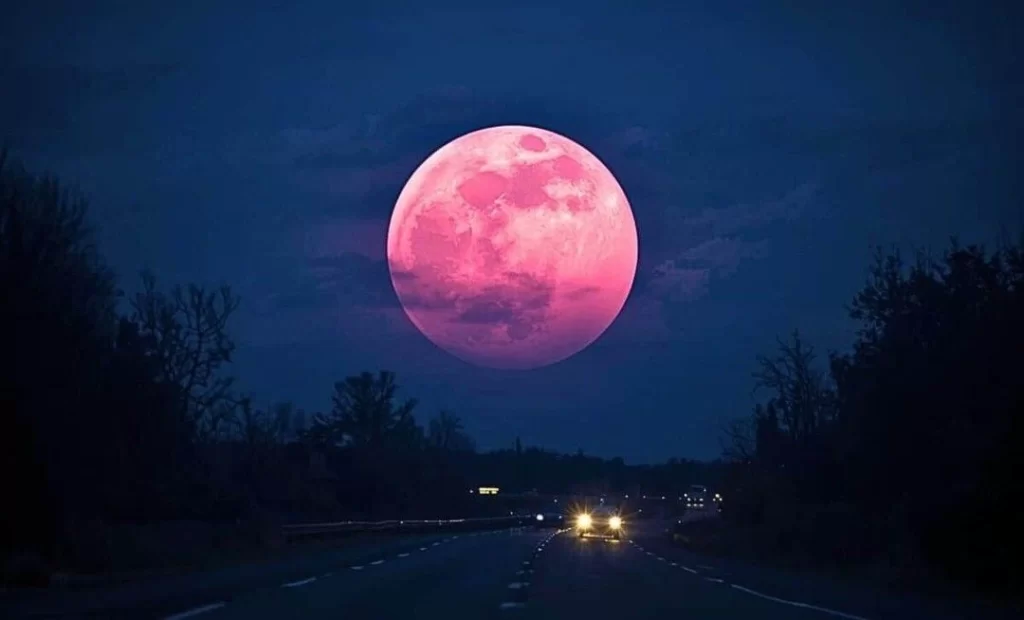
Native American cultures named the Pink Moon after the blossoming of early spring wildflowers like phlox. It has long been a sign of renewal and amazement. The moon won’t really turn pink, even if its name makes it sound like it would. Instead, when it rises, it casts a warm, golden light over the horizon that is made even brighter by atmospheric refraction. This full moon will happen on April 13, 2026, at 12:22 AM IST. It will be the first supermoon of the year, which is when the moon is at perigee, its closest point to Earth. It will look up to 14% bigger and 30% brighter than normal.
Astronomers from the Indian Institute of Astrophysics (IIA) in Bengaluru said that Pink Moon 2026 will be best seen in most of India, especially in rural areas where there is less light pollution. Dr. Ravi Kumar, a professional astronomer, says, “This event blends the majesty of a supermoon with subtle lunar drama.” “For people in cities like Mumbai or Delhi, roofs and terraces will be the best places to see it.” The moon’s larger size will make it stand out, competing with the sun’s daily presence and sparking viral interest on sites like Instagram and X.
The Mechanics of the Supermoon: What Makes April 2026 Special
There are three to four supermoons per year when the full moon lines up with perigee. However, the supermoon in April 2026 is even more impressive. On April 13, the moon will be at perigee, which means it will be only 356,500 kilometers from Earth, which is closer than the usual 384,400 kilometers. This will make it look much bigger than it really is. NASA’s historical data shows that supermoons have caused “moon illusions,” which make the moon look even bigger because of the low horizon. This adds to its viral appeal.
The U.S. Naval Observatory says that Pink Moon 2026 is special since it is the closest supermoon until 2028. This time of year is the dry season after Holi in India, which means that the skies will be clear in northern regions like Rajasthan and Uttar Pradesh. Southern areas like Kerala and Tamil Nadu may see haze before the monsoon, but views from the shore will be clear.
Important Supermoon Facts for 2026:
Up to 3,476 kilometers wide (the average is 3,475 km).
30% brighter, perfect for taking pictures.
Tidal Influence: High tides could surge 20 to 30 cm higher, which would affect places like Chennai on the coast.
The Pink Moon, a sight to behold, also resonates with ancient lunar calendars. These calendars indicated that the full moon in April signaled the beginning of planting and harvesting for agrarian societies.
The Partial Lunar Eclipse: A Dark Turn in the Pink Glow
A partial lunar eclipse will nibble at the edge of the Pink Moon 2026, making it more interesting. It will be visible in India from 8:25 PM IST on April 12 to 1:30 AM on April 13. The eclipse starts as Earth’s shadow moves across the moon’s northern limb. At 11:45 PM IST, 12% of the disk enters umbra, the darkest shade, and this makes a faint “bite” impression.
This partial eclipse is safe to see with the naked eye, unlike total eclipses, which need equipment. The lunar eclipse Pink Moon phase will make the shadowed edge look crimson because of Rayleigh scattering. This will give off “blood moon” sensations without fully immersing you. In India’s time zone, visibility is best, and the complete sequence lasts more than five hours.
Eclipse Phases and Times (IST):
Penumbral Start: April 12 at 8:25 PM, with a little shadow on the outside. Best view from eastern India.
Partial Start: 9:55 PM, April 12—shadow bites the top of the moon; viewable from all throughout the country.
Maximum Eclipse: April 12 at 11:45 PM, 12% blocked; best time to take pictures.
Partial End: 1:15 AM, April 13—shadow goes away; drama fades.
Penumbral End: The moon is entirely restored at 2:45 AM on April 13.
Experts say that city lights can make the penumbral stages less clear, so they suggest using applications like Stellarium to keep track of them accurately. Many amateur astronomers live in Pune, Maharashtra. The Jawaharlal Nehru Planetarium, for instance, arranges public viewings, a move designed to draw in the local population.
The Pink Moon will grace India’s skies in 2026. Here’s when and where you can see it.
The key to seeing the Pink Moon is knowing when to look. The spectacle begins after sunset on April 12th. In most locations, the moon will rise around 6:45 PM IST, quickly becoming visible against the evening sky.
From 7:00 PM to midnight, northern India has the clearest view. Eastern regions like West Bengal see it early because they are farther east.
The Pink Moon is best viewed from elevated, low-light locations in India.
Consider the Himalayan Foothills, specifically Himachal Pradesh and Uttarakhand. Rohtang Pass and Nainital Lake offer excellent opportunities for capturing silhouette photographs.
Desert Skies, Rajasthan: The Jaisalmer dunes, a place where the moon’s ascent transforms the sands into a shimmering gold.
Southern Highlands (Ooty, Tamil Nadu): Clear views from Nilgiri viewpoints, minus the fog.
Palolem Beach in Goa, or maybe the Varkala cliffs, where the sea meets the sky.
Bring binoculars or a DSLR with a 200mm lens to see details up close. According to the India Meteorological Department, weather projections say that 70–80% of the country will have clear sky. Dust drifting in from the northwest might blur the view a bit.
Cultural Significance and Scientific Value
The Pink Moon of 2026 holds cultural significance in India, and it’s also a sight to behold. In Hindu tradition, the full moon in April coincides with Chaitra Purnima, a time considered auspicious for both religious rituals and storytelling.
Tribal folklore in Odisha links it to fertility ceremonies, echoing its Native American origins.
People who love the modern world are hosting “Pink Moon parties” where they can meet up with telescopes.
This event shows how the moon moves in a scientific way. Supermoons are linked to small increases in seismic activity. For example, investigations by the USGS have found that shallow earthquakes increase by 1–2%. However, there is no direct link between the two. Brighter nights disturb wildlife that is active at night, which is why conservationists are calling for light control during peak hours.
Things to think about and safety tips for viewers
Some skies won’t work with you. According to a 2025 Light Pollution Map study, urban light pollution impacts 60% of India’s people, making fainter eclipse phases less bright. Monsoon antecedents in the northeast could make it hard to see Gangtok, which would send people to Guwahati.
Never use telescopes on the moon next to the sun without filters. Safety first. Families with kids should make early evening hours a priority to avoid being tired. How to safely watch Pink Moon:
Dress warmly; the temperature drops to 15°C at night in the plains.
Use red flashlights to keep your night vision.
Download sky maps that don’t need the internet to work.
How India Compares on a Global Scale
Pink Moon 2026 glows all around the world, but India’s location near the equator lets people see the eclipse for longer than in Europe, where it cuts off at daybreak. Australia and Asia both get to see the show, but India’s large stargazing community, supported by groups like the Astronomical Society of India, makes sure that there is a lot of local coverage.
Pink Moon 2026: The exact dates, how to see it in India, and why this supermoon eclipse is a once-in-a-decade event