
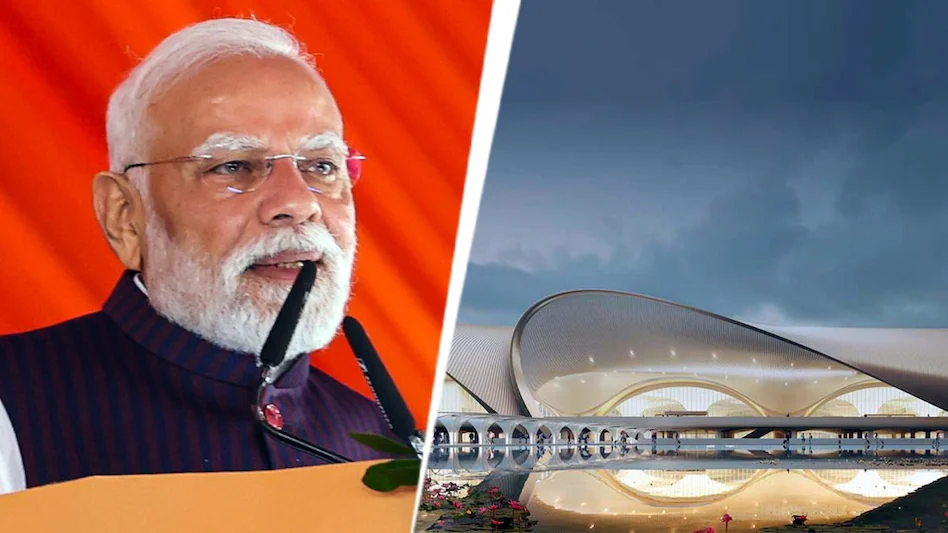
Navi Mumbai, October 8, 2025: Prime Minister Narendra Modi today inaugurated the long-awaited Navi Mumbai International Airport (NMIA), marking a historic moment for India’s aviation infrastructure. Touted as one of the most advanced airports in Asia, the new facility is expected to transform air connectivity in the Mumbai Metropolitan Region and significantly ease congestion at the existing Chhatrapati Shivaji Maharaj International Airport (CSMIA).
The event witnessed the presence of Maharashtra Chief Minister Eknath Shinde, Deputy Chief Minister Devendra Fadnavis, Union Civil Aviation Minister Jyotiraditya Scindia, and several top officials from the Adani Group, which developed the project. Addressing the gathering, PM Modi emphasized the government’s commitment to modern infrastructure, stating that NMIA will “strengthen India’s global aviation network and drive regional economic growth.”
A Decade-Long Dream Realized
The Navi Mumbai International Airport, conceived over two decades ago, finally comes to fruition after years of planning, environmental clearances, and land acquisition challenges. Developed by Adani Airports Holdings Limited (AAHL) in collaboration with the City and Industrial Development Corporation (CIDCO), the airport represents a massive investment exceeding ₹20,000 crore.
Built across 1,160 hectares in Ulwe, Navi Mumbai, the project is designed to handle 60 million passengers annually upon completion of all phases. The first phase, inaugurated today, will initially manage 20 million passengers per year, significantly reducing the burden on Mumbai’s existing airport, which is nearing full capacity.
World-Class Infrastructure and Green Innovation
NMIA sets new benchmarks for sustainable airport infrastructure in India. The terminal’s design, inspired by the national flower, the lotus, symbolizes purity and energy. It incorporates cutting-edge technologies such as facial recognition-based check-ins, automated baggage systems, and advanced air traffic management systems.
In a push toward environmental sustainability, the airport will operate as a “greenfield, net-zero carbon emission facility.” Solar power installations, water recycling systems, and green landscaping are integral to its operations. Officials confirmed that NMIA aims to be one of the few airports in the world powered entirely by renewable energy sources.
Connectivity and Economic Impact
Strategically located near the Mumbai Trans Harbour Link (MTHL), NMIA ensures seamless connectivity to both Mumbai and Pune. The airport will be linked to the Mumbai Metro, suburban rail network, and the upcoming coastal road projects, making it accessible from all corners of the metropolitan region.
Experts predict that the airport will act as a catalyst for regional economic development, generating over two lakh direct and indirect jobs and boosting real estate and industrial activity in Navi Mumbai and Raigad districts. The surrounding areas are already witnessing a surge in commercial investments and housing projects.
A Boost to India’s Aviation Future
With NMIA’s inauguration, India adds another feather to its cap in global aviation infrastructure. The airport is expected to serve as a major hub for international airlines and logistics operations, complementing Mumbai’s position as India’s financial nerve center.
As PM Modi noted during the ceremony, “This airport is not just a building—it is a symbol of New India’s progress, ambition, and technological capability.”
The Navi Mumbai International Airport now stands as a testament to India’s infrastructural evolution and its readiness to meet the demands of a rapidly growing aviation sector.
Keywords: Navi Mumbai International Airport, PM Modi, Adani Group, CIDCO, Maharashtra, aviation infrastructure, green airport, Mumbai air travel, NMIA inauguration, India aviation growth.

