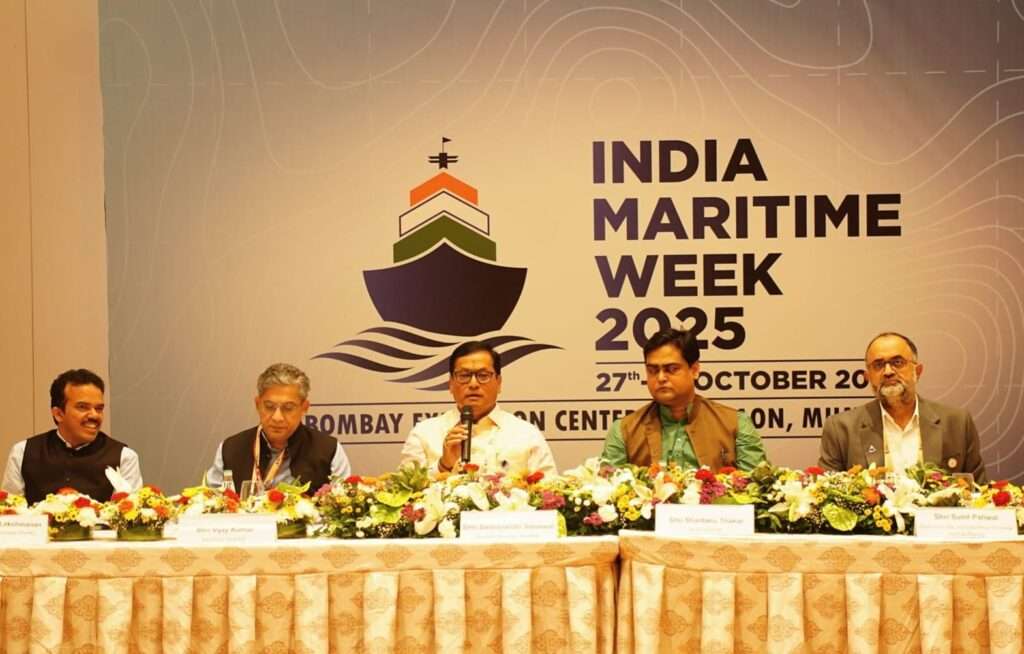
Prime Minister Narendra Modi today issued a clarion call to international investors to partake in India’s ambitious maritime expansion, presenting the country as a premier destination for port-led development, green shipping initiatives and logistics innovation. Speaking ahead of the conclusion of India Maritime Week 2025 in Mumbai, he outlined the strategic advantages that position India as a global maritime hub and emphasised the government’s resolve to open the doors wide for foreign direct investment in the sector.
India’s coastline spans over 7,500 km and the Prime Minister asserted that the country combines this natural advantage with world-class ports, infrastructure, innovation and intent. According to official figures, major port capacity has grown from some 1,400 MMTPA to 2,762 MMTPA in recent years, while vessel turnaround time has been cut significantly—from around 93 hours down to 48 hours. With reforms sweeping the regulatory environment—such as the enactment of the Indian Ports Bill (2025) and the Bills of Lading Bill—the government says that trade documentation has been streamlined and ease of doing business improved.
In his address, Modi urged global shipping firms and logistics operators to “bet on India” now, pointing to an umbrella package of ₹70,000 crore for the maritime sector and schemes aimed at attracting over ₹4.5 lakh crore in investment for ship-building, port operations and allied services. Key projects were referenced, such as the offshore deep-draft Vadhavan Port in Palghar with a proposed investment of ₹76,000 crore, and the first green-hydrogen facility at Kandla Port, underscoring how the focus goes beyond mere connectivity to value-added services, sustainability and global supply-chain integration.
The timing of the appeal aligns with India’s broader maritime vision of boosting its share in coastal shipping, expanding inland waterways, modernising shipyards and cutting logistics costs—which currently stand at an estimated 16 percent of GDP, according to government estimates. Analysts note that India’s push comes amid shifting global supply-chains, rising demand for greener shipping alternatives, and an increasing emphasis on regional maritime corridors. For global investors, India presents a compelling combination of scale, regulatory clarity and long-term demand growth.
By issuing this invitation, Prime Minister Modi has signalled that India views the maritime sector not merely as infrastructure, but as a cornerstone of its economic strategy—encompassing ship-building, port logistics, coastal shipping and export competitiveness. As investment flows into these domains, the implications extend beyond jobs and trade: they touch on India’s positioning in global maritime value-chains, its green-shipping ambitions and its ability to convert coastline advantage into industrial and service-led growth. The next few years will be critical in turning the vision of India as a “perfect harbour for investments” into reality.