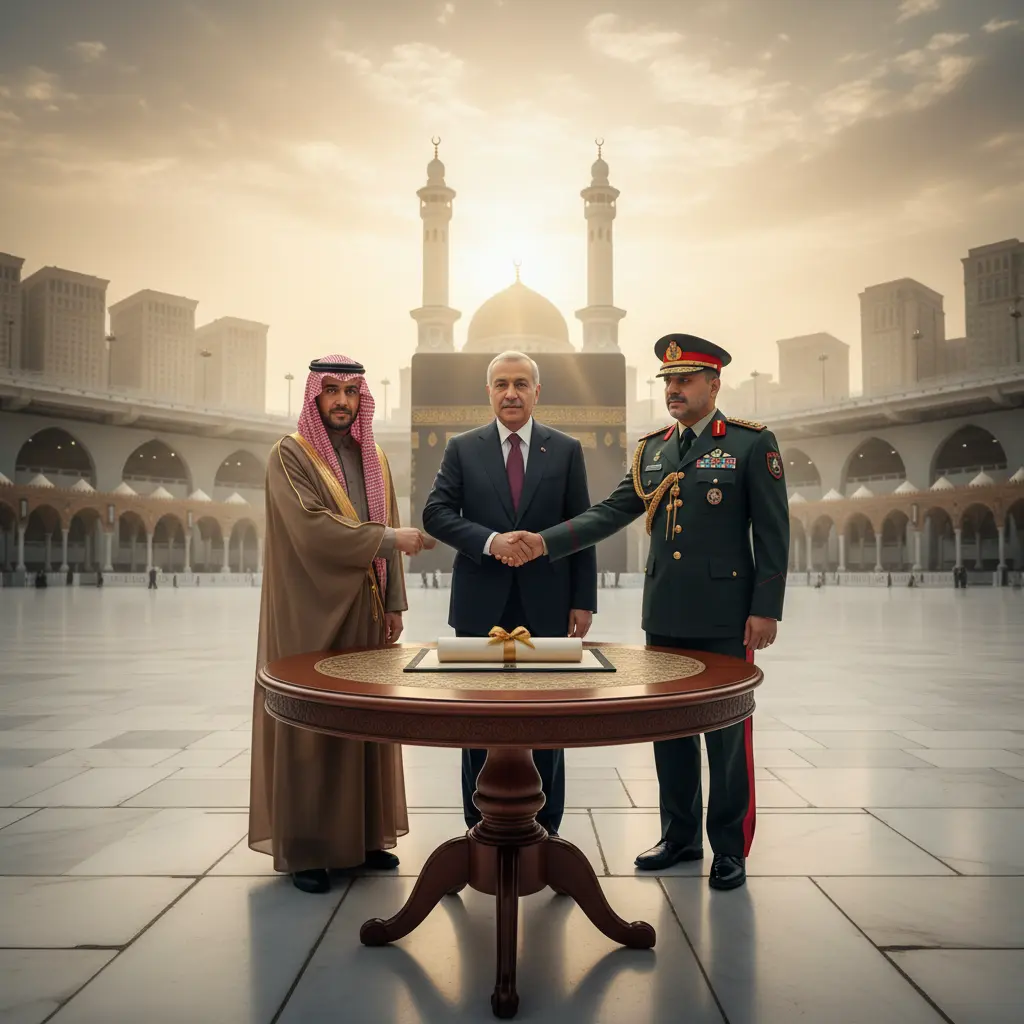
In a move that could reshape the security map of the Middle East and South Asia, Saudi Arabia, Turkey and Pakistan have signed a sweeping new mutual defence agreement in the holy city of Mecca. The deal, formally titled the Mecca Joint Defense Agreement, brings together three of the Muslim world’s most influential powers under a single security umbrella, with each side pledging that an attack on one will be treated as an attack on all.
The signing ceremony took place on Friday, August 7, and was attended by Saudi Crown Prince Mohammed bin Salman, Turkish President Recep Tayyip Erdogan and Pakistani Prime Minister Shehbaz Sharif. Foreign and defence ministers from the three countries were also present, underscoring the weight Riyadh, Ankara and Islamabad are placing on the pact. Choosing Mecca, the holiest city in Islam, as the venue was widely read as a deliberate symbolic gesture, framing the agreement not just as a military arrangement but as an expression of shared faith and brotherhood among the three nations.
What the Mecca Defence Pact Actually Says
At its core, the agreement is straightforward: any armed attack on Saudi Arabia, Turkey or Pakistan will be regarded as an attack on all three. That single clause has already earned the deal comparisons to NATO’s Article 5, the collective defence principle that underpins the Western alliance. While the joint statement released by the three governments did not spell out exactly what military, financial or logistical obligations each country has signed up for, the intent is clear — deterrence through unity.
The pact builds directly on an earlier bilateral defence agreement between Saudi Arabia and Pakistan, which was signed roughly a year before this trilateral deal. Turkey’s inclusion adds a new dimension, bringing its formidable defence-industrial base — including drones, missile systems and a growing domestic arms manufacturing sector — into the fold. Analysts note that the combination is a powerful one: Turkish defence-industrial capability, Saudi financial muscle, and Pakistan’s battle-tested military along with its status as the only nuclear-armed nation in the Muslim world.
The Backdrop: A Region Under Pressure
The timing of the Mecca defence pact is no accident. This comes as the ongoing conflict between the United States, Israel and Iran has pulled in Iran-aligned groups across the region. Saudi Arabia in particular has borne the brunt of retaliatory strikes, having been targeted repeatedly this year by Iran-backed forces, including Houthi fighters from Yemen and Shia armed groups operating out of Iraq. Those attacks have put Saudi oil exports and the kingdom’s ambitious economic development plans at risk, while also raising uncomfortable questions in Riyadh about how reliable its long-standing security relationship with Washington really is.
Turkey and Pakistan, by contrast, have so far avoided being drawn into direct strikes, but both nations have strong incentives to help contain a conflict that threatens to destabilize the wider region and rattle their own economies. For Pakistan, the deal also offers a chance to deepen ties with a wealthy Gulf patron at a moment when its economy remains fragile. For Turkey, the arrangement opens the door to securing Saudi investment for its defence manufacturing sector while expanding co-production and arms sales opportunities with Pakistan.
NATO’s concerns addressed
Turkey is a NATO member. The new pact inevitably raised questions about its compatibility with existing alliance commitments. Erdogan was quick to assure observers, stating publicly that the Mecca agreement does not contravene Turkey’s obligations to NATO and that the pact is not aimed against any particular country. Saudi officials echoed that sentiment, with a senior Saudi diplomat calling the deal defensive, not a threat to regional stability.
Not everyone in the region has welcomed the news, however. Iranian officials have publicly dismissed the pact, with a member of Iran’s parliament suggesting that a written agreement alone won’t guarantee Saudi Arabia’s security, drawing a pointed comparison to what he characterized as decades of unfulfilled American security guarantees.
A New Security Architecture Takes Shape
Regional analysts believe the Mecca Joint Defense Agreement could mark a genuine turning point, reshaping the balance of power across the Gulf and South Asia. By formally linking Saudi financial resources, Turkish defence technology and Pakistani military manpower and nuclear capability, the three countries have effectively created one of the most consequential security partnerships in the Muslim world in recent memory.
Whether the pact will hold up under real pressure remains to be seen, especially with the US-Israel-Iran conflict still unresolved. But for now, the message from Mecca is unmistakable: Saudi Arabia, Turkey and Pakistan are betting that standing together offers better protection than standing alone.