
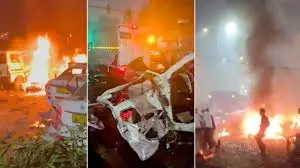
In a major development following the deadly car explosion near the Red Fort in Delhi, Indian security forces have demolished the house of suspect Dr Umar Un Nabi in Pulwama, Jammu & Kashmir, as the investigation reveals a four‑year conspiracy to create a “home‑grown” terror outfit with foreign backing. The government is treating the incident as a full‑scale terror attack and has launched a wide‑ranging probe into the network behind it.
The blast occurred on November 10 near the Red Fort, killing eight people at the time, with later reports indicating a higher toll, and injuring many more. Investigators confirmed through DNA testing that Dr Umar Un Nabi – a medical professional from Pulwama – was behind the wheel of the Hyundai i20 that exploded in the heart of the capital.
In the ensuing investigation, authorities uncovered what is being described as a “doctor‑module” terror cell, reportedly involving medical professionals, that operated over a period of four years with the intention of establishing a domestic terror infrastructure. The module is said to have been in contact with foreign handlers based in Turkey and Afghanistan, coordinated by a handler codenamed “Ukasa.” The conspirators allegedly used encrypted messaging apps and set up multiple vehicle‑borne IEDs across cities, targeting symbolic dates such as December 6 and Republic Day 2026.
The demolition of the suspect’s house in Pulwama comes after this scale of planning became evident. The destruction of property is being used as a deterrence measure under counter‑terror norms. Meanwhile, raids and detentions have expanded across Jammu & Kashmir, Haryana, Uttar Pradesh, and Delhi. Over 2,900 kg of bomb‑making material—including ammonium nitrate—was seized, according to official statements. Authorities say the network had links to banned outfits such as Jaish‑e‑Mohammed (JeM) and Ansar Ghazwat‑ul Hind (AGuH), and included both Kashmir‑based and external operatives.
From a security perspective, the attack has triggered alarm at multiple levels: the site was a highly visible heritage location, visited by tourists and locals alike, raising questions about risk mitigation and urban‑security resilience. Political leadership, including the Prime Minister and Home Minister, have called for swift and decisive action.
The demolition of Dr Umar Un Nabi’s house in Pulwama is a stark indicator of how deeply the probe into the Red Fort car blast has penetrated. As investigators trace the four‑year planning, foreign handler networks, and the so‑called “doctor module” terror cell, the incident underscores the evolving nature of domestic terror threats—where highly educated professionals may be radicalised and leveraged within home‑grown infrastructures. With massive quantities of explosives seized and further arrests underway, authorities are working against time to prevent another strike, while balancing civil liberties and due‑process concerns. The coming weeks will test India’s counter‑terror architecture, intelligence coordination, and societal resolve in the face of this emerging challenge.

