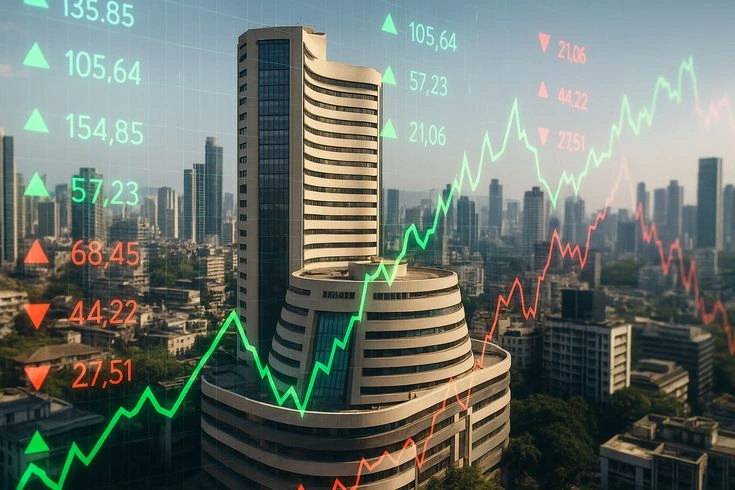
Indian stock indices Sensex and Nifty opened the week on a weak note on Monday reflecting jitters in global markets. The BSE Sensex dropped about 500 points in early trade on April 28, 2026, but recovered some losses to end 0.8% lower at about 81,200. The NSE Nifty 50 was not much better, losing 0.9% to remain at 24,650. This volatility is not a one-off – it is a rude reminder of how integrated India’s markets are with the rest of the globe, compounded by continued problems at home like the weakening in the banking sector. With investors watching everything from U.S. tariff threats to domestic credit bottlenecks, the question remains: Can India’s bulls hold the line, or are we due for more turbulence?
Global Headwinds Take Toll
Picture this: Wall Street takes a crash, and Mumbai is almost instantaneously on its feet feeling the aftershocks. This is where things stand for Sensex and Nifty traders currently. The latest round of volatility is partially on account of fears of repeated U.S. policy adjustments under a possible second Trump term – rumors of heavy tariffs on imports, especially India, have terrified everyone. U.S. Treasury rates climbed above 4.5% last week as inflation data came in hotter than expected and the Federal Reserve suggested fewer rate reduction this year. Asian markets followed suit. Japan’s Nikkei sank 1.2%, and Hong Kong’s Hang Seng fell 1.5%.
Foreign institutional investors (FIIs) sold out ₹12,000 crore in April alone in India, their biggest selling in months. This outflow puts pressure on the rupee which fell to 83.75 to the dollar. “Global forces are testing our resilience,” said Ravi Shankar, an analyst in Mumbai and a market veteran. When the U.S. sneezes, our markets become sick. Throw in geopolitical tensions, be it the continuing U.S.-China trade spats or Middle East flare-ups driving oil prices near $85 a barrel, and you have a perfect storm.
But it’s not all gloom. India’s GDP growth projection for FY27 remains a strong 6.8%, ahead of the bulk of its rivals. But short-term nerves are in control. Ever wondered why a tariff boost in Washington can shave off billions from Dalal Street? It’s globalization’s butterfly effect. We’re all connected by supply chains.
The banking sector’s soft underbelly has been exposed.
Sensex and Nifty are being dragged down by the undertow of banking weakness, the great wave of global troubles. Public sector banks (PSBs), which make up a large part of the indices, faced the burden today. State Bank of India (SBI) declined 2.1%, Punjab National Bank (PNB) 1.8%, while private companies such as HDFC Bank slipped 1.2%. Why the slide? Growing non-performing assets (NPAs) in retail lending, particularly unsecured loans such as personal loans and credit cards. Reserve Bank of India’s (RBI) figures paint a bleak picture. Retail NPAs increased by 25% year-on-year to ₹4.5 lakh crore in Q1 FY27. The lending boom that fueled growth after COVID is now backfiring, as consumer spending slows with high interest rates. The RBI’s recent 50-bps cut in the repo rate to 6.25% provided some comfort but banks are cautious, raising lending rates nonetheless. Major lenders’ net interest margins (NIMs) dropped to 3.2% from 3.8% a year ago.
Banking pain points:
Microfinance unsecured loan defaults rise 30%.
Funding squeezed by rising corporate bond yields.
Deposit growth 10% versus loan growth 14% is trailing.
Nifty Bank index down 1.4%, worst session in weeks, dragged lower by sector pressure. Smaller banks like Bandhan, IDFC First are most affected as provisions hit profitability Economist Priya Mehta says: “Banks grew too rapidly without stress-testing borrowers.” “Now the clean-up begins.”
Sector Watch: IT, Auto Defy Trend, Energy Trails
So the whole market is not bleeding. U.S. tech spend picking up and that provided a silver lining for IT equities. Infosys rose 0.5% while TCS was flat. Nasscom sees India’s IT exports at $250 billion this fiscal, AI agreements come in Autos too sparkled with Tata Motors rising 1.1% on robust SUV sales statistics and Maruti Suzuki riding on rural demand revival.
Compare that to the energy. Crude volatility and weak refining margins hit, with Reliance Industries down 1% and ONGC 0.9%. FMCG majors such as Hindustan Unilever fell 0.7% as urban spending remained poor – anticipate fewer impulse buys at Kirana outlets. Among banks Kotak Mahindra alone was in the green, rising 0.2%. Wipro led the IT pack with a 0.8% rise while Tata Motors led the auto pack with a 1.1% rise. Energy witnessed BPCL down 0.5% and ONGC behind at 0.9%
This mixed bag is the rotation trade: money coming out of defensives like banks into growth plays like IT.
The Bigger Economic Picture: Inflation and Elections Coming Up
Zoom out and India’s market volatility is part of greater forces. Retail inflation softened to 4.8% in March, providing RBI room to maneuver, but food prices – up 8% on veggie shortages — keep things tense. Monsoon predictions look excellent at 105 percent of long-period average and that might reduce that pressure and enhance rural incomes.
Elections are the spice. Welfare pledges in Maharashtra polls might expand deficits, rattle bond markets in November. Fiscal deficit objectives at 4.9% of GDP are under observation, any slippage could alarm rating agencies. India’s attraction as a China+1 destination remains robust globally with FDI inflows topping $80 billion last year but execution problems exist in manufacturing drive
The average investor in Pune or Delhi is feeling this volatility. Nifty mutual funds’ retirement funds lose steam. Should you average down now or wait for clarity?
Investor strategies in tough times
Smart money isn’t panicking, it’s rotating. Record ₹2.1 lakh crore domestic mutual fund inflows in FY26 buffer FII outflows Analyst Report:
Diversify away from banks. Go big on phama (up 0.6% today) and renewables.
Go for quality: Large caps above mid caps which corrected 5% this month.
Hedge with gold: MCX gold at ₹72,000/10g, up 12% YTD
Rohit Kapoor, a retail trader from Mumbai, says, “I cut bank exposure last month. “Volatility like this is when you buy dread.” Options trading sees rise in volumes of 40% as punters bet on swings
Looking Forward: Stability in Sight?
The recent volatility in the Sensex and the Nifty has exposed the weaknesses of the market. Global pressures are straining the nerves of investors and banking problems are demanding solutions. But the tale of India is a story of growth. Next week sees the start of the Q4 earnings season; strong statistics from IT and autos could spur a recovery. RBI’s steady hand, govt’s capex drive – ₹11 lakh crore budgeted – provide tailwinds
Will markets settle down by May? It’s the earnings and the Fed decisions that will tell us. So for now, hang on. This isn’t the fall of 2020. It’s a speed bump on the way to 85,000 Sensex by year end, if bulls win. What’s next for investors in this turbulent sea?
Sensex, nifty tumble on global jitters, banking blues: What’s driving India’s market volatility?