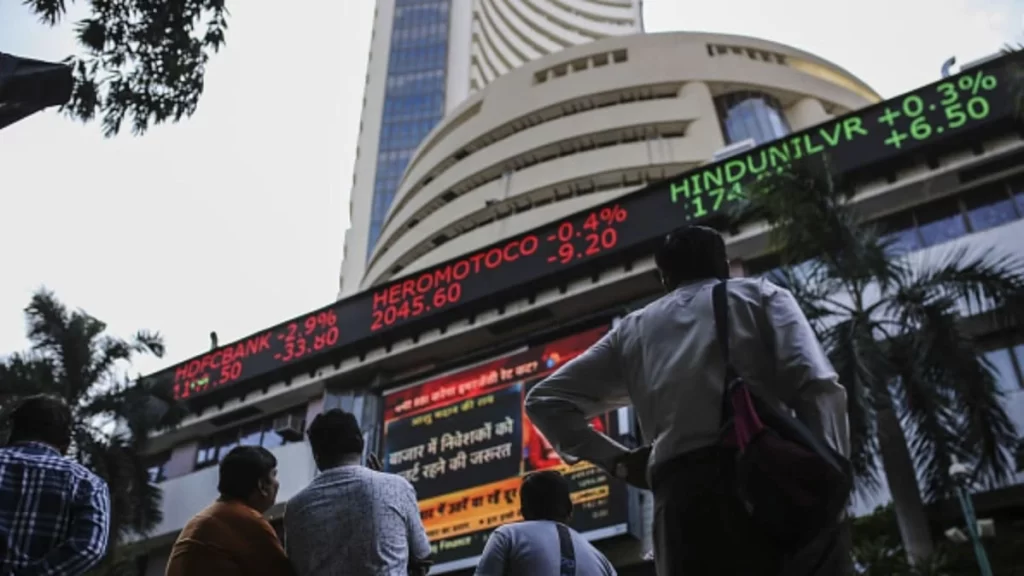
India’s benchmark Sensex index fell and then recovered lost ground this week, in a rollercoaster ride driven by global economic challenges. With investors throughout the globe grappling with persistent inflation in the US and new trade threats from Europe, Mumbai’s trading floors hummed with cautious optimism. The 30-share BSE Sensex closed flat at roughly 74,500 points on Friday, only 0.2% off the week’s open but not without some heart-stopping swings. What does that mean for an average Indian investor, who is watching his retirement nest egg? In a year when local growth tales battle with foreign storm clouds, these moves are not simply numbers; they are a barometer of India’s economic resiliency.
Global Signals Fuel Volatility
It started with a bang over the Atlantic. Wall Street spiraled down after the latest minutes of the US Federal Reserve signaled fewer rate cuts than predicted. The Dow Jones lost more than 400 points mid-week, taking Asian markets with it. The Indian Sensex was no exception, falling roughly 800 points in a single session on Wednesday, wiping out gains made over the preceding fortnight.
But now, here comes the intriguing part. Emerging markets are feeling the heat from global indications like rising US Treasury rates, which are about 4.5% today. But India’s fundamentals were strong. The foreign institutional investors (FIIs) pared their positions, dumping equities worth ₹2,500 crore, but the domestic players came in aggressively. Mutual fund inflows hit record ₹45,000 crore in March alone, backing up heavyweights like HDFC Bank, Reliance Industries.
Check this out: How did India’s markets bounce back so fast with China’s property crisis still in the offing and Europe’s energy issue still on the table? The major deal: strong GDP forecasts – India’s economy is forecast to rise 7% this fiscal year ahead of global counterparts. The Nifty 50, the Sensex’s wider cousin, closed the week up 0.1% at 22,600, reflecting this resiliency.
The Key Sectors That Are Feeling the Heat – and the Hope
The deeper you look, not all sectors were moving to the same beat. US consumers are cutting back as recession fears hammer perennial favorites, IT stocks. Infosys and TCS fell 3-4% on worse guidance from American tech spend. “Trading desks are expressing the idea that the export-heavy sectors are being tested by global economic signals,” said a Mumbai-based analyst.
On the other hand, brilliant were banks and financials. ICICI Bank and other lenders were up 2% on strong loan growth, while the Reserve Bank of India (RBI) kept rates on hold at 6.5%. Auto companies also revved up. Maruti Suzuki gained 1.5% on positive sales statistics as rural demand surged on a bumper monsoon forecast.
Winners of the week: Banking (+1.8%), FMCG (+1.2%), Autos (+0.9%)
Losers: IT -2.1%, Metals -1.5%, Pharma -0.8%
This division is the hallmark of India’s dual economy: one foot in global trade, the other in local consumption. Middle East concerns kept oil prices volatile at $85 a barrel but energy equities were mostly spared with ONGC remaining stable.
India’s Steady Hand: The Larger Economic Picture
Zoom out and the view gets better. Inflation in India slowed to 5.1% in March, allowing the RBI some leeway to avoid knee-jerk hikes. The corporate earnings season also got off on a positive note – Q4 results from blue-chips like Tata Motors bettered predictions, with profits climbing 25% year-on-year. “We are witnessing resilience in earnings even while global signals are flickering,” an economist at a large brokerage said.
Government spending is the fuel. Infrastructure spending: The interim budget has earmarked ₹11 lakh crore for infrastructure, keeping construction and realty busy. Unemployment has come down to 7.8% in metropolitan areas with jobs being created in roads, trains and renewable energy projects. But there are hurdles ahead. Monsoon concerns might push up food prices. A strong rupee (₹83 now to the dollar) could hit IT exporters’ margins.
For Indian homes, this has significant stakes. The stock market has seen a surge in involvement, with over 10 crore demat accounts, many from Tier-2 towns like Pune and Jaipur. A 30-something salaried worker in Mumbai might be asking: Should I average down on that IT slump or play it safe with bank FDs at 7%?
Investor Sentiment: Fear, Greed and Everything In Between
India VIX surged to 15 before settling at 13.5, a level indicating considerable concern as the market mood swung violently. Retail investors bought the dip pumping in ₹18,000 crore into equities through platforms like Groww and Zerodha. FII outflows represent a buying opportunity,” chirped a popular finfluencer on social media, finding favour with young traders.
But the veterans are wary. Sensex PE at 23x, high valuations scare some, especially with US elections in Nov. Trump’s anticipated return might spark trade conflicts, affecting India’s $120 billion exports to US But the optimists point to diversification with India’s weight in the MSCI Emerging Markets index now at 18% attracting long-term flows.
The global context is key here. Japan’s Nikkei hit 40,000 on the yen’s weakening while Europe’s Stoxx 600 was the laggard. India relative strength? It’s turning becoming a safe haven for EM investors, just as it was during the COVID mayhem.
Policy Plays, Looming Triggers
What the RBI does next will be crucial. Governor Shaktikanta Das has maintained a neutral posture although there are hints of a 25 bps cut by July, if inflation cools further. Elections in major states like Maharashtra could bring volatility too – polls forecast a BJP edge, which would lift market sentiment.
Corporate India prepares for more earnings disclosures. Tech firms’ expenditure on AI and capex plans of Adani Group and Tata Steel are likely to be in focus. Geopolitics throws a wrench in the works: Red Sea delays have pushed up freight prices by 30%, reducing margins for importers.
Here’s the gist of what to watch:
RBI will meet on June 6
Friday US non-farm payrolls statistics
GDP figures for Q1 mid-May
Monsoon Arrives by Early June
Sensex Shrugs Off Global Woes: Indian Markets Ride on Mixed Signals