There are election results that confirm what everyone already suspected. And then there are results that make the entire country stop, put down whatever it’s doing, and pay attention.
West Bengal 2026 is the second kind.
The numbers coming out of one of India’s most politically charged states have sent ripples far beyond the borders of Bengal itself. BJP’s significant gains in the West Bengal election have redrawn the political map of eastern India in ways that analysts are still trying to fully process. Television studios haven’t slept. Social media hasn’t paused. And in the corridors of every major political party in the country, quiet, urgent conversations are happening about what this means — not just for Bengal, but for the national picture ahead.
A State That Has Always Defied Easy Predictions
West Bengal has never been a simple political story. This is a state with a tradition of fierce, participatory democracy — where voter turnout is high, political identity runs deep, and elections are contested with an intensity that can feel overwhelming to outsiders. It is a state that gave the left 34 uninterrupted years of power, then swung dramatically to Mamata Banerjee’s Trinamool Congress, and has now delivered another seismic result.
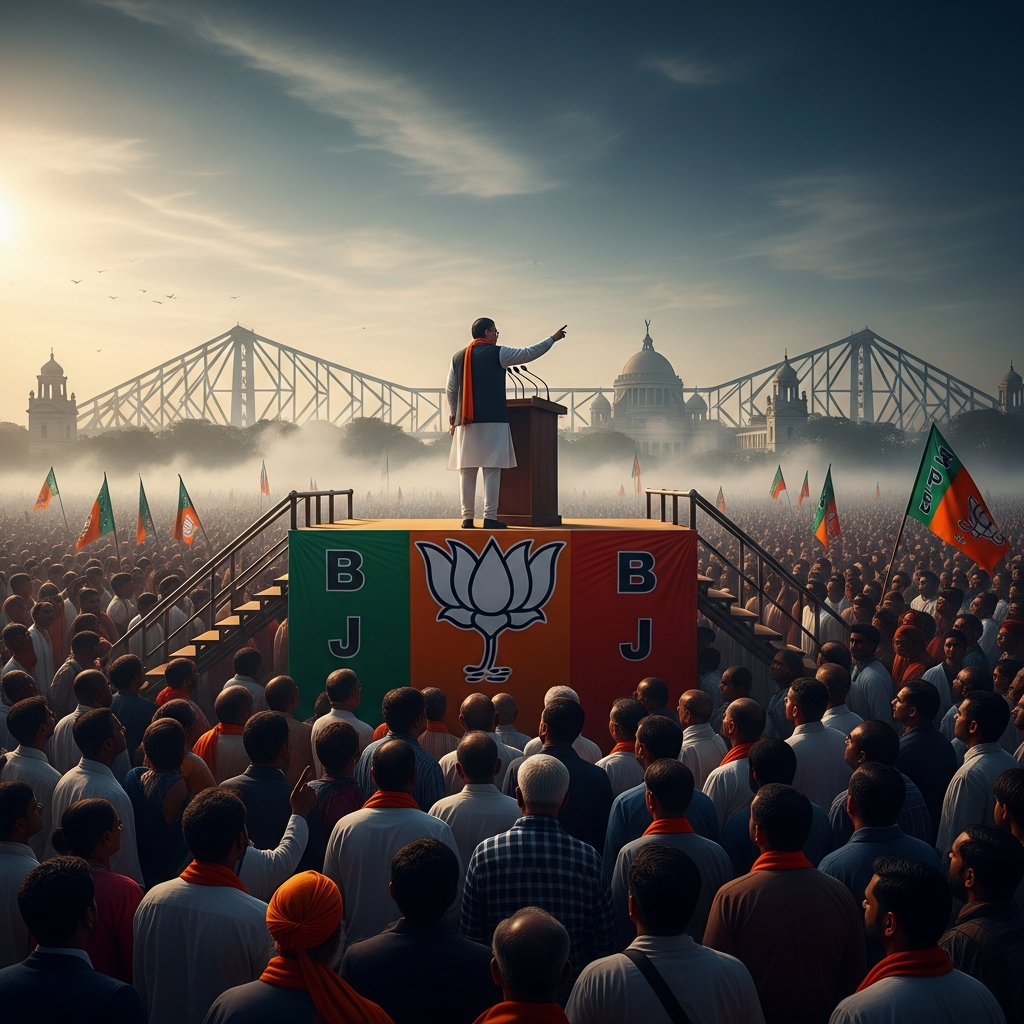
To understand BJP’s Bengal victory in 2026, you have to understand that this didn’t come from nowhere. The party has been laying the groundwork in the state for years — building booth-level organization, penetrating communities that were once believed to be out of reach and wrapping its campaign around a mix of national identity, anti-incumbency and specific local grievances that resonated with voters across constituencies.
The results suggest that work has paid off at a scale that even optimistic BJP strategists may not have fully anticipated.
TMC Pushes Back — Hard
The Trinamool Congress is not accepting this verdict quietly, and nobody who knows Mamata Banerjee expected them to.
The TMC’s response has been swift and combative. The party’s leadership has questioned the way the polls were conducted, citing some specific incidents in the campaign and voting stages which they say have compromised the credibility of the outcome and questioned the electoral process. Mamata Banerjee, who has built her entire political identity around her connection to Bengal’s soil and its people, is unlikely to give up ground without a protracted battle – legally, politically and in the court of public opinion.
This is where the Election Commission of India finds itself in an uncomfortable spotlight. Opposition parties, led by TMC but joined by others, have directed sharp criticism at the commission over poll management. Questions about deployment of central forces, complaints handling, and the overall conduct of what was always going to be a high-stakes, high-tension election are now being aired loudly and publicly.
The Election Commission has maintained that the polls were conducted fairly. But in the current political climate, that assertion will face sustained scrutiny, and the back-and-forth between the commission and opposition parties is likely to continue for weeks.
What India Politics Today is really watching Strip away the noise and television debates and there are a few things specific that political observers across the country are watching closely in the wake of these results.
First, the arithmetic of alliances. The Bengal outcome could redraw the map of political alliances across east India. Regional parties that have been sitting on the fence — calculating which way the wind is blowing before committing to national alliances — now have new data to factor in. The results will influence how parties position themselves not just in Bengal but in neighbouring states where electoral cycles are approaching.
Second, the opposition’s unity question. The INDIA alliance, which had hoped to present a consolidated front against BJP’s national dominance, faces a complicated moment. But when an anchor member like TMC suffers heavy losses in its home state, it presents practical and psychological challenges for the larger coalition. Does this result accelerate opposition consolidation, as parties realise the stakes? Or does it heighten internal tensions as blame is assigned?
Third, BJP’s own strategic calculations. A big win in Bengal does something important for the party — it dispels the narrative that certain states are simply beyond its reach. This will have implications for the party’s resource allocation, national messaging and approach to the next parliamentary contest. A party that can win in Bengal can credibly claim to be truly national in its reach.
The human side of the numbers
In the heat of political analysis, it’s easy to forget what elections actually are – millions of individual choices made by ordinary people in voting booths across thousands of villages, towns and cities.
Bengal’s voters in 2026 were thinking about jobs and prices. They were thinking about law and order, about whether they felt safe, about whether the government in power had delivered on its promises. They were thinking about identity — cultural, religious, regional — in ways that are deeply personal and not always reducible to neat analytical categories.
Some voted for change because they were frustrated. Some voted for continuity because they were cautious. Some were first-time voters exercising a right they take seriously. The aggregate of all those individual choices produced a result that has surprised many, confirmed suspicions for some, and opened a new chapter in Bengal’s long, turbulent political story.
A Long Shadow of a Verdict
The 2026 West Bengal election will be studied, debated and argued over for years to come. It will be part of political science papers and memoirs and campaign planning documents of every major party going into future contests.
What’s clear right now, in the immediate aftermath, is that Indian politics today looks different than it did before these results came in. The map has shifted. The calculations have changed. And Bengal — as it has done so many times before — has reminded the rest of India that it refuses to be predictable.
The Bengal Verdict: What BJP’s Major Gains Mean for India’s Political Future.