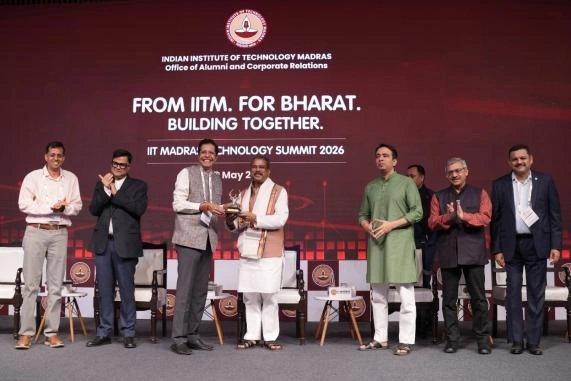
The first ever IIT Madras Technology Summit held at Bharat Mandapam, New Delhi on May 5, 2026, marked a milestone event emphasizing the crucial role of industry-academia-government partnerships in steering India’s innovation ecosystem towards Viksit Bharat 2047. The conference is titled “From IITM. For Bharat. “Building Together” convenes cross-sector professionals to co-create pathways for technology outside of research metrics and towards scalable societal impact. The summit is not simply a celebration of India’s tech might but a trumpet appeal to come together to turn research into solutions that can be applied to the country’s most pressing concerns.
Driving Innovation and Collaboration at
The IIT Madras Technology Summit 2026 will be a milestone event on the Viksit Bharat route of India – a goal of a developed and self-reliant India by 2047. Union Minister of Education, Shri Dharmendra Pradhan inaugurated the event. “IIT Madras is spearheading the creation of a research-based innovation ecosystem connected with society, which enhances the connection between academics, industry and public purpose,” he said. The summit is to construct a collaborative framework bringing together the three pillars to design, develop and implement ideas that have an impact on India’s growth trajectory.
“It is a clarion call to industry, business houses and academics to co-create technology led paths for India’s development,” stated Prof. V. Kamakoti, Director, IIT Madras. Major agreements with industry heavyweights NTPC Limited, Bharat Petroleum Corporation Limited (BPCL and HSBC were announced at the event to develop specialized research facilities to advance healthcare technology and foster a sustainable future. The facilities were opened by the minister for education as part of a commitment to transfer the latest research into scalable, real-world solutions.
From the Lab to Life-Changing Results
The institute has announced the launch of 15 Centres of Excellence (CoEs) at IIT Madras under the Institute of Eminence (IoE) structure. The CoEs presented groundbreaking solutions to tackle key societal challenges in healthcare, sustainability, semiconductors, energy and innovative materials. The exhibition gave an interesting insight into the lively innovation environment in India and how research may find its purpose when industry provides the direction.
For instance, the summit highlighted advances in cardiovascular research and robotic surgery that potentially revolutionize the delivery of healthcare in the country. Similarly, the success in semiconductor ecosystems and sovereign AI such as the Bodhan AI project is a reflection of India’s desire to become self-reliant in key technologies. Not academic exercises but markers of scalable solutions that can bridge gaps in India’s healthcare and improve its digital sovereignty.
Viksit Bharat Vision Beyond the Numbers
The topic of the summit, Viksit Bharat 2047, is a reflection of a greater national ambition to make science, innovation and entrepreneurship the key engines of India’s success. “A mature innovation system is not about the quantity of citations, patents or IPOs but the ability to convert research into deployable goods, scalable technology and meaningful solutions to society,” Shri Pradhan added. This move from measures to outcomes is key for India’s development trajectory.
Many strategies of crucial relevance can be used to achieve the Viksit Bharat objective.
2047 – World level of 3% of GDP spent on R&D to create an active innovation environment.
Build world-class innovation clusters. Establish centres of excellence in each state to attract talent and investment.
From the beginning, school curricula should integrate entrepreneurship to develop an innovative culture.
Equip the workforce for future challenges. Train 50 million adolescents in future technology skills by 2047.
Enhancement of Industry, Academia and Government Partnership
IIT Madras Technology Summit 2026 stresses the importance of strong industry-academia-government links for the growth of India’s innovation ecosystem. These partnerships aren’t new. These have been fostered through initiatives like Scheme for Promotion of Academic and Research Collaboration (SPARC), Impacting Research Innovation & Technology (IMPRINT) and Uchhatar Avishkar Yojana (UAY). But the summit goes beyond, calling for a more balanced 50:50 partnership between public sector and industry.
The summit had a Bharat Innovates project which will put Higher Education Institutions (HEIs) and Centrally Funded Technical Institutions (CFTIs) on a worldwide platform to build up deep-tech innovation. The report underscores the importance of global connectedness and consistency of institutions in India’s innovation ecosystem. India can join hands with the global partners to leverage the global competencies and contribute to the global knowledge base.
India’s position in the global innovation ecosystem
India is seeking to become Viksit Bharat by 2047 and is trying to become a global leader in innovation ecosystem. India’s ambition to be a leader in technological innovation is reflected in its focus on deep-tech, AI, semiconductors, sustainability, healthcare tech, innovation & entrepreneurship, skilling & development, and its commitment to sustainable development and climate resilience, ensuring that innovation is also aligned to global environmenta l objectives.
The Future of Interesting Questions
As India marches to Viksit Bharat 2047, some questions arise:
How do we democratize and include India’s innovation ecosystem for all, especially for people of tier-2 and tier-3 cities?
Young entrepreneurs and start-ups: How can they drive the innovation agenda in India? How could government create an enabling ecosystem for them?
These challenges require a holistic strategy to innovation that combines economic growth with social equity and environmental sustainability .
IIT Madras Technology Summit 2026 to Highlight India’s Journey to Viksit Bharat 2047