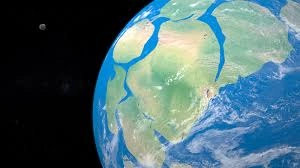
The continents of Earth are always shifting, even though the ground we walk on looks still. They move over the surface of the Earth at a speed that is about the same as how fast human fingernails grow, which is about one to two centimeters a year. Even though it’s hard to observe, plate tectonics is the big motor that makes this transition happen. Over hundreds of millions of years, it has formed mountains, opened oceans, and caused earthquakes and volcanic eruptions. Scientists can now witness these changes unfold in real time thanks to new satellite observations and geophysical models. They talk about how this slow, steady process changes the weather, causes natural disasters, and even affects the long-term future of human civilization.
The Plates Move Slowly
The Earth’s outer layer is made up of a patchwork of rigid tectonic plates. These plates float on top of the mantle, which is hotter and more flexible. Some of these plates are on the ground, and some are in the water. Convection in the mantle, slab pull at subduction zones, and ridge push in mid-ocean spreading centers all make them move. The average relative motion of plates that are near to each other is between one and several centimeters each year, which is about the same speed as fingernails grow.
The Pacific Plate, for instance, is moving northwest at a speed of around 7 to 10 cm per year compared to the North American Plate. This is what makes it one of the plates that moves the fastest on Earth. On the other hand, some parts of the Eurasian Plate move about one centimeter each year. This indicates that continental drift isn’t always smooth. Over millions of years, these small changes add up to big changes in the topography. For instance, the Atlantic Ocean is getting broader, and the Himalayas are forming as India moves slowly toward Eurasia.
How to Keep Track of the Move
Geodesy nowadays has converted the idea of continental drift into a fact that can be monitored very accurately. GPS and other Global Navigation Satellite System (GNSS) stations can tell you where things are on the Earth’s surface with an accuracy of a millimeter. By looking at observations made across years or decades, geophysicists may figure out the speed and direction of plate motion with amazing accuracy.
Satellite-based interferometric radar (InSAR) and seafloor geodetic arrays enhance this image even better by finding small changes at plate boundaries and in areas that are under stress before big earthquakes. These technologies have shown that continents are not solid things. Instead, they are sections of the Earth’s crust that move around all the time owing of forces from deep inside the Earth.
What Plate Tectonics Used to Do
Many people believe that plate tectonics is one of the most important things that has ever happened to the Earth. For the last few hundred million years, continents have moved around and formed supercontinents like Pangaea, Rodinia, and Gondwana. These supercontinents have split up and come back together. When a supercontinent forms and breaks apart, it modifies the temperature, the ocean currents, and the places where plants and animals live.
When continents come together, they can build huge mountain ranges that change how the air moves and how much rain falls. When they break up, they make new ocean basins. This causes the water levels throughout the planet to go up and down, which creates new places for marine species to live. The cycling of carbon between the air, oceans, and rocks has helped maintain the Earth’s temperature stable for a long period. This is mainly due to volcanic activity and subduction at plate boundaries.
Natural disasters including earthquakes, volcanoes, and others
Some of the deadliest natural disasters on Earth are caused by the gradual shifting of continents. When two plates come together, one moves under the other. Stress builds up along faults until it is released in major earthquakes. The 2011 Tōhoku earthquake in Japan and the 2004 Sumatra–Andaman earthquake are two very clear instances of how moving plates can swiftly let out huge amounts of energy.
Divergent boundaries, such as the Mid-Atlantic Ridge, are where tectonic plates pull apart. This lets magma rise and produce new oceanic crust. This process makes volcanoes erupt and builds mountain ranges under the water, which changes the ocean currents and marine habitats. The Pacific “Ring of Fire” is where many tectonic plates meet. This means that places on the coast with a lot of people are always at risk of earthquakes, tsunamis, and volcanic eruptions.
How it affects the weather and the sea level
The movement of continents has a small but important effect on climate change throughout time. When continents move, they change the shape of the oceans and the paths of major currents. This, in turn, changes how heat is spread around the globe. The Gulf Stream was formed millions of years ago when the Central American Seaway closed. This stream carried warm water to the North Atlantic faster, which helped the ice sheets in the Northern Hemisphere grow.
The placements of the continents change how much of the polar regions is covered by big landmasses, which in turn changes how ice sheets expand and shrink. When continents are arranged in a way that makes it easier for glaciers to form, the sea levels around the planet drop. Setting up ice sheets in ways that make it harder for them to grow causes sea levels to rise. Changes in the plates that make up the Earth’s surface, as well as changes in the Earth’s orbit and the amount of greenhouse gases in the atmosphere, have affected the planet’s climate for tens of millions of years.
What Will Happen to the Continents on Earth
The shape of the Earth will keep changing in the future because to plate tectonics. It looks like the Atlantic Ocean will get bigger and the Pacific Ocean will get smaller as subduction zones eat away at the oceanic crust. Africa might crash into Europe in tens of millions of years, closing the Mediterranean Sea and building a new mountain range.
Australia is likely to keep traveling north until it gets to Southeast Asia. India, on the other hand, will stay closed off from Eurasia. This will stop the Himalayas from rising. Geologists think that the continents could come together to make a new supercontinent, even if it takes a long time. This new continent is often called “Pangaea Proxima” or “Amasia,” depending on the model.
People Who Live in a World That Changes
The slow movement of continents is a fact that has been known for a long time and is also a huge danger to human societies. Because the plates are always moving, municipalities along active faults, like those in California, Turkey, and Japan, have to deal with the fact that big earthquakes will happen. Coastal settlements are at peril because of rising sea levels and tectonic activity that makes the land sink or rise. Depending on the geology of the location, these problems can make floods worse or better.
Tectonic action has also sculpted many of the regions where metals, fossil fuels, and geothermal energy are found. These are the things that keep modern economies running. For more than just staying safe, it’s crucial to understand how plate tectonics works. It’s also important to plan for the future and use resources in a way that lasts.
The continents of Earth are still migrating at the same speed as fingernails grow, which is changing the shape of our world.