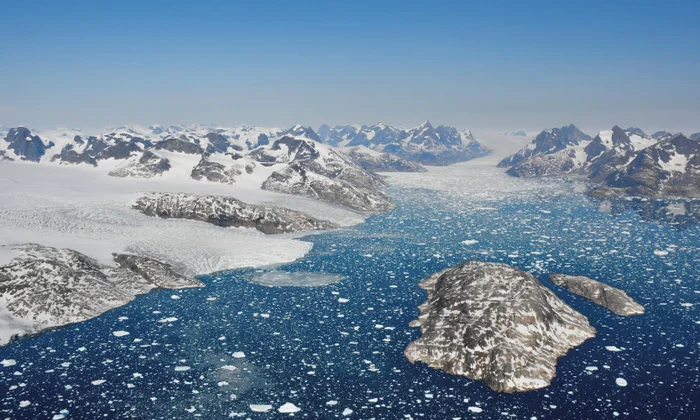
The Scary Amount of Ice Greenland Is Losing
Greenland’s huge ice sheet, which is the second largest on Earth after Antarctica, is currently shedding more than 250 billion metric tons of ice every year. This number has grown about seven times since the 1990s. Satellite data over the last thirty years show that the island has lost trillions of tons of ice, which has already raised global sea levels by more than a centimeter. This constant melting is no longer just a talking point about climate change; it is a real, observable shift that is happening right now and will have immediate effects on coastal towns, weather patterns, and the flow of the world’s oceans.
The facts are clear: recent studies of Gravity Recovery and Climate Experiment (GRACE) and follow-up satellite data show that the average amount of ice lost each year in the early 21st century was about 250–260 billion tons, with some years losing more than 300 billion tons. For every 360 billion tons of ice that melts, the world’s sea level rises by around one millimeter. This means that Greenland is currently adding about one millimeter to the height of the world’s oceans every year. That small elevation adds up over time in low-lying coastal areas, making flooding, erosion, and saltwater intrusion into freshwater systems happen more often.
How the Ice Sheet in Greenland Is Melting
There are two main ways that the Greenland ice sheet loses mass: surface melt and runoff, and calving glaciers that break off and flow away. In short, warm air melts snow and ice on the surface, making meltwater that flows into the ocean. At the same time, warm ocean waters wear down the edges of glaciers, causing them to break off as icebergs and move inland. Research indicates that around fifty percent of Greenland’s yearly ice loss results from surface melting and runoff, while the remaining fifty percent is attributed to glacier calving and underwater melting.
There are a few things that are making this happen faster. Arctic amplification, which is when the Arctic warms up at more than twice the world average pace, has elevated the air temperatures in Greenland. This has made the summer melt last longer and cover a larger region. Second, warmer ocean currents are getting to the base of outlet glaciers, which speeds up their movement toward the sea by cutting them off from below. Third, dust, soot, and microbes growing on the surface of the ice make it darker, which lowers its albedo. This means that the ice absorbs more solar radiation and melts faster. These feedbacks work together to generate a cycle that becomes worse every year. Each year of warming makes the next year’s melt season worse.
What Extreme Melt Events Do
Greenland is also seeing more and more intense melt events that can dump hundreds of billions of tons of ice into the ocean in only a few weeks. This is on top of the gradual loss of ice. For instance, an abnormally warm summer in 2012 caused a melt event that took away nearly 250 billion tons of ice in just a few months. This raised sea levels by about 0.8 millimeters in that one season. In 2019 and other years with a lot of loss, there were similar jumps. This shows that short-term heatwaves can have effects that are as bad as or worse than a whole “normal” year of melt.
Recent studies show that major melt events are happening more often and with more force. This is partially because changes in the way air moves in the atmosphere are pushing warm air over the ice sheet. Models show that if these kinds of occurrences keep happening more often, Greenland’s contribution to rising sea levels by 2300 might be several centimeters higher than it would be without catastrophic melt. This indicates that even if the average annual melt stops, short-term surges might still cause a lot of extra sea-level rise over the next few hundred years. This is important for policymakers and coastal planners.
Coastal Vulnerability and Sea-Level Rise
Greenland’s melting ice is currently responsible for around 20% of the rise in sea level throughout the world. The rest comes from seawater expanding because of heat and melting from Antarctica and mountain glaciers. The Intergovernmental Panel on Climate Change (IPCC) says that if emissions are high, Greenland could add between 8 and 27 centimeters to sea level rise by 2100. Other sources could also add to this rise, making it more than half a meter in some places.
The effects are not the same for everyone. Gravitational and rotational factors make sea levels rise more in tropical and mid-latitude coastal areas, where many of the world’s biggest cities are. Mumbai, Dhaka, Jakarta, Miami, and Lagos are all low-lying megacities that are more likely to experience persistent flooding, damage to infrastructure, and the displacement of millions of people. Even small rises in sea level can make storm-surge flooding happen more often, making what used to be unusual disasters into everyday problems.
Wider effects on the climate and oceans
Greenland’s melting ice is changing the flow of the water and the temperature in many areas, not only the sea level. Greenland’s runoff is adding fresh water to the North Atlantic, which can lower the salinity of the ocean. This can make the Atlantic Meridional Overturning Circulation (AMOC), which moves heat between the tropics and the North Atlantic, less strong. If AMOC slows down, some portions of Europe could get cooler, storms could get stronger, and rainfall patterns could change over the Atlantic basin.
The loss of ice is affecting Greenland’s own geography and ecosystems in its own area. As the ice sheet gets lighter, some areas of the bedrock are rising, which changes the depths of the fjords and makes it harder for coastal towns to get about. Marine ecosystems are also affected by more iceberg calving and meltwater discharge, which changes the flow of nutrients and the conditions of fish and marine mammal habitats. These changes affect traditional hunting routes, food security, and cultural practices related to the ice for Indigenous and rural people.
Why 250 billion tons is important
The number 250 billion tons per year isn’t simply a number; it’s a way to measure how quickly the earth is changing. If spread out equally, 250 billion tons of ice would cover the whole United States with a layer of ice that is several meters thick. That much water in the ocean changes coastlines, puts stress on infrastructure, and changes the level of risk for hundreds of millions of people.
Scientists are especially worried about the trend speeding up. Greenland was losing roughly 30–35 billion tons of ice each year in the 1990s. By the 2010s, that number had grown to nearly 250 billion tons, a seven-fold increase. The ice sheet has been losing bulk every year since the mid-1990s, even in the last several years when things have been somewhat “quieter.” This means that the system has crossed a line where it is unlikely to recover without long-term global cooling.
What the policy means and what to do next
The amount of ice that Greenland has lost shows how important it is to cut emissions quickly and deeply to stop additional warming. Every little bit of heat that doesn’t happen means less melting, slower sea-level rise, and fewer extreme events.
Scientists want to get better at figuring out how much Greenland will raise the level of the sea. This is especially crucial because glaciers are melting more often in disastrous ways, yet we still don’t fully understand how they work. We need better satellite monitoring, field observations, and high-resolution models to help us with risk assessments and long-term planning.
Greenland loses more than 250 billion tons of ice per year, and the world is feeling the effects.