
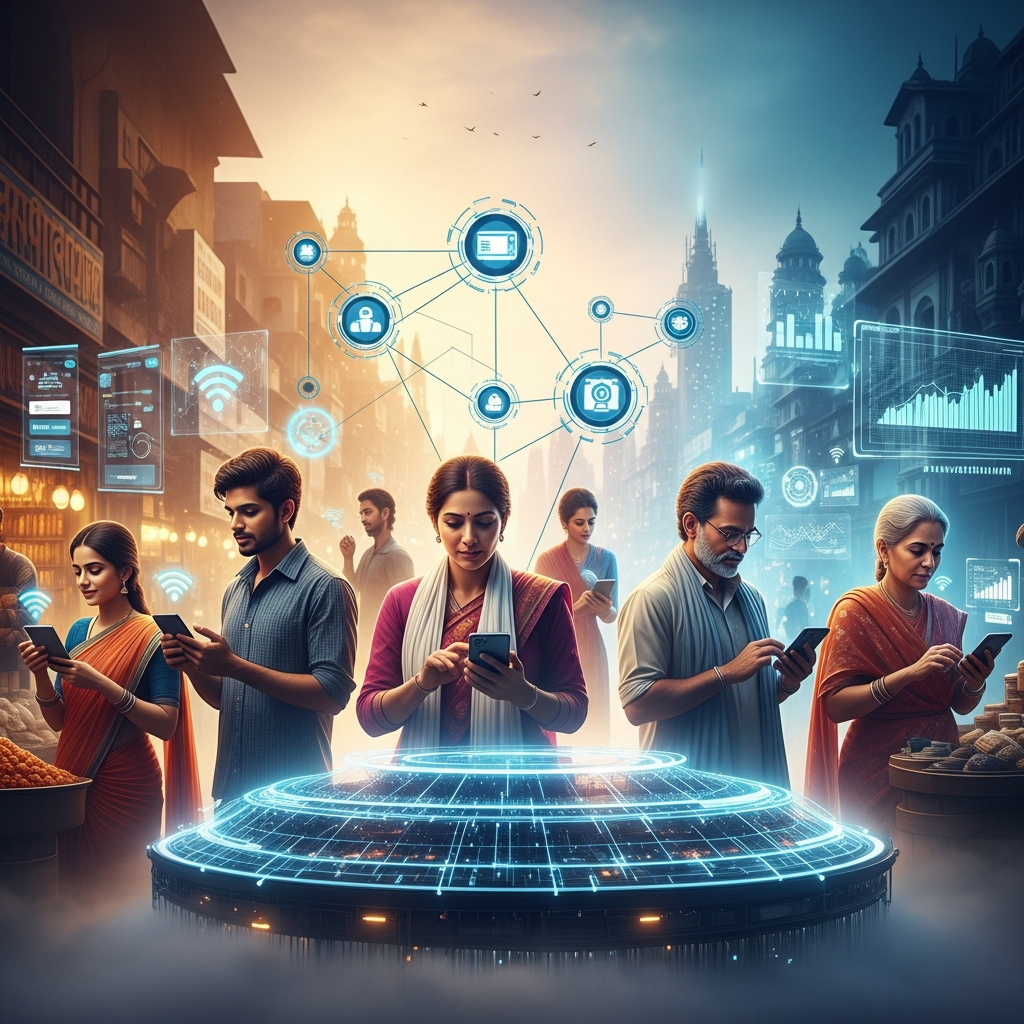
In the past, a farmer in rural Rajasthan had to drive for hours to get to the nearest bank branch to deposit his money or get a small loan. That same farmer can now open a bank account, move money around, and get crop insurance—all in less than ten minutes with a simple smartphone. This isn’t a dream that will never come true. It’s happening right now, and it’s one of the most amazing stories in the world of money.
In the past ten years, India’s financial system has changed a lot, but not in a very loud way. India has built a digital economy that people all over the world, including governments and investors, are very interested in and studying. This is because of brave policy decisions, a young population that wants technology, and a fintech sector that is growing up quickly.
The Base: DPI and the Digital Public Infrastructure
India has pushed for Digital Public Infrastructure, or DPI, to be a big idea on the world stage. It is the main part of this revolution. DPI stands for foundational, open digital systems. These are not the same as private platforms that are made to make money. These systems are like roads that let trade happen and the economy grow.
There are three main layers in India’s DPI stack, which is also called the India Stack. Aadhaar gives over 1.3 billion people a digital identity based on their fingerprints. The Unified Payments Interface (UPI) lets you make digital payments right away and on any device. The Account Aggregator framework also lets people share their financial information with other institutions if they agree. This gives millions of people access to credit and investment options that were once out of reach.
The results are very clear. In the first month of 2026, UPI alone handled more than 17 billion transactions. This is a number that is close to the total amount of digital payments made in a few big economies. India built things that took decades to build in other places in just a few years. DPI made this possible by giving all fintech companies, banks, and startups a common language and a clear path to follow.
Old to New in Banking Technology
People used to think that India’s traditional banks were slow-moving giants because they had old systems and processes that were full of paperwork. That picture has changed a lot. They’re pouring resources into banking technology, overhauling core systems, launching online-only products, and trying to keep pace with agile fintech players.
The emergence of neo-banks and digital lending platforms has accelerated this shift. Companies like Razorpay, Slice, and Jupiter have demonstrated that financial services can be straightforward, fast, and user-friendly. Consequently, public sector banks, which still cater to the majority of India’s population, are intensifying their digital efforts. They’re rolling out mobile banking apps, implementing AI-driven customer service, and deploying systems for real-time fraud detection.
Its regulatory sandbox framework lets innovators test out new ideas without having to follow all the rules right away. This was a smart bet that worked out. Instead of driving fintech entrepreneurs to other countries, it made a generation of responsible ones.
Financial innovation that reaches the last mile
India’s financial innovation story is unique not only because of its size, but also because of its purpose. Many of the new ideas in Indian fintech are meant for people who don’t have access to them, such as small business owners, migrant workers, women entrepreneurs, and people who are borrowing money for the first time and don’t have a credit history.
New ways of scoring credit look at things like utility bills, GST filings, and even social commerce to see how likely someone is to pay back a loan. This means that a kirana store owner who has never taken out a formal loan can now get money to run their business in hours instead of weeks. Micro-insurance products sent through WhatsApp and USSD are helping rural families who weren’t part of the financial system before pay for crop failures and health emergencies.
This is what real financial innovation means: not doing something new just for the sake of it, but doing something new that will help everyone. And it’s building something that will last a lot longer than market share: trust.
India’s Digital Economy in the World
India’s way of building its digital economy is no longer just a success story at home; it’s also something other countries want to copy. When India was in charge of the G20 in 2023, it was able to push for DPI as a tool for global development. Since then, India has been asked by a number of countries in Africa, Southeast Asia, and Latin America to help them copy parts of the India Stack.
Investors have seen it too. India is still one of the best places in the world to get money for fintech. Along with the US and the UK, it is always in the top three. There are now more than 10,000 fintech companies in the country. Some of them have already reached the “unicorn” level and are looking to list on exchanges around the world.
Big Tech might be the best indicator of India’s place in the world of finance. Google, Meta, Amazon, and other major global payment companies have all made financial products just for India because Indian consumers are some of the most tech-savvy in the world. These items aren’t just afterthoughts; they’re the main new ideas.
The Next Step
India’s financial changes are far from over. There are still things that need to be fixed. As more people use digital technology, data privacy laws are still being worked on, and rural internet access is getting better but is not yet universal, the risks of cybercrime are growing. There are also questions about how long this can last: can the fast growth of fintech keep going without putting consumer safety at risk?
But it’s clear what will happen next. India has shown that when smart public infrastructure and responsive regulation are in place, technology-driven financial innovation can move at a speed and scale that goes against what most people think. The farmer in Rajasthan didn’t wait for Wall Street to figure out how to make the economy work for everyone. India built the first system that got to him.
As the rest of the world watches India’s digital economy grow, that might be the most important thing they learn.

