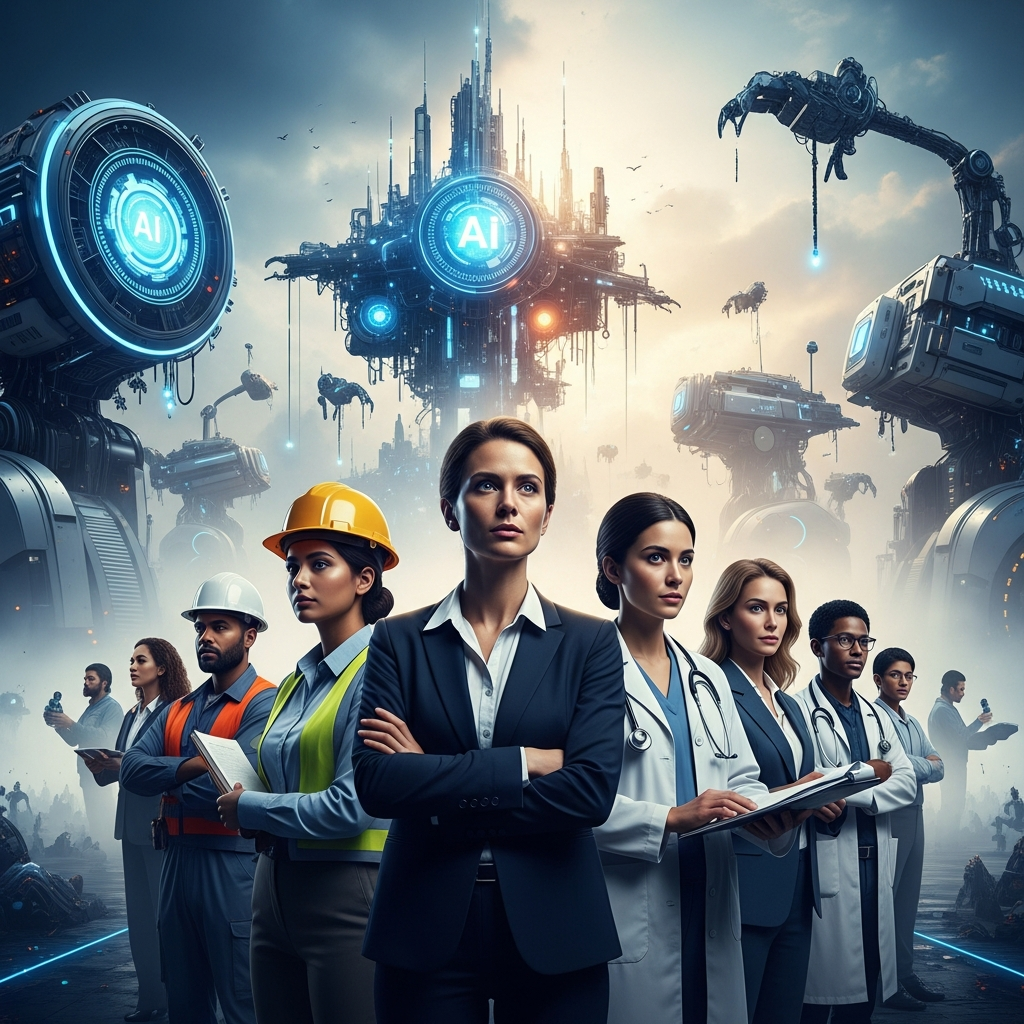
Artificial intelligence is no longer a distant disruption on the horizon — it is already inside the building, sitting at the desk next to yours, and in some cases, doing your job faster than you can.
hink about the last time you genuinely worried about your job — not the everyday stress of deadlines and performance reviews, but the deeper, quieter anxiety that comes from wondering whether the role you have built your career around might simply stop existing. For a growing number of workers across the world, that worry has stopped being abstract. The conversation about AI jobs impact has moved out of technology conferences and into kitchen tables, union meetings, and government briefing rooms. And it is not going away.
The numbers, when you look at them plainly, are arresting. Researchers at the International Monetary Fund estimate that artificial intelligence could affect up to 60% of jobs in advanced economies — not necessarily eliminating them outright, but transforming them in ways that will require workers to adapt or be left behind. In emerging markets the figure is lower, but the trajectory is clear and the direction is the same everywhere: automation is accelerating, and it is no longer confined to factory floors and manual labour. It has moved decisively into offices, hospitals, legal firms, newsrooms, and classrooms.
What makes the current wave of technology disruption genuinely different from previous industrial revolutions is not just its speed — though that is remarkable — but its reach. Past automation waves largely displaced physical labour. Machines replaced hands. What artificial intelligence is doing now is something qualitatively different: it is replacing cognitive work. The tasks most vulnerable today are precisely those that previous generations considered reliably human — reading documents, drafting reports, answering customer queries, interpreting data, writing code. Entry-level knowledge roles, once seen as the natural entry point for young workers building careers, are particularly exposed.
This creates a troubling paradox. Young people entering the workforce have historically developed skills and professional judgment by doing the foundational work — the first drafts, the routine analysis, the initial client calls. If AI absorbs that layer of work, the career ladder loses several of its lower rungs. You cannot climb to the top of a profession if there is nowhere to start. This is not a theoretical concern. Recruiters at major professional services firms are already reporting reduced entry-level hiring volumes, even as senior roles remain in high demand. The workforce change is not coming — it is underway.
“Every previous technological revolution created more jobs than it destroyed. The honest answer is: we do not yet know whether this one will do the same.”
The optimists — and there are genuine, credible optimists in this debate — point to history. The industrial revolution displaced agricultural workers and created factory jobs. Computers replaced typing pools and generated entire new industries. The internet destroyed travel agencies and built the gig economy. The argument is that AI will follow this pattern: displacing some work while generating new categories of human activity that we cannot yet fully imagine. There is real substance to this view. AI is already creating demand for prompt engineers, AI auditors, ethics reviewers, and machine-learning specialists. New roles are emerging even as old ones compress.
But even the optimists tend to concede a critical caveat: the transition will not be smooth, and it will not be fair. The workers most likely to benefit from AI augmentation are already skilled, educated, and well-resourced. The workers most likely to face displacement are those with fewer options, less flexibility, and limited access to retraining. Without deliberate intervention, AI risks compressing the middle of the labour market and widening inequality in ways that will be deeply destabilising — economically and politically.
This is why the conversation about reskilling has become so urgent — and why the gap between rhetoric and action in this space is so frustrating to those who study it closely. Governments around the world have announced reskilling initiatives. Corporate training budgets have grown. Online learning platforms report surging enrolment in technology and digital skills courses. These are genuine positive signals. But the scale of investment in workforce adaptation remains dramatically mismatched with the scale of the disruption underway.
Why reskilling alone is not enough
Reskilling programmes work best when workers have time, financial stability, and clear pathways to new roles. Many displaced workers — particularly older employees or those in lower-income brackets — lack all three. Structural support, including income bridges, affordable education, and employer incentives, must accompany training programmes for them to succeed at meaningful scale.
Alongside reskilling, the debate around AI regulation and ethical deployment has gained serious momentum. Policymakers in the European Union, the United States, and increasingly in Asia are grappling with questions that were largely academic just a few years ago: How transparent should AI decision-making be in hiring processes? What accountability do employers have when automated systems eliminate roles? Should companies be required to disclose when AI has materially altered their workforce composition? These are not easy questions, and the answers will shape the experience of working in the decades ahead.
What is becoming clear — across the political spectrum and across industries — is that leaving the workforce change driven by AI entirely to market forces is not a viable answer. Markets are efficient at allocating resources toward profit. They are not, on their own, efficient at protecting the dignity and economic security of workers whose skills have been made redundant by forces entirely beyond their control. That is a problem that requires public policy, institutional investment, and genuine political courage to solve.
“The question is not whether AI will change work. It already has. The question is whether we will manage that change — or simply survive it.”
The story of AI jobs impact is ultimately a human story about adaptation, anxiety, and the possibility of renewal. Societies have navigated transformative technological change before and emerged, eventually, with labour markets that were broader, more productive, and more inclusive than what came before. But “eventually” is doing a lot of work in that sentence. The transitions were painful, often generational in length, and extracted enormous human costs from those who lived through them. We have the knowledge — and arguably the tools — to do better this time. Whether we choose to use them is the defining economic and social question of this decade.