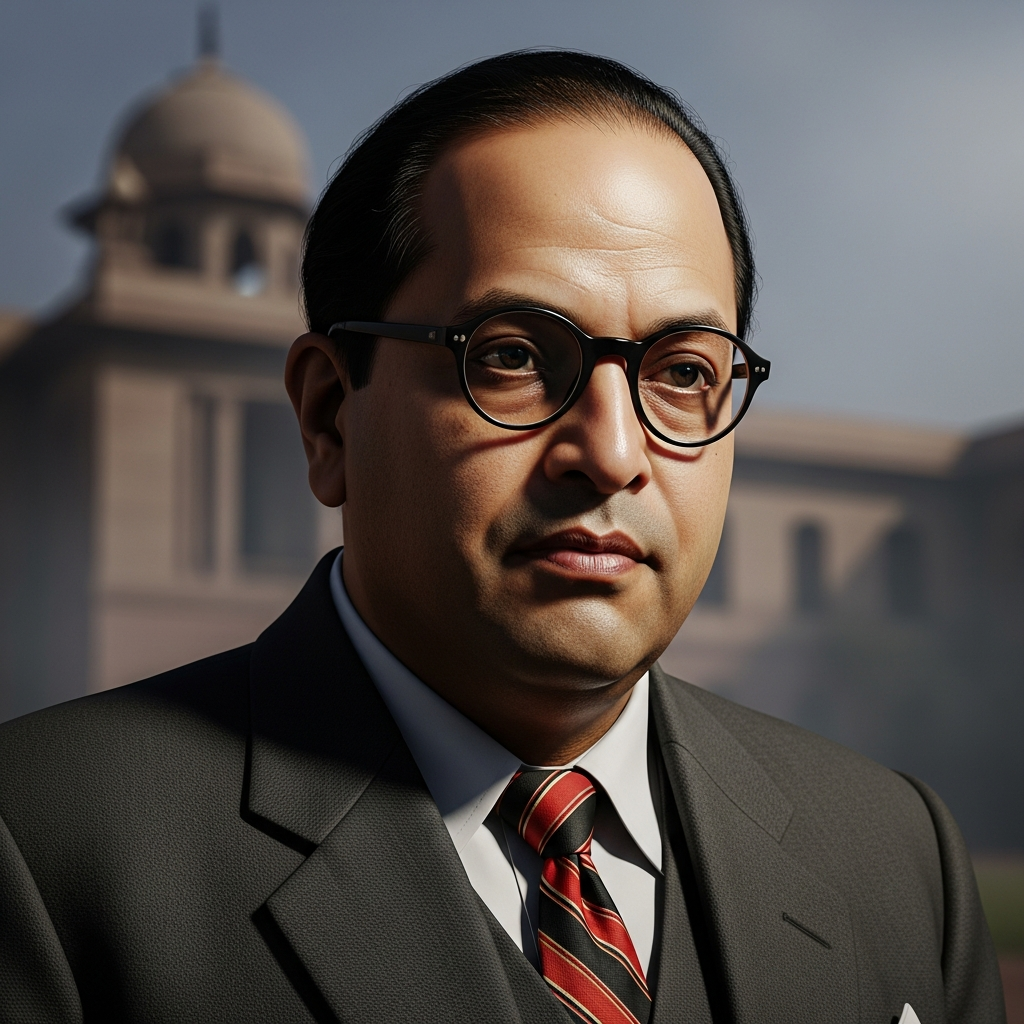
There are some birthdays that a nation doesn’t just celebrate — it reflects on them. April 14th is one of those days in India. Streets across the country come alive with blue flags and garlands of marigold. Statues are draped in fresh flowers before the sun has fully risen. Schoolchildren recite constitutional preambles. Politicians make speeches. And somewhere in all of that noise and colour, if you listen carefully, you can still hear the echo of a man who refused to let India be comfortable with its own injustice.
Ambedkar Jayanti 2026 is being observed today with the same mix of reverence, pageantry, and — for many — deeply personal gratitude. Government offices, banks, and public institutions remain closed across much of the country as India marks the 135th birth anniversary of Dr. Bhimrao Ramji Ambedkar. It is a public holiday India has honoured for decades, but the meaning behind it has never felt more layered or more relevant than it does right now.
More Than a Holiday
It would be easy to reduce Ambedkar Jayanti to a day of closed offices and political rallies. That would be doing it a disservice.
Dr. B.R. Ambedkar was born on April 14, 1891, the fourteenth child of a Mahar family in Mhow, in what is now Madhya Pradesh. His community sat at the very bottom of a caste hierarchy that decided, before a child could walk or speak, what they were worth and what they could become. The indignities Ambedkar faced growing up were not abstract or systemic — they were daily, physical, and deliberate. He was made to sit outside classrooms. He was not allowed to touch the water pot that other students used. He was reminded, constantly and cruelly, of the place the world had assigned him.
He refused to stay there.
What followed was one of the most extraordinary intellectual journeys in modern Indian history. Ambedkar became one of the most educated men of his era — holding degrees from the University of Mumbai, Columbia University, the London School of Economics, and Gray’s Inn. He earned multiple doctorates. He wrote prolifically. And he returned to India not to claim personal success, but to dismantle the system that had tried to break him.
The Architect of the Indian Constitution
When India gained independence in 1947, the question of what kind of nation it would become was still wide open. Jawaharlal Nehru’s government made a consequential choice: they asked B.R. Ambedkar, a man who had every reason to distrust the Indian establishment, to chair the committee that would draft the supreme law of the land.
It was, in hindsight, exactly the right decision.
The Indian Constitution that Ambedkar shepherded into existence is a document of remarkable ambition. It abolished untouchability. It guaranteed fundamental rights to every citizen regardless of caste, religion, gender, or place of birth. It established reservations in education and government employment for historically marginalized communities — a policy so contested and so consequential that it continues to shape Indian politics to this day. And it enshrined a vision of social justice not as charity, but as a constitutional obligation.
The national events held every year on this day are, in a sense, a public reckoning with that document and the values it carries. Schools conduct essay competitions on constitutional rights. Legal aid camps are held in villages where people who have never stepped inside a courtroom learn about the protections they are entitled to. Dalit cultural organisations perform plays and music that speak of dignity reclaimed. These aren’t just commemorations — they are, at their best, acts of democratic renewal.
A Legacy That Remains Unfinished
And yet, to celebrate Ambedkar Jayanti honestly is also to sit with the discomfort of how far India still has to go.
The principles of the Indian Constitution — equality, fraternity, liberty — remain aspirational for millions of citizens. Caste-based discrimination hasn’t disappeared; it has, in many places, simply grown quieter and more sophisticated. Manual scavenging, despite being illegal, still exists. Inter-caste couples still face violence. Dalit students still navigate campuses where their identity marks them for exclusion rather than welcome.
Ambedkar himself seemed to anticipate this. In his final speech to the Constituent Assembly, he issued a warning that reads today like a prophecy: political democracy, he said, was meaningless without social democracy. Without equality in daily life, no constitution — however perfectly written — could deliver justice.
That tension — between what is written and what is lived — is what makes this day more than a public holiday. It is an annual audit. A moment where India measures itself not against other countries, but against its own stated ideals.
Why It Matters Today
In 2026, as national events unfold across every state — from rallies in Mumbai’s Shivaji Park to quiet prayer gatherings in northeastern villages — the underlying question remains the same one Ambedkar spent his life asking: Who does this country truly belong to?
His answer was unambiguous. It belongs to everyone. Equally. Without condition.
That answer was radical in 1891. It remains radical today. And perhaps that’s the most honest tribute India can pay to the man who gave it a conscience written in law — not to treat his birthday as a moment of comfortable pride, but as a renewed commitment to making that answer real.
The flags will be folded by evening. The offices will reopen tomorrow. But the work that Ambedkar began has no closing time.