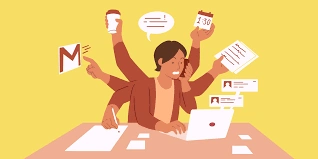
Many individuals still think that being able to do more than one thing at once is a sign of being productive, even if notifications and digital requests are continually flooding in. But new research in neuroscience demonstrates that the human brain doesn’t really perform many things at once. Instead, it switches activities quickly, which makes mistakes more likely, makes you more mentally weary, and diminishes your overall cognitive abilities.
The Myth’s Science
Neuroscience research demonstrates that what we think of as multitasking is really just the brain switching between tasks very quickly. This process, known as task-switching, activates the prefrontal cortex, the brain’s executive control center, but it has a significant cost. Psychologists like Joshua Rubinstein and David Meyer did research that showed that each transition takes up cognitive resources to redirect attention. This slows down work and raises error rates by as much as 40% in sophisticated tasks.
The way neurons are arranged in the brain makes it hard for it to process information at the same time. Each task is handled by a different processor in a computer, which is why they can accomplish so many things at once. People, on the other hand, can only think about one item at a time since their working memory isn’t big enough. If you try to do more than one thing at once, like read your email while on a conference call, your neurons don’t operate as effectively. This is called “attention residue,” and it makes it harder to focus on the new task since portions of the old one stay in your memory. This effect was established in a study by Sophie Leroy in 2009. It explains why performance reduces while switching tasks, even after refocusing.
Being mentally tired makes the problem worse. Changing tasks for a long time elevates cortisol levels, which is the hormone that causes stress, and uses up the brain’s resources. When you split your attention, your brain uses up glucose, which is its major fuel, faster, which makes it weary faster. Studies employing fMRI scans demonstrate heightened activity in the anterior cingulate cortex during task transitions, signifying conflict resolution that gradually exhausts cognitive resources.
The past of multitasking and how it became popular
As personal computers and mobile devices grew increasingly ubiquitous in the late 20th century, the idea of multitasking became more popular. In the 1990s, when email and pagers became increasingly widespread, productivity experts praised the idea of “doing more with less.” But this shift didn’t take into account how humans evolved: the brain developed for tasks that need focus, like hunting or telling stories, not for digital distractions that split up our time.
By the 2010s, smartphones have made the problem worse. Apps that are supposed to keep people interested, such infinite scrolls and push alerts, use dopamine loops to urge consumers to switch tasks often. A study by Gloria Mark at the University of California, Irvine, found that office workers change employment every 47 seconds on average. It takes them 23 minutes to go back to normal after each break. This research reveals how modern places like open-plan offices and social media feeds make people less productive while claiming to be productive.
Cultural reinforcement is still going on. Saying things like “busy is best” makes it sound wonderful to be overloaded, but statistics shows that it’s not. The American Psychological Association believes that people who do a lot of things at once score worse on cognitive tests because they have less gray matter in brain areas that are linked to control and empathy. This long-term problem harms both people and teams, since people aren’t paying attention and mistakes that cost money occurs.
Finding out how much productivity is lost
Controlled trials give clear proof of the cost. Clifford Nass did a study at Stanford University in 2009 that looked at those who multitask all the time and people who only do it sometimes. Heavy multitaskers scored worse on tests that required them to switch tasks because their brains had problems ignoring information that wasn’t significant.
Rubinstein’s research looked at switch costs. Simple jobs take roughly 200 milliseconds to switch, whereas more complicated ones take about 1.5 seconds. This adds up to hours of missed work time over the course of a day. This means that professionals who have to deal with reports and emails at the same time are 20–40% less productive overall. EEG tests also demonstrate that alpha waves are less active when people are doing more than one thing at once. This means that they are more aware. A 2020 meta-analysis in Psychological Bulletin found that this was linked to 25% more tiredness.
In fields where the stakes are high, like medicine or aviation, the results can be very poor. A 2014 study in Pediatrics found that nurses who did more than one activity at a time made twice as many mistakes when giving medicine. This demonstrates that the assertion “multitasking reduces brain efficiency” is not an exaggeration. These signs reveal that there are difficulties with the system that make it harder to do well at work and in everyday life.
Expert Opinions and Effects in the Real World
Earl Miller, a cognitive scientist at MIT, says that the brain wasn’t intended to do more than one thing at a time. It developed to focus on one thing at a time. His lab’s research on primates shows that even little changes in time can break up brain impulses, just like a network that is excessively busy.
At work, things are at their worst. Gallup claims that U.S. workers waste 2.1 hours a day on things that don’t matter, and one of the main reasons is that they try to do too many things at once. Tech businesses like Google offer “no-meeting Wednesdays” to help people focus and cut down on fragmentation. Researchers at Virginia Tech found that programmers who employed single-task blocks created code that was 30% less likely to have defects.
Safety and education make things even more important. Researchers at the University of London showed that students who use their phones while doing other activities score 11 percentile points lower on tests. Texting while driving is just as dangerous for your brain as having a blood alcohol level of 0.08%, which is against the law.When you work from home, your brain works too hard and your surroundings change too quickly, which can make you tired of Zoom.
This approach is not in line with Cal Newport’s idea of “deep work.” He believes you should make time to work on one problem at a time. This can make professions that need expertise five times more productive.
Long-Term Task-Switching and Its Effects on Health
Long-term inefficiency may negatively affect health. Baumeister’s ego depletion hypothesis asserts that cognitive tiredness hinders decision-making and weakens willpower.Harvard Medical School did a study that showed that blue light from electronics at night can lower melatonin levels, which can make it harder for people to fall asleep.
One worry for the long term is that cognitive degeneration will happen faster. A 2022 study published in Nature Reviews Neuroscience reveals that engaging in excessive simultaneous activities can lead to atrophy of the prefrontal brain, a precursor to early dementia.According to the Journal of Experimental Psychology, people who transfer jobs a lot have 70% higher stress than other people. The Vision Council says that 59% of Americans with digital vision syndrome have bad posture and eye strain because they sit stationary and perform more than one activity at once.
Apps like Headspace and mindfulness training can assist. Headspace improved focus by 14% in tests.
How to Get Your Brain to Work Again
To get rid of the wrong idea, you need to practice on purpose using approaches that have been demonstrated to work. Cal Newport offers 90-minute focus sprints as a way to block out time. This is similar to a research by the Draugiem Group that revealed that the best achievers work best in 52-minute bursts with pauses in between.
RescueTime says that a notification detox, which means turning off devices during intense work, saves you 90 minutes a day. Neuroplasticity is used in monotasking training, which starts with one hour of focused work per day. When London taxi drivers practice focusing on one item at a time, their hippocampus gets bigger, for example. People can stick to their habits better with things like no-phone zones or the Freedom app.
Intel’s “monkey-free” meetings, which don’t allow laptops, make people 40% more productive.
Effects on society as a whole
As AI takes over ordinary chores, the value of people changes from being busy to being focused. But a lot of the time, edtech platforms make studying more fun by integrating games and other activities. People in France can’t send emails after work because of the “right to disconnect” rule. This makes them feel less weary. A 2019 study found that UK businesses waste £133 billion a year because they aren’t efficient. A big part of this is because they try to do too many things at once. This means that refocusing productivity might provide trillions of dollars in new opportunities around the world.
The Myth of Multitasking: How Changing Tasks Too Quickly Slows Down Your Brain and Makes You Less Productive