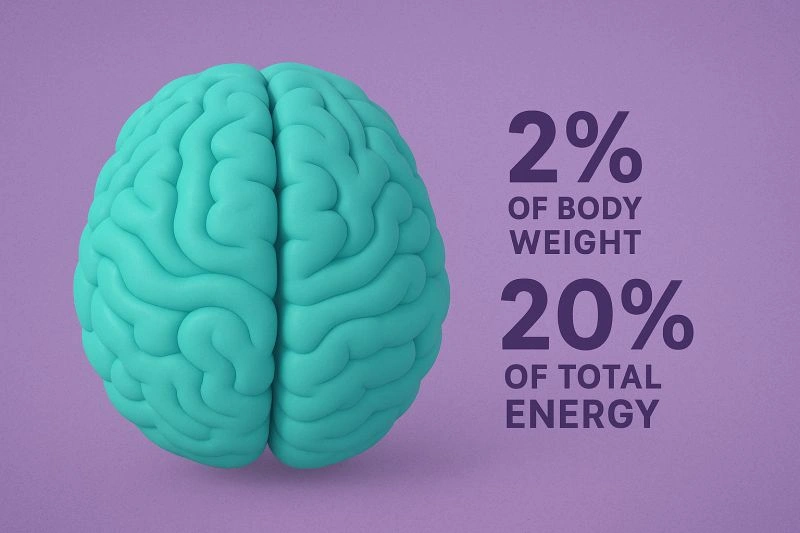
The brain, which makes up around 2% of an adult’s body weight, requires about 20% of the body’s total energy. This reveals how very efficient and hungry the human body is. This astonishing amount, which comes from decades of neuroscience research, explains why figuring out how the brain uses energy is one of biology’s most interesting problems. Even when you’re resting, it uses about 20% of your oxygen and calories. It gives energy to everything from simple thoughts to tough choices. Modern lifestyles impose a lot of stress on cognitive demands because they are always stimulating and doing multiple things at once. It is very vital to know about this energy-hungry organ for your health, productivity, and long life.
This page goes into great length regarding the science behind the brain’s unequal use of energy and what it entails for daily life, disease prevention, and changes in evolution. We look at metabolic pathways, real-world implications, and recent studies to figure out why this “20% energy paradox” is more essential than ever now that people have too much information.
Breaking Down the Brain’s Energy Profile
The brain’s energy profile doesn’t make sense. Adults weigh roughly 1.4 kilos, which is about the same as two grapefruits. It functions like a powerful engine that is idling at full power. Neuroscientists use positron emission tomography (PET) scans and magnetic resonance spectroscopy to measure this. These experiments demonstrate that the brain requires about 20 watts of electricity all the time, which is about the same as a light bulb that isn’t very bright.
When the body is at rest, baseline brain activity meets this need. Neurons, which are the brain’s signaling cells, send electrical signals through synapses. Adenosine triphosphate (ATP) is the cell’s energy currency, and this action needs it. Even though the brain isn’t particularly huge, it uses 20% of the body’s oxygen to turn glucose into ATP. Researchers, including those at the National Institutes of Health, have shown that the brain needs between 260 and 340 calories a day to perform correctly. This is more than twice what muscles need when they are working out moderately.
Why is there so much trash? The brain got better at keeping people alive through evolution. Homo sapiens had bigger brains, which helped them use tools, work together, and solve issues. However, this made their metabolism slower. Anthropological evidence from fossil records indicates that early humans sacrificed stomach size for increased brain expansion, redirecting energy into cognitive activities. This legacy carries on today: babies’ brains use up to 65% of their energy, which lowers to adult levels as their bodies expand.
The metabolic machinery: glucose, oxygen, and more
If you examine more closely, you’ll see that the brain’s fuel preferences reveal how weak it is. Muscles can use lipids or proteins instead of glucose when they are under stress. The brain, on the other hand, exclusively needs sugar. It eats about 120 grams a day and uses oxygen to break it down aerobically. This happens through a thick network of capillaries that sends 750 milliliters of blood per minute, which is 15% of the heart’s output for a 2% organ.
This situation depicts how things can go wrong. Hypoglycemia, or low blood sugar, can make you confused in just a few minutes. Hypoxia, or not getting enough oxygen, can make you pass out in a matter of seconds. The blood-brain barrier only lets in nutrients that are good for you and keeps out poisons. This is a double-edged sword that makes people need more energy.
Important numbers show us how this equipment works:
– The brain needs between 300 and 500 kcal a day, depending on what you’re doing. While you’re working hard, it can use up to 25% more.
– Oxygen uptake: 3.5 ml per 100 grams of brain tissue per minute, which is six times the average for the body.
– ATP turnover: Neurons recycle ATP every few seconds, and oxidative phosphorylation makes 90% of it in mitochondria.
Recent research shows that ketones can be utilized as backups. Your liver transforms fats into ketones when you fast or eat a ketogenic diet. They give the brain up to 70% of its energy. A study in Nature Metabolism from 2023 found that this change makes elderly people intellectually stronger. This shows that modifying their diet could help with neurodegenerative diseases.
The Mental Price of Always Eating
This persistent drain on energy changes the way we think every day. It’s not because you’re lazy that you feel weary after concentrating for a long period; it’s because your metabolism is low. GLUT1 and GLUT3 are glucose transporters that carry fuel to neurons. But when the need is always there, it eats up reserves, which makes it tougher for the prefrontal cortex to accomplish things like pay attention and manage impulses.
Surgeons claim their greatest work starts to fade after four hours, which is like what happens in the lab, where reaction speeds fall down by 20% after a task. Students who study hard burn more calories, like going for a light jog, which is why they are so weary after a test.
Doing more than one item at a time makes this worse. Studies from the University of California show that switching tasks takes 40% more energy than concentrating on one item at a time. This is because the brain has to shift things around between networks. Digital natives make it more harder since continuous notifications create dopamine loops that waste energy without getting anything done.
Health Effects: From Being Tired to Getting Sick
Big health concerns are linked to the brain’s desire for energy. Chronic underfueling manifests as “brain fog,” a term corroborated by fMRI studies indicating diminished connectivity during periods of undernourishment. Sleep restores reserves; REM stages recreate events from the day, strengthening memories through energy-intensive synaptic pruning.
Pathologies make dangers higher. Alzheimer’s disease changes how glucose is used in the body early on, and amyloid plaques hurt how mitochondria work. This means that the brains of people with this condition consume 20 to 30 percent less energy. Ion pumps that aren’t working appropriately and are eating up ATP in a random way might also cause epilepsy. Low metabolism in parts of the brain that affect mood is associated to depression. SSRIs indirectly boost energy levels in these areas.
Obesity problems get worse as they happen. When you eat a lot of sugar, your brain becomes resistant to insulin, which means it doesn’t get enough glucose. A 2024 meta-analysis in The Lancet Neurology found that metabolic syndrome was connected to quicker cognitive decline. If nothing is done, there would be 150 million dementia cases by 2050.
Making adjustments to your lifestyle can help:
– Intermittent fasting is like how our ancestors ate, and it helps our bodies use ketones and clean out cells.
– Exercise raises brain-derived neurotrophic factor (BDNF), which boosts blood flow and the supply of energy.
– Nootropics and caffeine affect how adenosine receptors act, which makes fuel use better for a short time without overloading.
– Mindfulness lowers activity in the default mode network, which saves 10–15% of energy when you sleep.
– Endocrine study shows that hormonal changes during a woman’s menstrual cycle can impact brain metabolism by as much as 10%. This can change your mood and make it hard to concentrate.
Limits of Technology and Evolution
The brain’s greed was what made humans evolve. Comparative anatomy indicates that apes allocate 8 to 10 percent of their energy for cerebral functions. We use twice as much for abstract reasoning. Richard Wrangham, an anthropologist, thinks that heating food freed up calories from digestion, which helped the brain grow. Raw diets, on the other hand, don’t work as well, thus they make the brain smaller.
This biology now includes technology. AI models copy the energy patterns of neurons. Training GPT-like systems uses as much electricity as a small town, which is about the same amount as running an organic system. Neuroprosthetics, like Neuralink implants, are supposed to help things perform better, which could imply less computer power.
Future medicines will have a direct effect on metabolism. Researchers are looking exploring methods to improve GLUT transporters using CRISPR, and mitochondrial transplants have shown promise in animal models for Parkinson’s disease. Wearable devices that can read EEG and glucose levels could help people eat healthier by tailoring their diets to their needs. For instance, apps may suggest snacks that would help individuals think more clearly.
Changes throughout the world make things more important. Climate change threatens food security, which in turn impairs brain fuel. People who live in cities tend to be less active, which is negative for their energy demands. Policymakers are looking into “cognitive health” programs that use neuroscience to make people healthier.
Conclusion: Giving Ideas Power for the Future
The brain can transport 20% of the body’s energy through a 2% frame. This is a great example of how smart and weak biology can be.This split in energy fosters creativity, empathy, and survival, but it must be managed carefully in today’s society. It is largely formed of glucose, is easy to destroy through metabolism, and can change depending on how you live.
Using the brain’s energy to its fullest might have a multitude of effects, from improving people’s health to propelling society ahead.For instance, it might help curb dementia outbreaks, boost productivity, and make AI and people work better together. As scientists learn more about how to employ ketones and neurotechnology, we move closer to being able to maintain this critical organ alive forever. It’s not a luxury to take care of your mind by getting enough sleep, eating well, and keeping focused. It’s important for the mind that drives our world.
The Brain’s Amazing Energy Needs: 2% of Your Body Weight Needs 20% of Its Fuel