
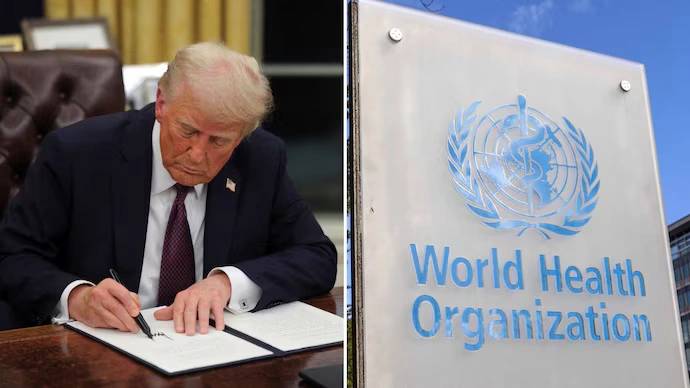
Today is the day that President Donald Trump finally pulls the United States out of the World Health Organization. This is a huge change in how global health is administered. This choice, based on years of criticism of the agency’s handling of pandemics and claims of prejudice, represents the end of a bold “America First” agenda that has split experts and countries alike.
The Announcement and the Backlash Right Away
The US left the WHO on January 22, 2026, exactly one year after Trump signed the executive order on his first day in office in 2025. This was required by law to give 12 months’ notice. During that time, the US paid off almost $260 million in debts to the UN health agency. Trump tried to withdraw out in 2020 during the COVID-19 issue, but then-President Biden stopped him. When Biden returned to government, the move gained new strength.
White House officials said that there were a lot of heated discussions behind closed doors in the weeks preceding up to the 2025 directive. People who know about the talks said that Trump’s close advisers, including health and national security professionals, showed him evidence that showed that the WHO relied too much on Chinese influence in the early stages of the pandemic response. The executive order clearly said that the organization had mishandled the COVID-19 pandemic that started in Wuhan, China, and that it had failed to make changes and give in to political pressure from member states. Some people in the administration who wanted to stay said that the US, which gives the WHO approximately 16% of its budget, had more power to make changes from within than to leave.
People reacted quickly. Tedros Adhanom Ghebreyesus, the Director-General of the WHO, said he was very sorry to lose its biggest donor. He also warned that this could put programs that fight tuberculosis, HIV/AIDS, and other dangers at risk. Officials from the European Union and delegates from low-income countries around the world condemned the move as a blow to multilateralism, saying it could make it harder for the WHO to respond to outbreaks in a coordinated way.
Historical Background and Trump’s Long-Standing Complaints
Trump has not trusted the WHO since the early days of COVID-19, when he said it was repeating Beijing’s story about where the virus came from and downplaying how easily it spread from person to person. People who worked in the White House in 2020 say that Trump was quite angry during Oval Office meetings when WHO figures said that just 1% of cases were asymptomatic. This was very different from private estimates from Chinese doctors who said the number was closer to 50%. This led to a story of institutional capture, with Trump promising at campaign rallies in 2024 to fight the corruption at the agency that is run by Chinese and business interests.
Robert F. Kennedy Jr., who has long challenged vaccine policy and international health bureaucracies, was a significant player in the 2025 resurrection. He will be the new Health Secretary. Leaked memoranda from the transition team pointed up problems with the WHO’s structure, such as the fact that decisions are made by agreement among 194 member states, emergency declarations are sluggish, and there are budget inequities where voluntary contributions are more important than assessed dues. Trump’s team saw them as obstacles to quick, US-led global health efforts. They preferred bilateral aid accords that fit with US goals.
In order to reverse Biden’s 2021 readmission, Congress has to be dealt with. The withdrawal notification followed the 1948 WHO agreement, but some Democrats tried to pass a law to stop funding cuts.
Elon Musk, who advised on efficiency and called for cutting financing to bloated UN agencies, and Vivek Ramaswamy, who said the WHO stifles innovation by prioritizing state-controlled pharma over private sector advances, were two important voices. On the other hand, Robert Malone, who is being considered for the job of CDC Director, said that there would be gaps in intelligence without WHO data sharing. However, these concerns were not as important as the anger that built up during the pandemic. The last executive order, signed at nightfall on Inauguration Day, marked a clean departure. Trump tweeted, “Time to Make Global Health Great Again – without WHO interference.”
During the notice year, the US didn’t give WHO any fresh money while paying off its debts. This caused budget problems and delays in programs. Insiders say that this “starve and exit” strategy gave the agency the most power, requiring changes like more openness in reporting outbreaks that the agency largely embraced but Washington thought were not enough.
Statistics and expert warnings about the effects on global health
The effects go far beyond only the symbols. The US gave WHO more than $700 million a year, which paid for 80% of its emergency budget. Some important programs are presently in danger:
The WHO’s top infectious killer, tuberculosis, kills 1.25 million people every year. To stop it, US-backed tests need to reach 50 million individuals in low-income nations.
HIV/AIDS programs: US money helps 25 million people around the world get antiretrovirals. If the US stopped giving money, infections might go up by 10–15% in sub-Saharan Africa, according to models by Johns Hopkins specialists.
Pandemic readiness: Last year, early-warning systems kept an eye on 1,500 occurrences. The US’s lack of presence may slow down actions by weeks, as happened with prior Ebola outbreaks.
Lawrence Gostin of Georgetown University and other experts say it is a global health crisis in the making. They expect that trust will be lost and responses to threats like mpox or new influenzas will be less coordinated. Developing countries rely on the WHO for 40% of their vaccination campaigns, and there are gaps in vaccines that make child mortality rates even worse, with 5 million children dying every year. Ironically, US companies like Pfizer and Moderna may lose their power over international standards, making it harder to export goods worth billions.
Effects on the home front and in politics
Polls reveal that 55% of Republicans support the decision because it protects sovereignty and saves money. The government wants to move WHO money to a “Department of Health Security” that will focus on biosurveillance at the border and stockpiling supplies at home. Critics, including former heads of the CDC, say there are blind spots: without WHO genetic sequencing, US laboratories would miss mutations like the ones that caused previous flu outbreaks.
There are legal problems in the horizon. The lawsuits say that the International Health Regulations treaty was broken, but Trump’s lawyers say that the president has the right to make decisions on foreign treaties. Congress is talking about a $2 billion “Global Health Independence Fund” to help with the aftermath through direct aid, which shows a shift to transactional diplomacy.
Changes in the world of politics
This withdrawal has effects on US alliances. China is now the biggest donor to the World Health Organization (WHO), which means it can dictate the story about future epidemics. Europe is rushing to fill the gap, with Germany promising an extra €500 million. India and Brazil are also making wagers during BRICS health talks. Trump’s comments at Davos this week confirmed that the military won’t go too far in other places, but health isolationism might make enemies stronger in biothreat areas.
The action goes against the post-World War II order of multilateralism in the long run. Similar withdrawals from the Paris Climate Accord and the TPP set a precedent. Experts think that Washington will negotiate with other countries in a “hub-and-spoke” approach, changing the balance of power.
Looking Ahead
Today’s US departure from the WHO shows that the country is putting national resilience ahead of collective action. While there are big risks to global equity, supporters see a more flexible US leadership that isn’t weighed down by red tape. This gamble will be put to the test in the future, and it will only work if new options come up quickly. The world is watching to see if isolation makes people stronger or weaker as Trump turns his attention to “Great Healthcare Plan” improvements at home.

