
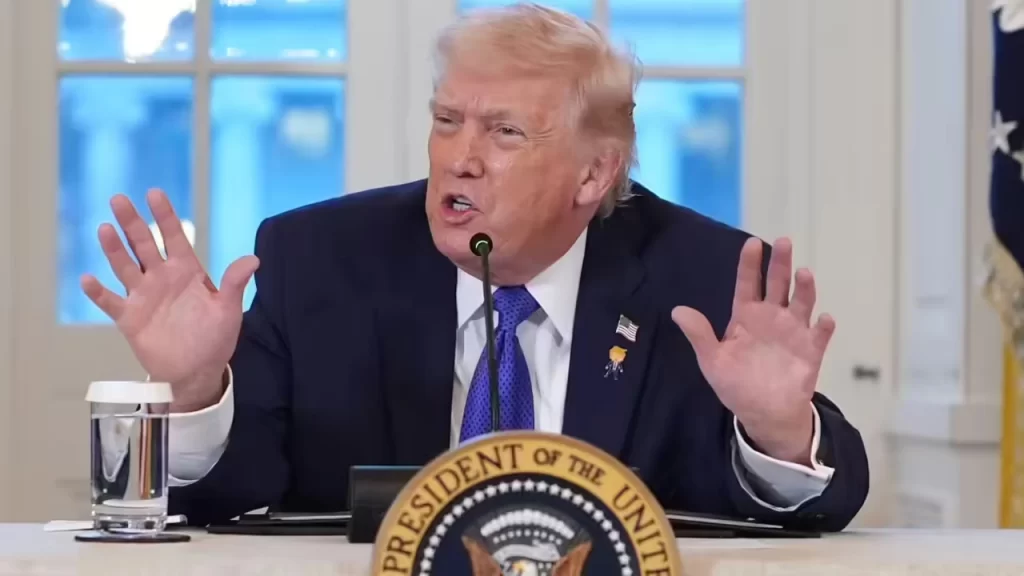
President Donald Trump has given Denmark a clear warning that he is ready to take control of Greenland “the hard way” as part of a bigger strategy for the U.S. to be the best in the Arctic. This address, which was given at the White House on January 13, 2026, depicts how tensions are rising over the strategically crucial island as the race for Arctic resources heats up.
A brief background of Trump’s ambitions for Greenland
Trump has been preoccupied with Greenland since his first term, but his reelection in November 2024 and inauguration in January 2025 brought the push back to life. The Arctic island is a separate area of Denmark with a population of about 56,000, most of whom are Inuit. It possesses a lot of rare earth minerals, oil, and natural gas that haven’t been used yet and might be worth more than $1 trillion. Greenland is now at the centre of global Arctic strategy because the melting of polar ice has made it easier to ship goods and get to resources.
The U.S. considers Greenland is very vital for keeping its people safe. Thule Air Base has been a major U.S. military base there since World War II. It aids with missile defence and surveillance. The Trump administration claims that if the US had full authority, Russia and China would not be able to grow their power in the area. As part of its Polar Silk Road program, China has built roads and other infrastructure in the Arctic. Russia has also militarised its Arctic coast. Trump famously called the 2019 attempt to acquire the land a “real estate deal,” but Denmark said no. He then said he would put economic pressure on them. The tone has changed to blatant threats now that the US has more leverage because of recent penalties on Danish corporations.
What the “Hard Way” Threat Means
In his most recent comments, Trump said, “Denmark has had enough time to make a fair deal.” If they won’t give us Greenland, we’ll take it the hard way—whatever it takes to safeguard America’s interests. This is a step up from diplomatic overtures to threats of military or economic coercion. Officials at the White House made it clear that “the hard way” means harsher punishments, cyber attacks on Danish infrastructure, and a bigger U.S. naval presence in the Arctic Circle.
From a military point of view, sending more B-52 bombers and submarines to Thule may put pressure on Copenhagen. Trump’s Arctic strategy declaration came out last month. It says that “absolute U.S. primacy” in the region is the most important thing. It sets aside $15 billion for more icebreakers and bases. Some people think this is like Cold War brinkmanship and could contravene international law because the UN Charter specifies that governments can’t use force to take over other countries.
Denmark’s response was immediate and defiant. Mette Frederiksen, the Prime Minister, branded the comments “unacceptable bullying” and stressed that Greenland has the freedom to make its own choices, as it says in its 2009 autonomy act. Greenland’s Premier Múte Egede remarked, “We are not for sale, nor conquerable,” and talked about indigenous rights and NATO pledges, because Denmark is a key member of the alliance.
The Arctic Race: A Political Stakes
The Arctic’s shift from a frozen edge to a geopolitical centre makes the problem worse. Climate warming has melted 40% of sea ice since 2000. This has opened up 13% of the world’s undiscovered oil and 30% of its natural gas reserves. Russia maintains it owns half of the Arctic seabed and has 20 icebreakers, while the U.S. only has two. As part of its “near-Arctic state” goals, China aims to develop research stations and invest in mining in Greenland.
The US has two icebreakers, Thule Base, and six submarines, and it emphasises on its interests in the Northwest Passage and a $15 billion plan that includes the Greenland push. This shows the power disparity in the Arctic. Russia says it owns half of the seabed and the northern base expansions. It has more than 20 icebreakers and 40 ice-class ships. China has two icebreakers on its Polar Silk Road, and it is investing in mining and bidding on ports in Greenland. Denmark and Greenland depend on the US-run Pituffik Space Base while claiming mineral rights and freedom.
Responses at home and abroad
The EU asked the U.S. ambassador to a meeting, and Emmanuel Macron of France said it was a “threat to post-WWII order.” Russia made fun of U.S. “hegemony” and offered Denmark security guarantees, which helped them. China didn’t say anything, but state-run media told stories about how hostile the US was. Some Greenlanders think that U.S. investment is a good way to gain money, while others are worried about losing their culture.
Greenpeace and other environmental groups are against the race for resources because they say that Greenland’s glaciers are responsible for 20% of the rise in sea level. Indigenous leaders use the UN Declaration on the Rights of Indigenous Peoples to ask for the ability to stop deals.
How it affects the law and the economy
From a legal point of view, Trump’s approach is hazardous. The 1951 U.S.-Denmark military treaty says that the U.S. can use bases in Denmark but not land. The International Court of Justice’s 1970 verdict on Namibia is an example of a case that argues you can’t annex land by force. Models predict that a trade war might cost Denmark $50 billion a year, which would also harm the U.S. partners.
But there are some: Even though there were sanctions, Russia’s invasion of Crimea in 2014 worked, which gave revisionists more confidence. Even though they don’t satisfy current criteria, Trump’s team references former U.S. purchases like Louisiana and Alaska as precedents.
Questions That Still Need to Be Answered and a Path Forward
Negotiations will start up again next week in Copenhagen. The U.S. will give $200 billion to aid with the changeover. Denmark wants Greenland to conduct a vote, but Trump can’t make it happen. The military is become more aggressive, and U.S. ships are getting closer to Greenland’s rivers and lakes.
The whole world is watching to see if diplomacy will win out or if “the hard way” will transform how we deal with the Arctic. What Greenlanders say, how alliances form, and how determined Trump is will all affect the results. As the polar ice melts, so do old truths, pushing this icy outpost into the history books.

