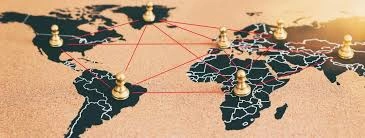
Countries are shifting their trade routes to lower the chances of penalties and violence as tensions escalate in key sections of the world. This transformation places resilience ahead of efficiency, which affects supply chains, costs, and the balance of economic power around the world.
The main reasons why trade routes change
Tensions between countries, like the U.S.-China trade war, the war between Russia and Ukraine, and the Middle East’s instability, have revealed that ancient trade routes like the Suez Canal and the Strait of Hormuz are not as strong as they used to be. Countries are using options like the Northern Sea Route and the Belt and Road Initiative lines more and more quickly to get around bottlenecks. These improvements can raise shipping costs on new routes by up to 30% and also lead to new collaborations. Ongoing U.S. sanctions against Russia and Iran make trade much harder, so exporters have to look for neutral places like Turkey and the UAE.
Effects on Key Trade Routes
Houthi attacks and upheaval in the region have made it hard for ships to get through the Suez Canal, which has slashed traffic by more than half in the past several years. Ships now have to go around the Cape of Good Hope in Africa, which adds 10 to 14 days to their trips. Drought is also causing problems for the Panama Canal, which is tripling the time it takes for ships to move between Asia and America and requiring carriers to cut drafts. Traffic congestion in the Strait of Malacca make delays worse, which makes insurers boost premiums by 20 to 50 percent and carriers merge their fleets because they are afraid of piracy. These chokepoints, which handle more than 30% of global trade, highlight how weak just-in-time logistics are during a time of hybrid warfare.
The Northern Sea Route’s rise
After the 2022 invasion of Ukraine, Western sanctions made it viable for Russia to invest in the Arctic. This has changed the game for the Northern Sea Route. It cuts the time it takes to get from Asia to Europe from 40 days to as little as 15 days in the summer, when the ice is getting thinner. State-owned firms including Gazprom and Rosneft run LNG transporters. In 2025, they witnessed more than 30 million tonnes of traffic. China wants to buy shares in these companies so they can work together with them all year round. Melting permafrost is bad for the environment, but since 2020, the amount of it has expanded by 20 times. This has affected how energy trading works and made it tougher for Europe to get LNG from Qatar.
China’s Belt and Road Initiative
The $1 trillion Belt and Road Initiative from Beijing encompasses 150 countries and builds land routes like the China-Pakistan Economic Corridor that don’t have any of the concerns in the Malacca Strait. Gwadar Port now handles 200 million tonnes of cargo a year. High-speed rail networks that are 3,000 km long connect it to Central Asia. Some parts of BRI are moving more slowly because India is angry over Himalayan passes and the West is criticising it for putting countries in debt traps. But BRI is responsible for 40% of the world’s container growth, and new routes into Iran are making it easier to get oil there. This network of infrastructure not only safeguards China’s imports of resources, but it also spreads soft power across Eurasia.
Energy trade is sending LNG tankers away from the Red Sea. This is making prices between Europe and Asia go up by 40% and speeding up the expansion of U.S. exports.
Electronics supply chains stay safe on the Taiwan Strait by using Japan-Korea lanes, which adds weeks to chip delivery times.
After the Black Sea blockades, grains from Ukraine had to move through Romanian ports, which lowered harvest margins by 15%.
Responses from Trade Blocs in the Region
The EU’s Global Gateway project, which contains $300 billion in green infrastructure, is in competition with BRI. It emphasises on naval linkages between Africa and India to make China less powerful. ASEAN strengthens RCEP integration, increasing trade between member nations to 30% of the region’s GDP with the use of digital customs and uniform standards. The AfCFTA in Africa makes it easier to get over the continent, which means that when things are unstable in the Sahel, Africa doesn’t have to rely as much on shipping across the Atlantic. It also boosts trade between African countries, which is predicted to rise from 18% to 50% by 2030. These groups suggest that regionalism is getting stronger as unilateral globalisation fades away.
Changes in technology in shipping
Businesses that have been impacted by sanctions find it easier to deal with customs when they use blockchain technology. For instance, Maersk-IBM’s TradeLens processes more than 1 billion transaction events every year to ensure sure the origins are clear. Autonomous ships and AI-driven routing use predictive analytics to discover the optimum detours, which saves 15% on fuel on longer cruises. Starlink and other satellite constellations provide reliable communication that can’t be blocked in places like the South China Sea where there is conflict. They also let 80% of flagged ships change course in real time.
What it means for the economies of countries that are still growing
India is the largest gain since the Chabahar-Mumbai corridor brings in $100 billion in trade from Central Asia and increases GDP growth by 1.5% through multiplier effects. Gwadar in Pakistan produces 100,000 jobs, but it costs $2 billion a year to keep it safe due of the threat of Baloch insurgency. Matarbari Port in Bangladesh collects Myanmar bypasses, which doubles exports. Djibouti and other small islands do well when they impose transshipment fees that are more than 10% of GDP. However, Chinese loans that make the government more subject to debt threaten its sovereignty.
Changes in the environment and long-term health
Longer detours require 40% more fuel, which adds 100 million tonnes of CO2 to the air every year and makes it harder to reach the targets of the Paris Agreement. The IMO backs green corridors, such as hydrogen-ready sections of the Northern Sea Route. Wind-assisted propulsion puts modern clippers back to life, decreasing emissions by 20% on runs between Europe and Asia. Port electrification in Singapore and Rotterdam also cuts down on emissions from ships that are not moving. Tensions unintentionally accelerate up decarbonisation since insurers boost premiums by 30% on routes with a lot of emissions.
Changes in Power and Strategic Partnerships
The International North-South Transport Corridor now connects BRICS with Iran and the UAE, bringing its total trade to $5 trillion. This means that you can take the train from Mumbai to Moscow in 15 days instead of 45 days by water. The U.S. leads AUKUS, which sends nuclear submarines to protect Pacific waterways. This discourages China from being aggressive in the Taiwan Strait. As layered sanctions stop flows, neutral hubs like Switzerland lose their advantages in re-exporting goods. This transfers $300 billion to Dubai and Singapore every year.
A Case Study on the Effects of the Red Sea Crisis
Houthi drone and missile strikes have modified the routing of 90% of Asia-Europe container ships since late 2023. This adds 4,000 nautical miles and $1 million in fuel expenses for each journey for very large ships. Maersk blocked ships from going through the Suez Canal for months, which made spot prices go up to $10,000 per FEU and left $200 billion worth of holiday goods delayed. Insurers are now removing standard coverage and increasing war-risk premiums of up to 500%. This makes prices go up by 5% to 10% over the world.