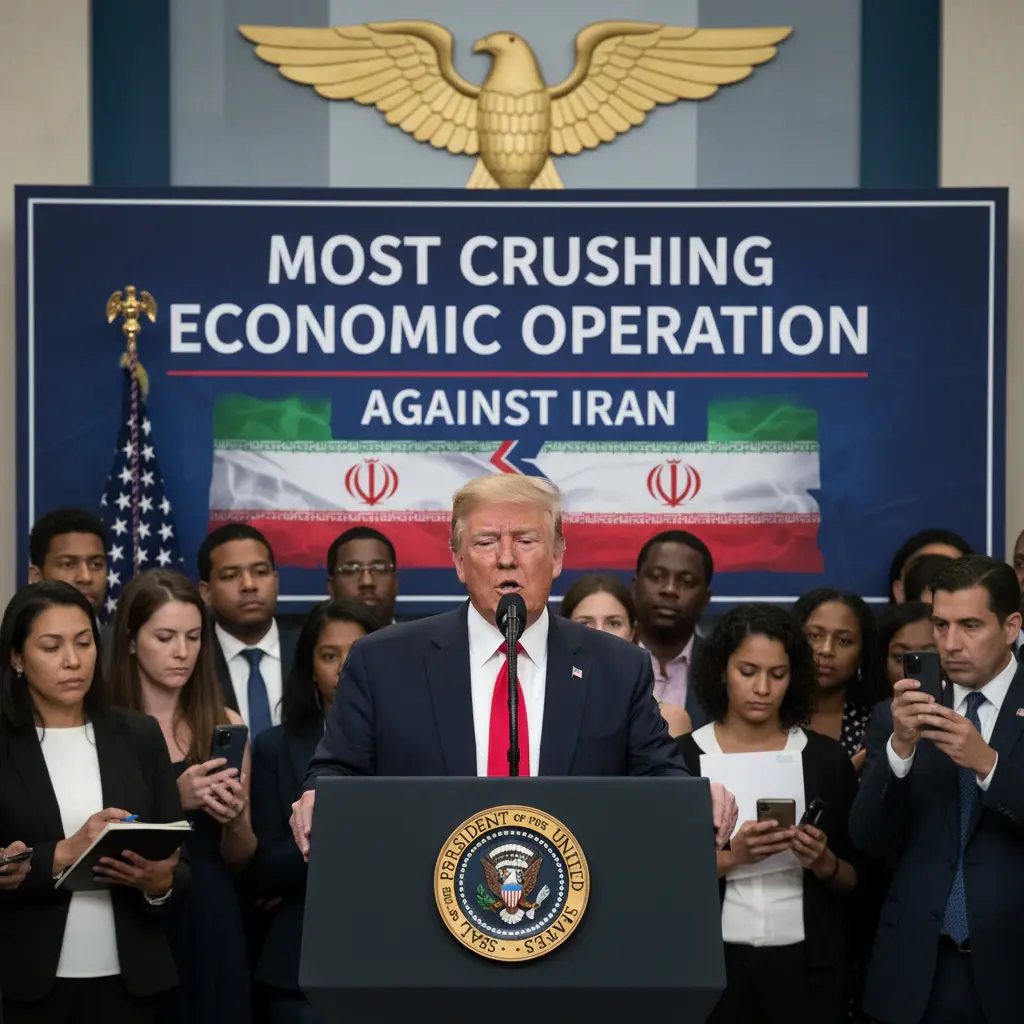
President Donald Trump has thrown down another gauntlet in the long-running standoff with Tehran, announcing on Truth Social what he called the most crushing economic operation ever launched against a nation. The declaration landed Wednesday evening, and by Thursday morning it had already rattled oil markets, drawn scorn from Iranian officials, and reignited the question that’s hung over this conflict for months: does squeezing Iran’s economy actually end a war, or does it just prolong the standoff?
What Trump Actually Said
Trump didn’t hold back on tone. In a lengthy, all-caps post, he said Iran had failed to seize the opportunity to make a deal and would now face economic warfare and isolation on an unprecedented scale. He then turned his attention outward, warning that any country letting its financial institutions, businesses, airports, or government entities offer Iran a lifeline would face tremendous economic consequences of its own.
The list of targets was surprisingly specific. Trump named oil smuggling, currency swap lines, cash transfers, exchange houses, ship registries, and front companies as channels that needed to shut down immediately. He wrapped the announcement in wartime language, branding it an “Economic D-Day” and calling on American allies to help isolate and defeat what he described as the Iran threat.
He also took a swipe at Iran’s military standing, claiming the country’s navy and air force had been destroyed and its currency rendered worthless — while reiterating a familiar red line, that Iran will never be allowed to obtain a nuclear weapon.
Context: A War That Started in February
This isn’t a sanctions push happening in a vacuum. The post came 178 days after the U.S. and Israel launched their war on Iran, and it builds on an economic pressure campaign the Trump administration has been running for months. That campaign, known internally as Operation Economic Fury, has already produced sweeping sanctions on Iran’s oil, shipping, and financial sectors, alongside a naval blockade of Iranian ports aimed at starving Tehran of energy revenue.
The timing matters too. This latest volley comes right as the Strait of Hormuz — one of the world’s most critical oil chokepoints — remains a live flashpoint. The waterway has been effectively shut since early March, and while Trump has claimed at various points that traffic is picking back up, shipping data tells a more cautious story. Weekly transits through the Strait actually fell to 73 during the week ending August 16, down from 91 the week before, according to Lloyd’s List Intelligence, as Iranian targeting of vessels and the American blockade kept most operators away.
Iran’s Response: “Psychological Warfare”
Tehran wasn’t shy about pushing back. Iranian state media dismissed Trump’s claims of economic collapse and a crippled military as delusional, framing the whole announcement as psychological warfare and just another chapter in Washington’s long-running maximum pressure campaign. Iran’s Foreign Minister, Abbas Araghchi, went further, accusing the U.S. of escalating sanctions after earlier rounds failed to force submission — and arguing that this approach is actually blocking any negotiated way out of the war, rather than accelerating one.
Oil Markets Feel the Squeeze
Traders didn’t wait for details. Brent crude ticked up as the news spread, and prices have been drifting toward five-week highs on fears that shipping disruption through Hormuz could stretch on indefinitely. Analysts watching the situation aren’t convinced the new sanctions alone will move markets much further — the bigger risk, they say, is whether Iran’s leadership responds with military escalation rather than economic retreat.
Adding another wrinkle to the picture, the United Arab Emirates — historically one of Iran’s most important trading partners — announced just a day before Trump’s post that it was cutting off trade and financial dealings with Tehran entirely, reportedly in response to Iranian missiles fired toward the Gulf state. Iran has denied responsibility, calling the accusation a false flag.
What Comes Next
Details on the actual mechanics of this new round of sanctions remain thin. Trump’s post was heavy on rhetoric and light on specifics — no formal Treasury Department rollout, no named entities, no timeline. That’s left analysts, allies, and Iranian officials alike guessing at what “crushing” will actually look like in practice, and whether countries like China, which maintains significant trade ties with Tehran, will find themselves directly in Washington’s crosshairs.
For now, the war grinds on without a diplomatic breakthrough in sight. Talks between Washington and Tehran remain stalled, the Strait of Hormuz stays a flashpoint, and both sides seem to be betting that economic pressure — rather than a return to the negotiating table — is the fastest route to an outcome they can live with. Whether that bet pays off, or simply hardens both sides further, is the question hanging over the months ahead.
Trump Unleashes “Economic D-Day” on Iran as War Drags Into Its Seventh Month.