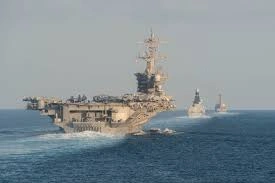
The USS Abraham Lincoln aircraft carrier strike group’s deployment to waters near Iran is a big step up in tensions between the US and Iran. President Donald Trump has said that the US will use military force if Tehran doesn’t agree to nuclear talks. This action comes after savage crackdowns on widespread protests in Iran, where many have perished, which has led to calls for regime change. Iran is doing live-fire naval maneuvers in response, and the world is watching a powder keg that might change the politics of the Middle East.
The history of US-Iran hostility
Relations between the US and Iran have been bad for decades, ever since the 1979 Islamic Revolution overthrew a US-backed monarchy and led to the hostage crisis. Tensions were at their highest during Trump’s first term, when the US pulled out of the JCPOA nuclear deal in 2018 and General Qasem Soleimani was killed in 2020, which led to Iranian missile strikes on US sites.
In his second term, President Trump has brought back a maximum pressure campaign, putting sanctions on Iranian leaders including Interior Minister Eskandar Momeni for stopping rallies. Last year’s US and Israeli attacks on Iranian nuclear sites and proxies have made Tehran weak, and intelligence reports show that the regime is in a weakened situation. This history leads up to the current issue, in which Trump wants a halt to the development of ballistic missiles and uranium enrichment.
The protests in Iran that led to the current crisis
In late December 2025, there were mass protests in Iran because to the economy’s collapse—the rial’s fall—and political repression by Supreme Leader Ali Khamenei. Security forces killed people with live bullets, tear gas, and arson. In Rasht, demonstrators were trapped in a blazing market, and survivors were shot as they tried to get away.
Human rights groups say the number of deaths is shocking: HRANA says 6,159 people have died, including 5 demonstrators and 92 children. Iran Human Rights says the number might be more than 25,000. Khamenei said that “thousands” died and blamed the US and Israel for becoming involved. The official death toll is 3,117, which includes security personnel. Since January 8, the internet has been down across the country, hiding more horrible things. However, smuggled recordings show children being shot and hurt in hospitals.
President Trump took advantage of this and wrote on Truth Social that “We are locked and loaded and ready to go” if Iran kills more nonviolent demonstrators. His words went from supporting protests to calling for regime change, suggesting that Khamenei was a “easy target.”
Military Escalation: The Armada Is Coming
The USS Abraham Lincoln carrier strike group, together with six guided-missile destroyers that could hit targets with accuracy, reached the Indian Ocean on January 26, 2026, under US Central Command. Defense Secretary Pete Hegseth said that alternatives are “ready if ordered.” The flotilla, which Trump called a “massive armada,” is ready to attack leaders, nuclear plants, or government installations from the air.
Iran responded with a two-day live-fire naval training in the Strait of Hormuz, near US warships, commencing on January 31. They also added 1,000 drones to their arsenal and promised “rapid retaliation.” Army Chief Mohammad Bagheri said that blocking the strait, which carries 20% of the world’s oil, might cause energy costs to rise. While Iran is preparing for a fight and trying to negotiate, US intelligence says that prerequisites like stopping enrichment have not been satisfied.
The US Navy has the USS Abraham Lincoln, a nuclear-powered carrier with F-35 aircraft, six destroyers, and the potential for ten or more vessels.
Iran’s responses include new drones, ballistic missiles that are constrained by previous strikes, and proxy threats from Hezbollah or the Houthis.
Risk Factors: It’s hard to eliminate Fordow’s underground enrichment site in a normal way.
Iran’s Nuclear Goals: A Constant Danger
Iran’s nuclear program, which is said to be for civilian use, has made worrisome progress: at fortified Fordow, they are enriching uranium to 60% purity, which is close to weapons-grade, and they want to build 32 additional IR-6 centrifuge cascades. After the JCPOA fell apart, IAEA access was limited, and monthly output might rise to 37 kg, which would cut the time it takes to make bombs.
Trump wants the end of permanent enrichment, limits on missile range (which are very important for Israel after 2025 intercepts), and the end of proxy funding. Tehran insists on its “peaceful nuclear technology” rights and won’t talk if it feels threatened. Analysts say such strikes might lead to a “regional nuclear cascade,” which could lead Saudi Arabia or others to get weapons.
Responses from around the world and diplomatic moves
Turkey offered to mediate, Russia received Iranian leaders, and the EU called Iran’s Revolutionary Guard terrorists. China is getting oil from other countries besides Iran because of sanctions. Israel wants action and is looking to sell Apache helicopters.
Piyush Goyal, India’s Minister of Commerce, is looking to close commerce with the US, even with tariffs. He is also balancing oil purchases from Russia. Oil markets are nervous: reserves like India’s at $709 billion help cushion shocks.
Worries about the economy and energy
A war might break out near Hormuz, sending Brent crude oil prices over $100 per barrel and hurting global GDP. Iran’s economy is in trouble because of demonstrations and sanctions, and hyperinflation is making things worse. US tariffs on its oil partners are also making things worse. Kevin Warsh, Trump’s choice for the Fed, shows that policy will be tight because of these risks.
Strategic Analysis: Trump’s Math
Trump thinks Iran is weak after the strikes and protests in 2025, so he uses the armada to get a “better deal.” There are options like targeted executions or nuclear hits, but no choice has been made yet. Critics are worried about a quagmire, like what happened in Iraq, while supporters see a chance for the regime to fall apart.
Iran’s Foreign Minister Abbas Araghchi is open to “fair” discussions, but he won’t give up enrichment. Even though there have been blackouts, protests continue, with “everyone knowing someone killed.”
USS Abraham Lincoln Deployment Sparks US-Iran Tensions: Trump’s Armada Signals Possible Attack During Nuclear Standoff and Protests in Tehran