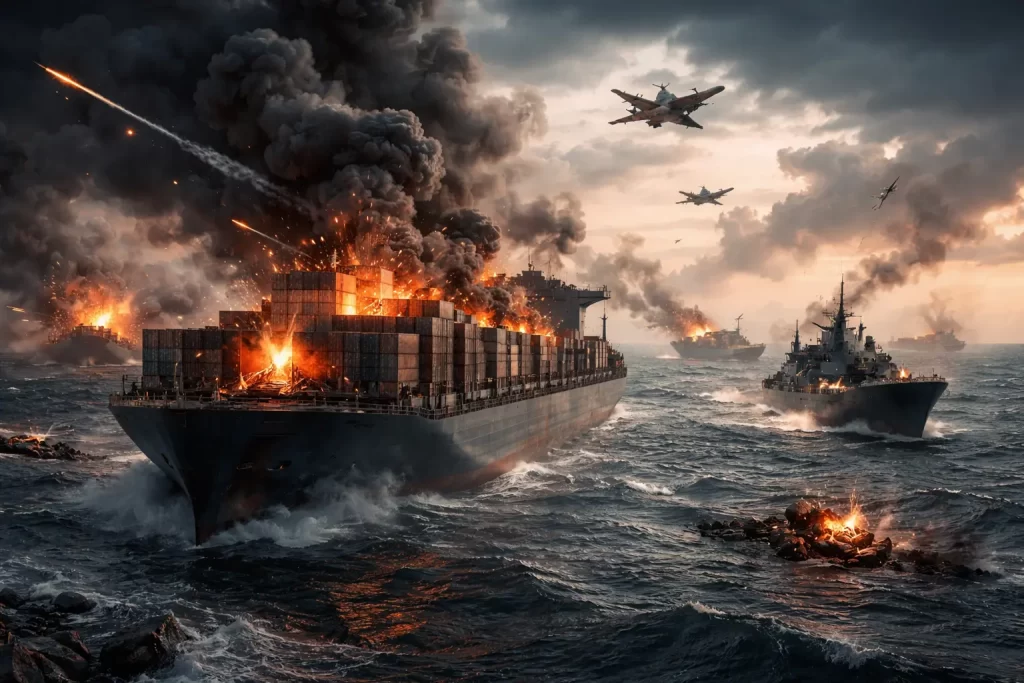
There is a quiet crisis unfolding on the water — one that does not make front pages as often as airstrikes or diplomatic ultimatums, but whose consequences reach into every grocery store, every petrol station, and every factory floor on the planet.
The 2026 global shipping crisis has moved from the periphery to center stage. The situation is unfolding rapidly, and the numbers are troubling.
A strike that rattled the Gulf.
This incident represented yet another troubling addition to the series of attacks on commercial ships navigating the waters near the UAE.
Discovery Alert The explosion occurred in uncomfortably close proximity to a bulk carrier, suggesting deliberate targeting rather than stray fire.
This was not an isolated incident. A similar incident east of Ras Laffan in Qatar on March 19 indicates that threats are expanding across waters surrounding the Strait of Hormuz, creating a broader zone of maritime risk. Discovery Alert What had once been a regional security concern has become an active threat to the arteries of global trade.
Maritime security firm Vanguard noted elevated risk of misidentification between naval and commercial vessels, increased likelihood of disruption to tanker traffic, and increased risk to US, Israeli, and Western-flagged ships. Seatrade Maritime For the crews aboard those vessels — ordinary seafarers doing their jobs thousands of miles from home — this is not geopolitics. It is a daily reality.
The Strait of Hormuz: The World’s Most Critical Chokepoint — Now Effectively Shut
To understand why this UAE maritime attack matters so profoundly to the rest of the world, you need to understand what flows through the Strait of Hormuz on an ordinary day.
This disruption has affected about 20% of the world’s daily oil supply and significant volumes of liquefied natural gas, prompting major shipping firms to suspend operations in the area. Wikipedia When that percentage disappears from global markets, the effects are not gradual — they are immediate and brutal.
Brent crude oil prices surpassed $100 per barrel on March 8, 2026 for the first time in four years, rising to $126 per barrel at its peak. The closure has been described as the largest disruption to the energy supply since the 1970s energy crisis. That framing — the 1970s energy crisis — should give everyone pause. That was the disruption that reshaped the global economy, triggered fuel rationing in Western nations, and fundamentally altered how the world thought about energy security. What is happening now carries comparable weight, and the logistics crisis shows no sign of easing quickly.
Major Carriers Abandon Routes — And the Costs Explode
The response from the world’s largest shipping companies has been swift and decisive. When missiles and drones are in the air, commercial logic is simple: get out, or stay out.
MSC instructed all vessels currently operating in, and en-route to, the Gulf region to proceed to designated safe shelter areas until further notice, and suspended all bookings for worldwide cargo to the Middle East. Maersk suspended all vessel crossings through the Strait of Hormuz until further notice. CMA CGM instructed all vessels in and outbound for the Gulf to proceed to shelter and suspended Suez Canal passage.
The rerouting decisions that followed are adding staggering time and cost to every shipment. Services are being rerouted via the Cape of Good Hope, adding an estimated 10 to 14 days to Asia-Europe transit times. 7emirates Ten to fourteen extra days per voyage, multiplied across hundreds of vessels, adds up to an almost incalculable disruption to global supply chains.
And that is before you factor in the surcharges. War risk surcharges of $1,500 to $4,000 per container have been added by all major carriers. If your container was priced at $2,000 before the crisis, you are now looking at $4,000 to $6,000 for the same shipment — and that is if a carrier even accepts the booking.
Insurance Markets Signal a New Era of Risk
Perhaps the most telling sign of how seriously the maritime industry is taking this situation comes not from the ports, but from the insurance markets.
Several marine insurers including Gard, Skuld, NorthStandard, the London P&I Club, and the American Club have issued cancellations of war risk cover for ships in Iranian waters, the Gulf, and adjacent waters, effective from March 5. Japan’s MS&AD Insurance Group has separately suspended underwriting of war risk policies for waters around Iran, Israel, and neighbouring countries. The Joint Maritime Information Centre has elevated the regional maritime threat level to CRITICAL.
When insurers — institutions built on calculating and pricing risk — begin refusing to underwrite voyages at any price, that tells you something fundamental has changed. The oil shipping risk in this region is no longer theoretical. It is actuarial fact.
Food, Fertilizer, and the Forgotten Consequences
The energy headlines are loud and unavoidable. Less visible — but potentially more lasting — are the disruptions to food supply chains.
The Gulf region produces nearly half of the world’s urea and 30% of ammonia, with about one-third of the world’s fertilizer passing through the strait. Urea prices have increased by 50% since the start of the war, as of late March 2026. Fertilizer prices at planting season is not an abstract economic indicator. It is the difference between a viable harvest and a failed one — and the populations most vulnerable to food price shocks are those least able to absorb them.
Professor Ben Fahimnia, who specialises in supply chains at the University of Sydney, warns: “If 20 per cent of globally traded supply is disrupted, then the price rises everywhere.” Scan Global Logistics Everywhere. Not just in Gulf states. Not just in countries adjacent to the conflict. Everywhere.
A Crisis Without a Clear Exit
As one analyst observed: “One week of direct impact can easily translate into more than a month of structural disruption, including increased port congestion.” Scan Global Logistics The shipping crisis of 2026 did not begin in a day, and it will not end in one either. Even when the guns fall silent, rebuilding trust in these routes — convincing insurers to return, carriers to resume, crews to sail — will take months.
On April 2, Iran said it will allow Philippine-flagged vessels and Filipino seafarers to cross the strait following talks Wikipedia — a small, tentative step, but a signal that diplomacy has not entirely given up on finding a way through.
The seas have long been humanity’s highways. What happens when those highways close is not just a shipping story. It is everyone’s story.
When the World’s Shipping Lanes Become a War Zone