I did everything “right” for years: watching calories, going to the gym five days a week, and eating low-fat foods. The scale rarely moved. I’d lose weight, then gain it back and more. It drove me crazy. I believed I just didn’t have enough willpower or wasn’t trying hard enough.I learned about insulin, and all of a sudden, everything made sense.
People know that insulin is linked to diabetes, but they don’t know that this hormone is actually in charge of weight reduction. If your insulin levels are always high, you can be doing everything else right and still not be able to lose a single pound.
Let me tell you why and, more importantly, what you can do about it.
What Insulin Really Does in Your Body
Your pancreas releases insulin when you consume, especially when you eat carbs.Its major duty is to assist transfer sugar (glucose) from your blood into your cells, where it can be used to make energy.
Insulin is like a key that opens your cells so that glucose may get in. This is a great method when everything is operating right. When you eat, your blood sugar goes up, insulin is released, glucose gets into your cells, and your blood sugar goes back to normal
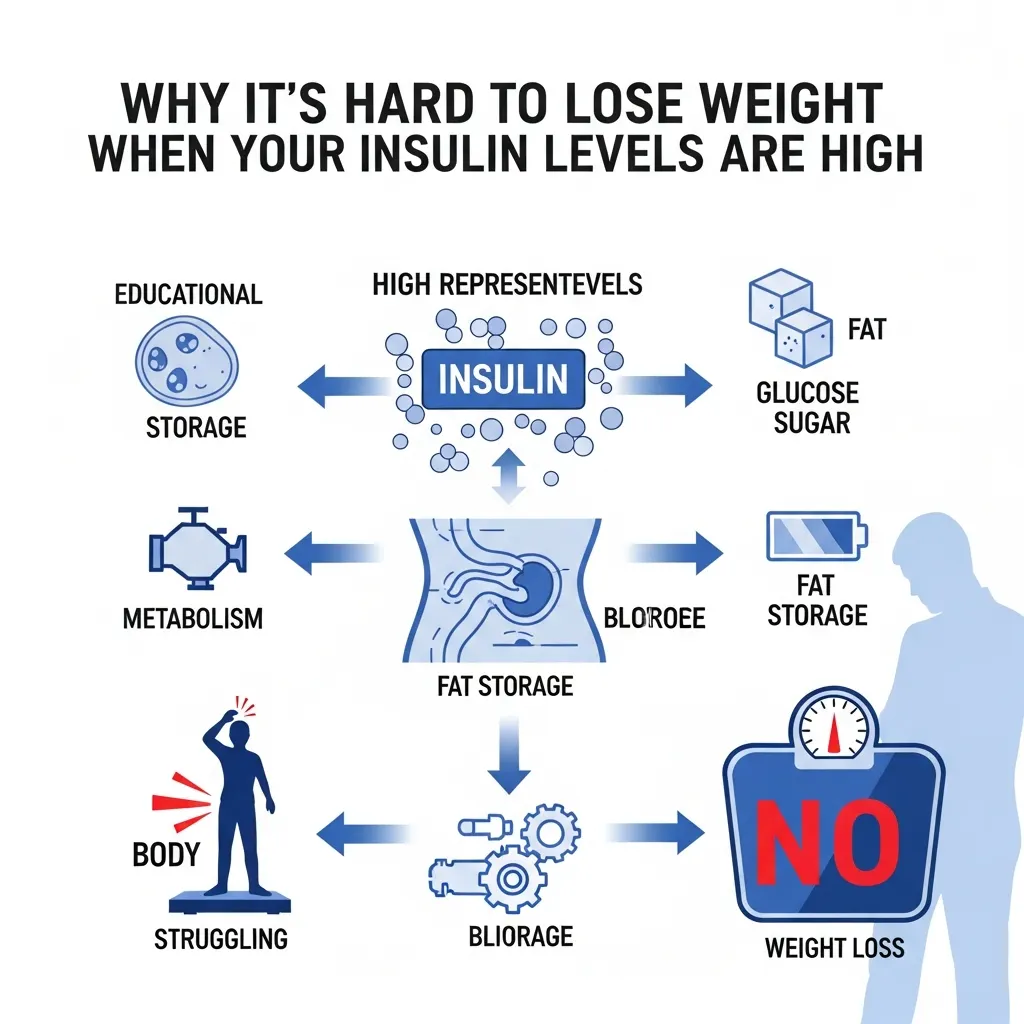
It has another important purpose that has a direct effect on your weight: it is the main hormone that stores fat in your body.## Insulin: The Signal Your Body Uses to Store Fat
When there is insulin in your blood, it signals your body to keep energy instead of using it. It’s like a switch that tells your body to “store” things.
When your insulin levels are high, your fat cells get a strong message: keep the fat you have and turn any extra energy into more fat. Insulin also stops the enzymes that break down fat for energy from working.I call insulin the “fat-locking hormone” because when it’s high, your fat cells are basically locked shut. No matter how little you eat or how much you work out, you can’t get to the energy stored in them.
I recall learning this and having a “aha” moment. I was maintaining my insulin levels high all day long while I ate six little meals a day to “boost my metabolism.”My body was always in storage mode, so it never had an opportunity to burn fat.
The Bad Cycle of Insulin Resistance
This is when things get really bad, and millions of individuals are locked in this trap without ever knowing it.
Your body is always making insulin when you eat things that raise your blood sugar, like refined carbs, sugary snacks, and processed foods. Eventually, your cells get tired of being hit by insulin all the time. They stop paying attention to its indications.This is what happens when your cells get resistant to insulin. Your pancreas has to make more and more insulin to obtain the same effect. You now have both high blood sugar and high insulin in your blood.
You store more fat because of the excess insulin. The fat that is accumulated makes your cells even less sensitive to insulin.This makes your body make even more insulin. And it goes around and around.
My doctor said to picture someone banging on your door every five minutes, all day, every day. You would eventually stop paying attention to the knocking, right? That’s what your cells do with insulin when they get it all the time.The worrying thing is that you might be insulin resistant for years before you get type 2 diabetes. The elevated levels of insulin are making it almost tough to lose weight during that time.
Why You Always Feel Hungry When Your Insulin Is High
One of the most annoying things about having trouble with insulin is always being hungry.And I mean all the time, like when you have a meal and then an hour later you feel hungry again.
You don’t have self-control, but there is a reason for this.When you eat something that quickly raises your blood sugar, such white bread, sugary cereal, or a muffin, your insulin levels go up to deal with the sugar spike. But here’s the catch: insulin does its job really well. At times, it removes too much sugar from your blood, leading your blood sugar to drop below where it started.
When your blood sugar drops, you are quite hungry. Your brain is begging for more glucose because it thinks you’re running out of energy.So you eat again, your blood sugar goes up again, and insulin goes up again. This cycle keeps on.
I used to assume I was just someone who “had a big appetite.” I’d have breakfast and be starving by 10 AM. I now know that it wasn’t hunger; it was my blood sugar going up and down, with insulin guiding the ride.In the meantime, what about all the fat you’re trying to burn? Still locked up and out of reach since your insulin levels never dip low enough for your body to use those reserves.
The Unseen Causes of Insulin Spikes
You could be saying to yourself, “Okay, I’ll just stay away from candy and sugar.” That’s a good start, but there are many more things that can make your insulin levels go up.
Refined carbs like white bread, pasta, white rice, crackers, and most breakfast cereals break down into sugar quickly and cause a big surge in insulin.Your body doesn’t really tell the difference between a bowl of Frosted Flakes and a bowl of normal cornflakes. Both turn into glucose quite quickly.
Another secret cause is eating a lot. Every time you eat, even if it’s a “healthy” small meal or snack every few hours, your body releases insulin. Your insulin never gets a chance to get back to normal if you eat six times a day.I discovered this the hard way. I was following the usual advise to eat every two to three hours to “keep my metabolism going.” But all I was doing was keeping my insulin levels up and my fat stores locked.
Stress and not getting enough sleep can also elevate insulin levels. When you’re anxious or don’t get enough sleep, your body releases cortisol, which raises blood sugar and makes more insulin.It’s another bad cycle.
Why working out alone isn’t enough
For years, I was upset that I could go to the gym every day, work out hard, and still not lose weight.
I don’t mean to sound rude, but exercising is good for your health. It makes your heart stronger, builds muscle, and makes you feel better. But if your insulin levels are always high, exercise alone won’t help you lose weight.If insulin is keeping your fat stores shut, exercise can’t get them open. Your body may burn some of the food you just ate, but it can’t get to the fat you want to lose.
Some kinds of exercise can even raise insulin levels for a short time.This is especially true if you undertake extensive aerobic sessions that use up your glycogen stores and then consume carbs to recharge.
People who can lose weight by working out alone frequently don’t have insulin resistance. Their bodies can still get to fat stores before, during, and after workouts.But you need to take care of your insulin resistance first.
The Low-Fat Diet Disaster
Here’s something that might surprise you: the low-fat diet fad that was popular for decades undoubtedly made the insulin problem worse for millions of people.
Food companies stripped the fat out of their products and added sugar and refined carbs to make them taste pleasant. Yogurt with no fat? Full of sugar.Dressing for salad with little fat? It has a lot of high-fructose corn syrup in it.
People ate these low-fat items because they thought they were healthier, but they were actually making their insulin levels go up all day. And because fat makes individuals feel full, taking it out made them hungrier, so they ate more often.
I remember when in the 1990s and early 2000s, I bought anything that was fat-free. I felt I was being quite strict.In actuality, every “healthy” snack I ate definitely made my insulin resistance worse.
Fat doesn’t raise insulin levels very much. Protein boosts it a little bit. Carbohydrates, especially refined ones, make it go up a lot. But we were told to be afraid of fat and eat a lot of carbs.How to Lower Your Insulin Levels and Get Free
Okay, that’s enough bad news. Let’s speak about remedies because you can definitely lower your insulin levels and start losing weight.
Let your body take breaks from eating. This is really important.Your insulin levels go down when you don’t eat. That’s when your body can finally use the fat it has stored. You don’t have to fast for a long time. Just extending your overnight fast to 14 to 16 hours can make a major effect.
I began by not eating breakfast and having my first meal at midday. I found that I wasn’t always thinking about food after two weeks.My energy level stayed the same. And I started to lose weight without even trying.
Eat fewer refined carbs. You don’t have to go completely carb-free or full keto (though some people find that helpful). Just cut back on the processed foods like white bread, pasta, pastries, sugary drinks, and most breakfast cereals.Instead, consume foods that don’t raise insulin levels as much, including veggies, proteins, healthy fats, and if you must eat carbs, choose ones with fiber, such sweet potatoes, quinoa, or legumes.
Stop snacking all the time. Every time you eat, even a modest snack, your body releases insulin. If you consume three full meals a day, you probably don’t need to snack in between.Allow your insulin levels to decline between meals.At first, this was hard for me because I had been persuaded that snacking was important to “keep my metabolism up.” But once I stopped, I found I wasn’t really hungry between meals; I was just used to eating.
Put protein and healthy fats first. These nutrients fill you up and don’t raise insulin levels as much as carbs do. These foods, like eggs, fish, poultry, almonds, avocados, and olive oil, will fill you up and keep your insulin levels steady.
Get moving on a regular basis. Exercise alone won’t lower elevated insulin levels, but it will assist.Building muscle helps your body respond better to insulin because muscle tissue is more responsive to insulin than fat tissue. Just walking after meals can help keep blood sugar levels from going up too high.
Take sleep seriously. I know this sounds dull, but not getting enough sleep makes insulin resistance worse. Get 7 to 9 hours of good sleep.Your hormones, including insulin, will be grateful.
What Really Happens When You Lower Insulin
Your body can now accomplish what it’s been trying to do all along: use stored fat for energy.
When insulin levels go down, the fat-locking mechanism lets go. Your body can get to those fat deposits you’ve been dragging around. You start to lose weight without feeling hungry all the time or being tired.
You don’t have to ride the blood sugar rollercoaster anymore, so your energy levels stay stable. A lot of people say their minds get clearer, and the brain fog that comes in the afternoon goes away.You feel better because you’re not always hungry.
I found that my clothes fit differently after a few weeks of reducing my insulin levels.My wedding ring came off. The tummy fat that had been there for years started to go away. And I wasn’t starving or miserable; I was eating meals that filled me up and feeling better than I had in years.
Blood tests often indicate big changes as well, such as lower triglycerides, higher HDL cholesterol, and fewer inflammatory markers. These modifications are the ones that will genuinely help your health in the long run.The Patience Factor That No One Talks About
I have to be honest with you: your body needs time to repair if you’ve had high insulin levels for a long period. You won’t be able to reverse insulin resistance in a week.
Some people notice changes right away, within a few weeks. Some people take a few months. It could take six months or more to get your insulin sensitivity back to normal if you’ve been resistant to it for a long period.A lot of individuals lose hope and give up at this point. They modify their ways, but don’t see results right away, so they go back to their old ways.
Don’t be that person. Even if the scale isn’t moving yet, your body is getting better. Your cells are getting better at responding to insulin.Your metabolism is getting better. You won’t see changes on the outside until these changes happen on the inside.
For about six weeks after I started working on reducing my insulin, I didn’t see any big weight loss. But when it started, it was consistent and long-lasting, not the cycle of losing five pounds and gaining seven that I had been caught in before.## Why Your Doctor Might Not Have Told You This
I was upset that none of the doctors I saw regarding my weight problems had ever brought up insulin resistance or advised evaluating my fasting insulin levels.
They would check my blood sugar and declare it was “fine,” which meant I wasn’t diabetic, and then they would encourage me to eat less and work out more. Thanks, doctor. Very useful.
The issue is that regular blood tests only examine your blood sugar and not your insulin levels.Your pancreas works extra hard to keep your blood sugar in check, so you might have normal blood sugar while your insulin levels are really high.
By the time your blood sugar is high enough to worry a doctor, you may have been insulin resistant for years, and the damage is already done.
If you think you might have insulin resistance, tell your doctor that you want a fasting insulin test, not only a glucose test. An even better option is to ask for an oral glucose tolerance test that also measures insulin levels. These tests demonstrate what is truly happening.The Bottom Line: Insulin Is the Key
I used to think that losing weight was all about calories and willpower. I was hard on myself for not being able to stick to diets and for being “weak” and “undisciplined.”
Knowing how insulin works altered everything. I didn’t lack willpower; my body was biochemically locked in fat-storage mode, and no amount of willpower could change that.
If you have high insulin levels, losing weight is very hard, if not impossible.It’s like trying to get water out of a boat while someone else is continuously putting water in. You might get a little better, but it’s going to be hard.
Once you know how insulin works and do things to keep it in balance, losing weight is a lot easier. Not easy—there’s no magic bullet—but your body finally works with you instead of against you.
If you’ve been trying to lose weight and doing everything correctly but still not getting results, check your insulin levels. This one hormone that no one talks about enough might be the answer you’ve been looking for.
Lower your insulin levels, free up your fat storage, and let your body do what it’s been trying to do all along.