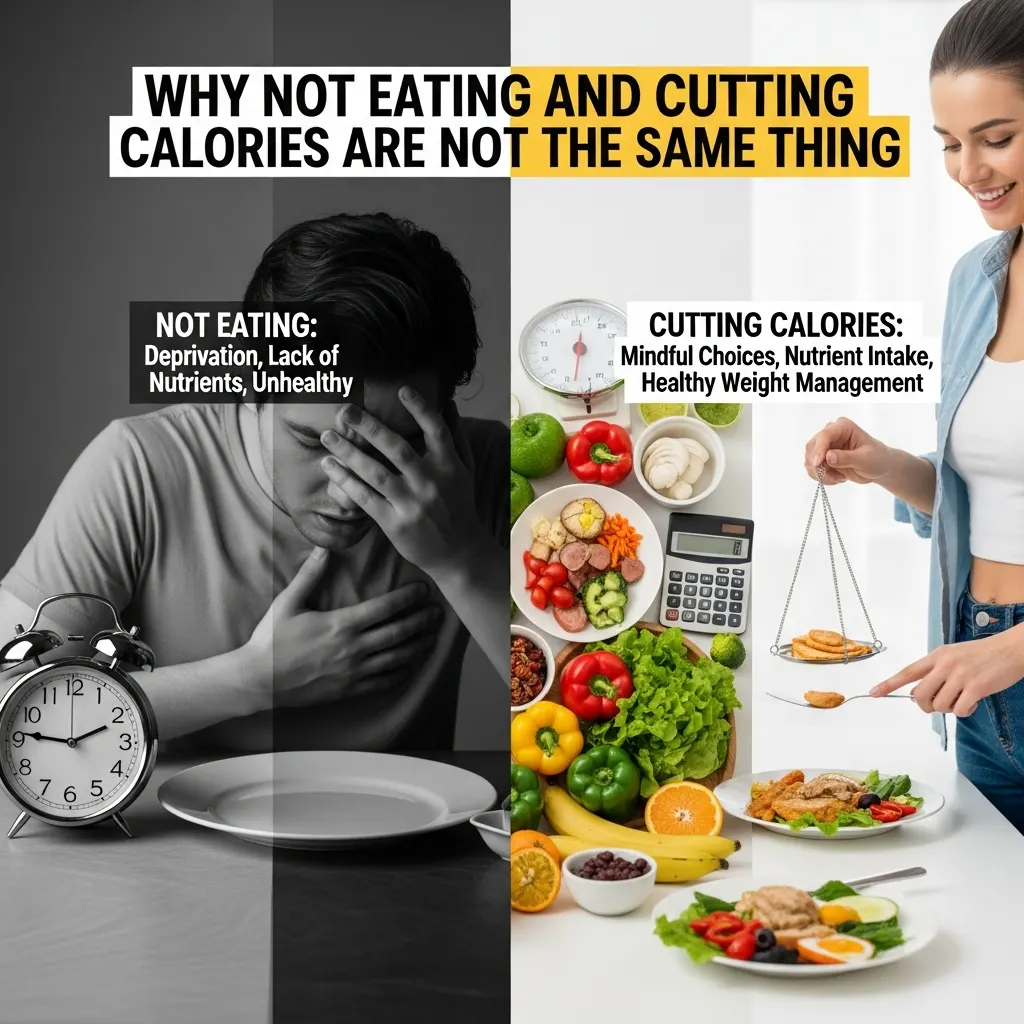
I’ve talked about this maybe ten times: someone tells me they’re fasting, and when I ask them about it, they say they eat little meals all day to keep their total calories low. Someone can pretend they’re cutting back on calories, but they’re actually eating all their food in a four-hour period.
I get why you’re confused. Both ways include eating less than you normally do, and both can help you lose weight. But here’s something most people don’t know: fasting and decreasing calories are two very different ways to lose weight that have very different consequences on your body.
This gap changed everything for me, and it might change everything for you too.
What does it actually mean to limit calories?
Let’s start with the basics. Calorie restriction is easy to understand: you’re eating less calories than your body burns every day. You used to eat 2,500 calories per day, but now you only eat 1,800. The math seems easy: reduce weight by eating fewer calories than you expend.
This is the main idea behind practically every diet you’ve heard of. When they work, Weight Watchers, keto, paleo, and Mediterranean diets all help you eat fewer calories than you burn. The exact rules and food restrictions are just two different ways to get you to that deficit.
Most calorie-restricted diets urge you to eat little amounts of food all day long. Three meals and maybe a few snacks. The idea is to keep your metabolism going and preventing you from getting too hungry. You’re eating less, but you eat a lot.
I tried this strategy for a long time. I’d use an app to keep track of every mouthful and figure out how much I was eating. I’d also eat my meals at different times. It worked sometimes, at least for a while. But I always felt like I was fighting hunger.
What Fasting Is
Fasting is something else entirely. You might not be eating less calories, but you are eating at certain times.
The most common variety is intermittent fasting. You could eat all of your meals in eight hours and then not eat for 16 hours. You might also try fasting every other day, eating normally one day and very little the next. Some people fast for extended lengths of time, such 24, 48, or even 72 hours. But this is more advanced.
This is the most crucial part: during your eating window, you may eat the same number of calories that you do now. Someone who is doing 16:8 intermittent fasting could eat 2,500 calories between noon and 8 PM and not gain weight, or they could eat 1,800 calories at that time and lose weight.
The magic isn’t only in the calories. It’s also in how long you can go without eating.
The metabolic difference that no one talks about
This is where things get very interesting, and I wish someone had told me about it years ago.
When you eat tiny meals often on a low-calorie diet, your body never completely stops being “fed.” Every time you eat, even if it’s just a small snack, your insulin levels go up. Your body stops burning fat and starts breaking down the food you ingest. You eat again a few hours later, and the cycle starts all over again.
Your body is continually attempting to digest food. When someone else is cooking, you never really get ahead when you try to clean your kitchen.
When you don’t eat, something else happens. After around 12 hours without eating, your body runs out of quick-access glucose stores. Your insulin levels go down a lot, and your body adjusts how it uses energy. It begins to make ketones and use fat as fuel.
I remember the first time I made it past 12 hours and felt the difference. The hunger I’d been fighting just… went away. My energy level didn’t change. I didn’t see why I should be fatigued without eating. Let me tell you about it.
When you eat six small meals a day on a conventional calorie-restricted diet, your insulin levels stay high all the time. It may not be as high as it would be if you were eating too much, but it never really gets back to normal. It’s like attempting to take money out of a bank account while someone keeps putting in small sums. You never actually get to spend your savings.
Insulin gets a break while you fast. When you fast for a long time, your insulin levels go far down. Your cells become more open to it again, and your body can finally use the fat you’ve been trying to burn.
Insulin isn’t the only thing, though. Fasting alters hormones that control metabolism, like norepinephrine, growth hormone, and others. No matter how low you go, these changes don’t happen when you just eat less.
For two years, my friend Dave ate six times a day and only 1,500 calories. He didn’t drop any weight. He started eating the same 1,500 calories in six hours instead of eight, and he started to lose weight. Same number of calories, yet at various times and with quite varied results.
The Hunger Factor: A Shocking Change of Events
People are really surprised by this: fasting typically makes you less hungry than eating a bunch of small meals.
I know, I know—it sounds wrong. I thought this was crazy at first. How can not eating make you less hungry?
But think about what happens when you eat a lot of calories. You have a small breakfast, and then two hours later you’re hungry again. You consume a snack, which makes you feel better for a time, but then hunger comes back with a bang. You can’t stop thinking about food, fighting cravings, or checking the clock to see when your next meal is.
Every time you eat, even a small bit, your body thinks it needs more food. Your insulin levels swing up and down, which makes hormones that make you hungry go up. You are virtually always in a state of semi-hunger.
After the first few days of fasting, when your body gets adjusted to it, something strange happens. Your body becomes acclimated to it. Your hormones that make you hungry become more stable. Many people report they don’t think about eating at all when they are fasting.
If I didn’t eat for three hours, I would get shaky and irritated. I now fast for 18 hours every day and feel terrific, sometimes even better than when I used to eat all the time.
The Issue with Metabolic Adaptation
Let’s talk about something that most diet books don’t tell you: when you eat less for a long period, your metabolism fights back.
Your body is smart. Your body learns to burn fewer calories when you eat less all the time. Your metabolism slows down, you feel tired and cold, and your body starts to use muscle for energy. This is why people get trapped on diets and why it’s so hard to keep the weight off.
Studies show that people who lose weight by cutting calories often have metabolic rates that are 200–300 calories lower than those of people who are the same weight but don’t diet. That’s a major issue.
Fasting seems to stop this slowing in metabolism. Studies show that intermittent fasting is better for your metabolism than always lowering calories. Some studies even show that your metabolism speeds up when you fast because your body tends to burn more fat.
Why? This may be because fasting is more in line with how humans evolved. Our ancestors didn’t consume six small meals a day. There were times when they had a lot of food and times when they didn’t. Our bodies are built to handle this rhythm without going crazy and slowing down metabolism.
Autophagy: The Cleanup Crew You Didn’t Know You Had
I wish more people understood about this difference between fasting and calorie restriction.
Autophagy is the process by which cells break down and recycle themselves in the human body. Autophagy is the process by which your cells get rid of garbage that has built up over time. It breaks down and recycles damaged parts. It’s like spring cleaning for your cells.
This phase is highly important for staying healthy, living a long time, and aging healthily. It helps stop cancer, neurological diseases, and difficulties with metabolism from happening.
When you fast for a long time, autophagy really speeds up. It starts to work when the organism isn’t busy eating. Even if you’re cutting back on calories, eating a lot stops autophagy from happening.
You can get very little autophagy by spreading 1,200 calories out over the course of the day. You could also fast for six hours and eat 1,800 calories, which would initiate a lot of autophagy. It’s more crucial when you eat than how many calories you eat to start this process.
Keeping muscle is a big difference.
One of the biggest things that terrifies people about fasting is losing muscle. I was worried about the same issue. Everyone knows that you need to eat protein every few hours to keep your muscles strong.
It turns out that isn’t entirely right.
When you cut back on calories in a normal way, especially if you do it for a long period or really severely, you often lose both fat and muscle. Your body needs energy, and if you don’t eat enough, it will break down muscle to get it.
Fasting is good for preserving muscle, which is surprising. When you fast, your body makes extra growth hormone, which helps protect muscle tissue. And when you do eat, you can receive enough protein to maintain your muscles healthy and help them grow.
The most significant point is that fasting is not always the same. You eat and then don’t eat again, which seems to tell your body to keep muscle better than eating extremely low calories all the time.
Intermittent fasting has helped me keep my muscle mass and strength, which I couldn’t do with regular eating. This happens to everyone who fasts correctly, not just me.
What should you do?
I’m not here to tell you that fasting is helpful for everyone or that limiting calories never works. There are good and bad things about both, and to be honest, some people do both: they fast and eat less than they need to.
If you like having a plan for your meals and sticking to it, if you have health problems that make you need to eat regularly, if you’re an athlete who trains a lot, if you feel better when you eat often, or if the thought of skipping meals makes you anxious, calorie restriction might be better for you.
If you’ve hit a plateau with regular dieting, find it hard to stay full on low-calorie diets, or want the cellular and longevity benefits that come with decreasing weight, fasting might be good for you.
- You have insulin resistance or type 2 diabetes (with medical supervision) – You’d rather not have to count and measure stuff.
Some people do well with a combination of both, such eating in a time-restricted method (like 16:8) and keeping their calories low. You get the greatest aspects of both plans with this.
The one thing about lifestyle that everyone forgets
I’ve tried both ways, and the greatest diet is the one you can stick to.
When you’re cutting back on calories, you have to continually be on the alert. You are continually keeping track, measuring, and planning. Some people think this arrangement is helpful. Some people, like me, find it tiring and hard to keep up with.
Fasting is fairly easy if you get used to it. You either eat or you don’t. You don’t have to worry about if that handful of almonds fits into your macros because there are no gray areas. The easiness is liberating.
But it can be challenging to fast around others. If your family always has breakfast together or your coworkers always have lunch together, you could feel left out. When you’re with other people, it’s easier to stick to a standard calorie limit. You can always eat whatever you want; you simply eat less.
Think about who you are, how you live, and what you can stick with for a long period. Short-term gains don’t matter if you can’t stick to the plan.
The Bottom Line: It’s More Than Just Calories
If someone had told me ten years ago that when you eat is equally as important as what you eat, I would have rolled my eyes. Do you know how many calories you eat and how many you burn? That’s what I always thought.
But the data is clear: fasting and cutting back on calories initiate different metabolic processes, produce different hormones, and have different impacts. These are not the same strategies; they are totally distinct ways to consume and keep your metabolism healthy.
The math underlying calorie restriction is easy: eat less than you use up. Fasting is all about timing: you need to give your body substantial breaks between meals to get it into optimum metabolic states.
You can lose weight using either way. But the big differences are in the quality of the weight reduction, how it changes your hormones and metabolism, how long it lasts, and the health benefits that go beyond the scale.
This difference changed how I think about food, losing weight, and my metabolism health. Instead of always limiting my body, I started working with it by timing things appropriately.
It could assist you too. Fasting and limiting calories are not the same thing; you need to know how your body works and choose the strategy that is best for your health.