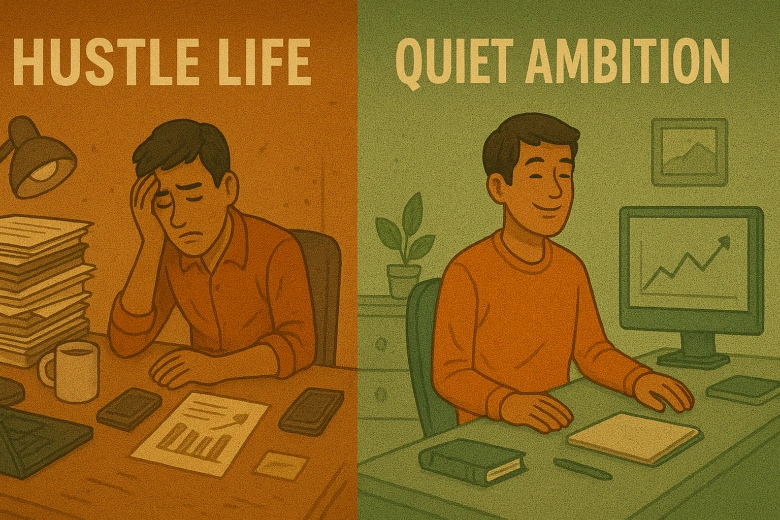
People usually say to work hard and keep busy, but things are really different right now. People all throughout the world are choosing to live a “quiet life” instead of one that is full of “hustle.” They are placing their work behind their mental health, critical connections, and happiness. Thoughts about what life will be like after the epidemic and changes on social media have helped this movement grow.People don’t want to live in ways that make them tired. Instead, they want to live a slower, more meaningful existence. “Living a quiet life” is no longer just a small desire. It’s a movement that’s getting bigger and making individuals happier, altering their jobs, and changing society.
The Rise of Hustle Culture and Its Hidden Costs
In the 2010s, the hustle culture started because online billionaires, motivational speakers, and influencers told people they had to work 80 hours a week, have side jobs, and never take a break. Gary Vaynerchuk and others made words like “crush it” and “hustle harder” famous. Being fatigued was something to be proud of. There were a lot of good photographs on social media of people working out early in the morning, late at night, and winning millions of dollars. This made it seem like hard work always paid off.
People are losing faith because of this bad part of the hustling culture. When famous people like IT CEOs and celebrities talked about going to therapy for workaholism, it helped other people comprehend the issue better. The tranquil life is the answer since it brings peace instead of tension.
What does it mean to want a tranquil life?
You don’t have to stay home or be lazy just because you’re calm. You can choose to live simply, be in the moment, and enjoy the little things in life every day. It all began with viral TikToks and books like “Digital Minimalism” by Cal Newport and “Soulful Simplicity” by Courtney Carver. It tells people to take their time, create friends, and do things that make them happy instead of those that make them money.
The main points are:
Minimalism in consumerism means not buying things only because you want them. A number of people have started employing “one in, one out” wardrobes or capsule living to cut down on stress and mess.
Some people are choosing to work from home four days a week or switch employment to impose boundaries at work. others in China are “lying flat” to stop working too much, and others in the West are “quiet quitting” to do the same thing.
People don’t go to the gym or networking meetings anymore. Instead, they stroll, garden, or “forest bathe” every day. Shinrin-yoku in Japan has shown that being outside can cut cortisol levels in half.
placing the community first implies placing things like family dinners, meeting local needs, and doing things like reading real literature or kneading bread before the competition.
The data reveals how great it is. Owl Labs’ 2024 poll found that 62% of those who work from home are happiest when they work less than 40 hours a week. There are more than a million people in Reddit’s r/simpleliving forum. A lot of them have talked about leaving high-paying jobs to go to the country or follow their artistic passions. They say they’re pleased now.
Real Stories: How to Turn Your Stress into Joy
Elena Vasquez is a great example of how things have changed. She used to work in marketing in the Valley of Silicon. She made $180,000 a year and loved the fast-paced life until panic attacks compelled her quit. In interviews, she explains, “I was chasing promotions that made me feel empty.””Vasquez moved to a small town in Colorado, opened a pottery studio, and now works 25 hours a week.” She says her days were “full of quiet joys,” and her sleep became better, her relationships got stronger, and her income went down.
Social media is full of stories like these. People in their 20s and 30s in the UK have loved the picture of the “coastal grandma.” There are linen garments, books, and herbal drinks on the beach. Three times as many people who use Pinterest have searched for this style. The Japanese “hikikomori” culture turns into the good “satori generation” minimalism, where young people choose to live alone instead of working their way up the corporate ladder. Emma Watson, a well-known person, would rather have “quiet luxury” than the frenzy of the red carpet. This changes how individuals dress and live.
This makes sense for the economy because it’s hard to get job and prices are going up. A Pew Research poll from 2025 indicated that 40% of Americans under 40 would rather work in safe, low-stress employment than establish businesses that are dangerous. The “work from hills” trend in India has led to a 25% rise in tourism in the Himalayas, where city workers go to unwind.
What Experts Say About the Quiet Life That Works
Psychologists claim that the movement became popular since it didn’t fit with how things evolve over time. In her podcast The Happiness Lab, Dr. Laurie Santos, a Yale expert on happiness, talks about this. She also says that individuals were made to work for brief periods of time and then take breaks, not to run digital marathons all the time. She says that “hustle culture messes with dopamine and lowers serotonin.” “This makes treadmills that are fun.” Stanford neuroimaging research show that working too much for too long can cause the prefrontal cortex to shrink, which makes it harder to make decisions.
Rutger Bregman, an economist who wrote the book “Humankind,” is one person who believes that the typical means of getting things done don’t really work when you look at them closely. Countries that have tried four-day work weeks, like Iceland (where 86% of workers now favor them), show that stress levels go down by 40% and GDP stays the same. Brené Brown’s research on vulnerability suggests that working hard can help you forget about your guilt. However, living quietly can let you make true connections that the Harvard Grant Study says can add 50 years to your life.
Some people say that privilege is harmful since not everyone can afford to stop. People that agree with the idea think that it’s easy to get going. You may, for example, avoid spending money, make your hobbies more essential, or take a break from screens. Mindfulness is now available to everyone because to apps like Forest and Calm, which have been downloaded 200 million times.
Problems and Criticisms of Stopping the Hustle
Moving can be tough. In 2024, a LinkedIn study found that 55% of the people who answered said they were worried about not having enough money.You might not get a promotion if you don’t work hard, because most of them go to people who are clearly hard workers. People still push back and call people who resign without saying anything “lazy.”
But there is more and more evidence that things will get better with time. A long-term research in the UK looked at 10,000 people over ten years. It revealed that people who placed work-life balance first made 20% more money over their lives because they kept healthy and made friends. Businesses have altered in the following ways: People were 40% more productive during the four-day test at Microsoft Japan in 2019.
Effects on society as a whole
Capitalism needs progress, so a peaceful life doesn’t function. People are happier when they don’t have to work, as shown by experiments with universal basic income in Finland and Kenya. This is because machines are doing work. Using fewer stuff is better for the environment since it lowers your carbon footprint. A research from Lund University found that minimalists let out 30% less CO2.
It influences how people in the culture think about success. People want to be in school, but jobs want them to leave. Being quiet helps people get along better in a society that is divided. This is the reverse of how hustling makes people feel alone for their own reasons.
Why People Are Choosing a “Quiet Life” Over Hustle Culture: A Global Shift Toward Living in a Way That Lasts