
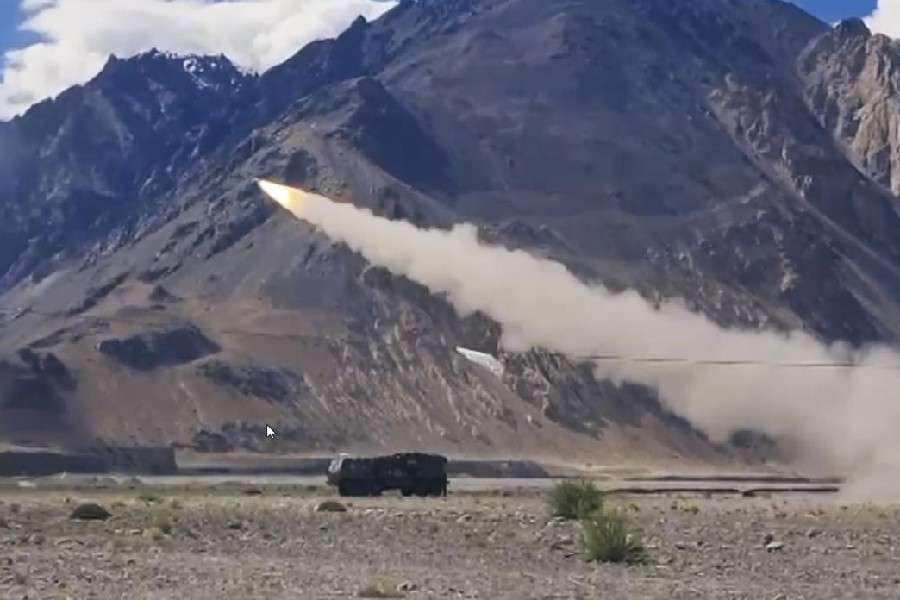
July 18,2025 — In a significant development aimed at bolstering India’s air defense capabilities in high-altitude regions, the Indian Army has successfully test-fired the indigenously developed Akash Prime surface-to-air missile at an altitude of 15,000 feet in the Ladakh sector.
The test, conducted in coordination with the Defence Research and Development Organisation (DRDO), demonstrated the missile’s operational effectiveness in extreme climatic and terrain conditions. According to official sources, the Akash Prime missile intercepted and destroyed an aerial target with precision, meeting all mission objectives.
Developed by DRDO, Akash Prime is an upgraded version of the existing Akash missile system. It features an enhanced active seeker and improved accuracy, allowing it to effectively neutralize aerial threats such as fighter jets, drones, and cruise missiles, even under challenging environmental conditions.
“The successful test at high altitude validates the missile’s performance and strengthens the Indian Army’s capability to defend critical assets in forward areas,” a senior defense official said.
This achievement is seen as a major step forward in India’s efforts to deploy reliable air defense systems in strategically sensitive regions, especially along the Line of Actual Control (LAC). Ladakh, being a high-tension zone due to ongoing border concerns with China, holds critical importance in India’s security architecture.
Defense analysts have noted that the successful test highlights the growing self-reliance of India’s defense sector, aligning with the government’s ‘Atmanirbhar Bharat’ initiative. “Deploying a sophisticated air defense system like Akash Prime in such regions will serve as a force multiplier for the Indian Army,” said retired Air Marshal Anil Chopra.
Akash Prime is equipped with advanced components, including a modified active seeker and enhanced propulsion, making it more effective in high-altitude warfare. The system can engage multiple targets in all-weather conditions and is capable of operating in sub-zero temperatures—an essential requirement for operations in regions like Ladakh.
Sources from DRDO confirmed that more user trials will be conducted under various operational scenarios before full-scale deployment of the system begins.
The successful test also demonstrates the synergy between India’s armed forces and the scientific community in building next-generation defense platforms to counter emerging threats.
With the induction of Akash Prime into active service in the coming months, India’s preparedness in defending its airspace in hostile environments is expected to witness a significant boost.

