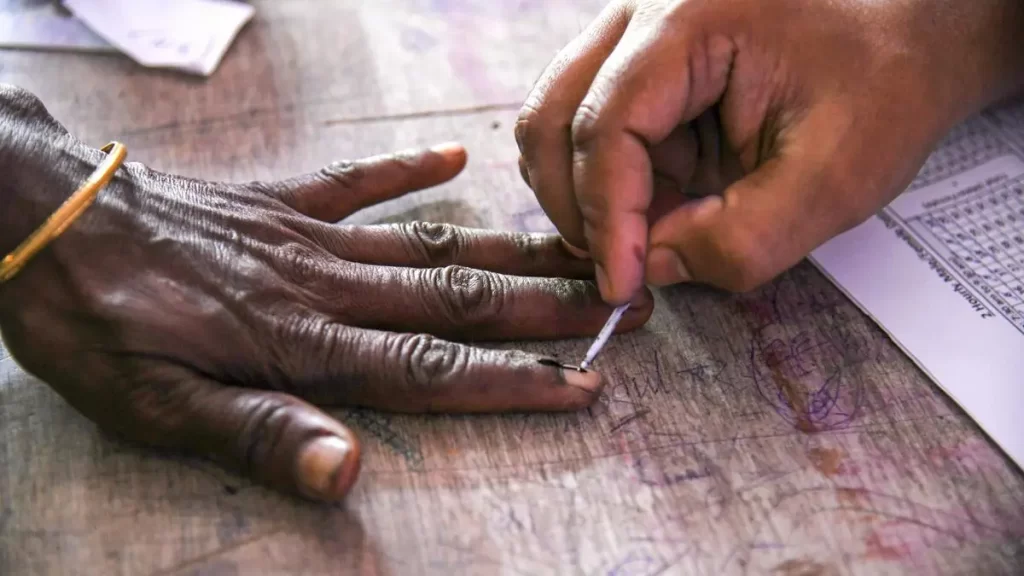
The first phase of the 2025 Bihar Legislative Assembly election — a crucial test for political fortunes in the state — began on Thursday with approximately 3.75 crore voters across 121 constituencies casting their ballots. While voter turnout hovered around 40–50 percent by early afternoon, the elections were overshadowed by a violent incident in which the convoy of Vijay Kumar Sinha, Deputy Chief Minister and BJP candidate in the Lakhisarai constituency, was reportedly attacked. The episode has drawn sharp criticism and raised serious questions about poll-day conduct and law-and-order in Bihar.
The first phase of voting covers a politically sensitive mix of constituencies across Bihar, including the regions of Mithilanchal, Magadh and Seemanchal. This phase is viewed as a litmus test for both the ruling Bharatiya Janata Party-led National Democratic Alliance (NDA) and the opposition Rashtriya Janata Dal (RJD)-dominated Mahagathbandhan. Early data showed a turnout of approximately 42.31 percent by 1 pm, with Lakhisarai registering roughly 46.37 percent.
In Lakhisarai, Vijay Kumar Sinha alleged that his convoy was surrounded by a group who hurled slippers, cow-dung and stones at his car as he arrived in Khoriari village, while slogans of “murdabad” were raised. He blamed the RJD for orchestrating the disturbance and accused local agents of his campaign of being blocked from reaching the booths. In reaction, Sinha threatened strong retaliation, stating that once the NDA returned to power “the bulldozer would run on their chest.” Meanwhile, the RJD denied the specific claims and counter-accused the Deputy CM of staging a drama, as tensions escalated between him and RJD MLC Ajay Kumar in a heated verbal exchange.
In view of such reports, the Election Commission of India reaffirmed its “zero tolerance” policy for election-day violence and ordered immediate action. Officials stated that FIRs have been registered, vehicles seized and local police asked to act swiftly to ensure the integrity of the electoral process.
The incident feeds into the broader narrative of law-and-order concerns and “jungle raj” critiques that have featured heavily in campaign messaging. With both coalitions investing in mass mobilisation, women’s turnout, and EBC/MBC votes, irregularities and violence risk tilting momentum. Analysts suggest that the first phase outcome may influence tactical shifts ahead of the second phase scheduled for November 11 and perhaps even sway undecided voters around development versus governance issues.
As a marathon of democracy unfolds in Bihar, the first phase of voting has lived up to its high-stakes billing but has also exposed deep fractures in the state’s political fabric. With 3.75 crore voters exercising their franchise under heightened scrutiny, the convoy attack on Deputy CM Vijay Kumar Sinha in Lakhisarai has become a flashpoint in an already charged contest. The Election Commission’s promise of strict action is a necessary signal, but the incident underscores how fragile the atmosphere remains. The coming days will reveal whether this phase shapes the final outcome or simply highlights the volatile nature of Bihar politics.