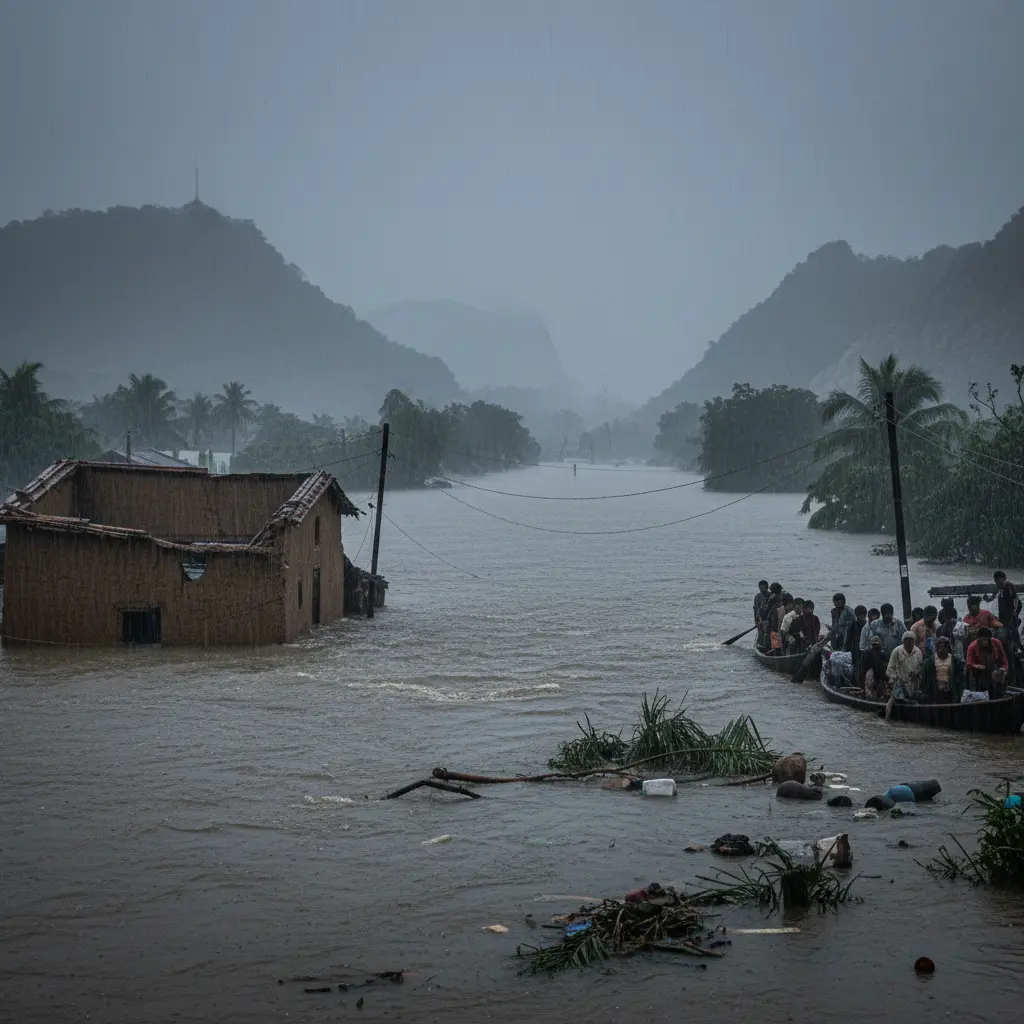
Odisha is once again staring down the wrath of the monsoon. Relentless rain over the past several days has pushed the Mahanadi river system well past its comfort zone, and the state’s disaster machinery is now working around the clock to keep pace with rising water and rising worry in equal measure.
At the centre of it all sits the Hirakud dam. Engineers have been forced to open 22 of its gates as inflow into the reservoir crossed the 4-lakh-cusec mark, and by Saturday morning roughly 6.69 lakh cusecs of floodwater was pouring through Mundali on its way downstream. That is not a small trickle — it is a wall of water working its way through the Mahanadi delta, and everyone living in its path knows exactly what that means.
Ten Districts, One Word: Alert
Authorities have placed ten downstream districts on high alert, with particular concern reserved for Cuttack, Puri, Khurda, Jagatsinghpur and Kendrapara — all of them sitting squarely in the vulnerable Mahanadi delta belt. Angul, Boudh, Sambalpur, Subarnapur and Nayagarh round out the list of districts being watched closely upstream.
But the Mahanadi isn’t acting alone this monsoon. Other rivers — the Salandi, Brahmani, Baitarani, Jalaka and Budhabalanga — have also overflowed their banks in the northern part of the state, damaging well over a thousand homes. Bhadrak has borne the brunt so far, with Jajpur, Balasore and Mayurbhanj close behind. Add it all up and the deluge has now touched more than 8 lakh people spread across 20 districts, chewing through farmland, roads and civic infrastructure along the way.
A View From Above
Chief Minister Mohan Majhi didn’t waste time getting a firsthand look at the damage. Fresh off a four-day trip to Delhi, he headed straight into an aerial survey of the worst-affected pockets — Bhadrak, Jajpur, Kendrapara and Jagatsinghpur — alongside Revenue and Disaster Management Minister Suresh Pujari. From the air, the scale of the flooding becomes hard to argue with: submerged fields, marooned villages, and rivers that have simply outgrown their banks.
On the ground, the response has been sizeable. More than 500 relief centres are up and running across the north and coastal belts, with capacity to shelter close to 2 lakh people. Close to 1.9 lakh residents have already been moved to safety, and disaster response teams continue evacuation work in the hardest-hit pockets even as officials caution that water levels could keep climbing for a while yet, given how much is still flowing into Hirakud from the upper catchment in Chhattisgarh.
There is a small silver lining, at least for now — a lull in fresh rainfall over the past day has given engineers a bit of breathing room to manage the release without an added deluge on top of it.
The Show Must Go On
What makes this monsoon season particularly tricky for Odisha is that it isn’t pausing anything on the state’s calendar. President Droupadi Murmu is still set to travel to her home state between August 3 and 5 for a packed schedule of pre-planned engagements, including the inauguration of a university near Cuttack and a visit to the Maa Kandhuni Devi shrine near Taptapani in Ganjam district. Given the flooded conditions, her rail journey from Bhubaneswar to Berhampur was itself planned with the monsoon in mind, and security has been tightened considerably at Bhubaneswar railway station and along her route, including a no-drone order in parts of Cuttack district.
On top of that, Bhubaneswar is preparing to host the BRICS India Chairship education track meetings from August 5 to 7 — an event that puts the state in the international spotlight at the very moment it’s fighting floodwater on multiple fronts. It’s a genuinely tough balancing act: protocol teams and disaster management officials are essentially running two operations in parallel, one focused on VVIP security and diplomacy, the other on evacuation and relief.
What Happens Next
For now, the situation remains fluid, quite literally. Officials are hopeful that with rainfall easing in both Odisha and the upper Mahanadi catchment, water levels will gradually stabilise over the coming days. But with the reservoir at Hirakud still holding close to its full capacity and outflow numbers running into several lakh cusecs, the danger for low-lying delta districts hasn’t passed yet.
Residents near the river have been urged to stay well away from the water and heed local warnings. Embankment breaches have already been reported in a few spots, and repair work is expected to begin only once the floodwaters properly recede.
Odisha has weathered monsoon floods before, and its relief network — built up over years of cyclone and flood response — is clearly functioning at scale. But between the scale of displacement, an incoming presidential visit, and an international summit on the calendar, the next week will test just how much the state can juggle at once.
India Faces Monsoon Fury as Odisha Floods Force High Alert.