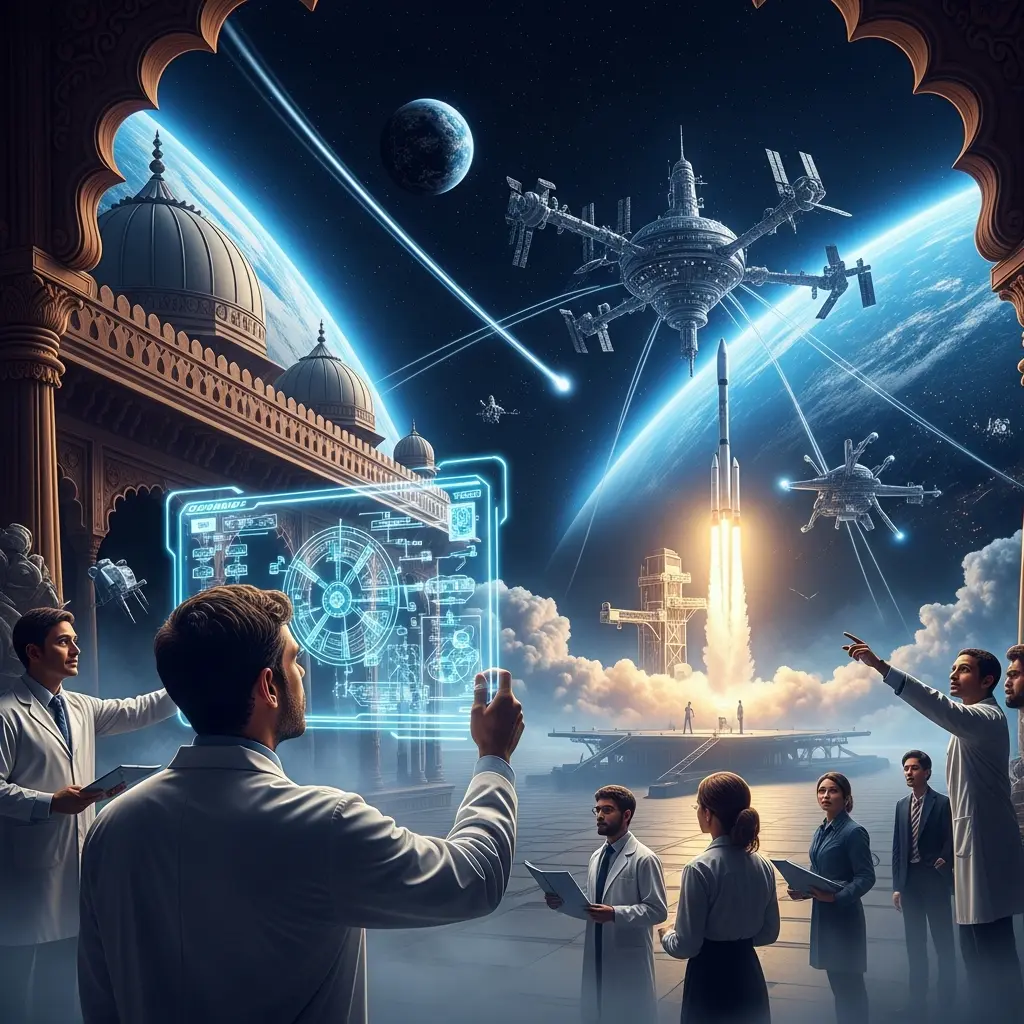
From cost-defying lunar missions to satellite technology that rivals far wealthier programmes, ISRO’s steady rise is drawing the world’s attention — and its partnership requests — in ways that would have seemed improbable two decades ago.
There is a particular moment in the story of any rising power when the world stops treating it as a curiosity and starts treating it as a partner. For India’s space programme, that moment has arrived — not with a single dramatic announcement, but through an accumulating body of evidence that is now simply too substantial to overlook. ISRO missions have been quietly, methodically rewriting the assumptions that the global space community once made about what a developing nation’s space agency could accomplish. The question being asked in space agencies from Washington to Tokyo to Brussels is no longer whether India belongs at the table of serious spacefaring nations. It is what kind of role India will play in shaping the next chapter of human activity beyond Earth.
The foundation of India’s growing credibility in space is, above all else, cost-effectiveness executed without compromise on results. When Chandrayaan-3 made its historic soft landing near the lunar south pole in 2023 — making India only the fourth country ever to achieve a controlled lunar landing, and the first to reach that specific region — the price tag stunned the global space industry. The mission cost less than many Hollywood blockbusters. That achievement was not an accident of frugality. It was the result of decades of disciplined engineering culture at ISRO, a tradition of doing genuinely difficult things with genuinely limited resources, and a deep institutional understanding of how to extract maximum scientific value from every rupee spent. In an era when even the wealthiest space agencies are feeling budget pressure, that skill set is extraordinarily valuable.
“India isn’t offering the world cheap space services. It’s offering something rarer — reliable, innovative, affordable access to some of the most complex capabilities in science.”
India space capabilities in satellite technology have also matured in ways that command serious international respect. ISRO’s ability to design, build, and launch satellites for earth observation, communications, navigation, and scientific research — often on timelines and at costs that leave Western counterparts quietly envious — has made it a go-to partner for countries that want capable satellite infrastructure without the geopolitical complications or price premiums that come with relying solely on the United States, Russia, or China. Dozens of foreign satellites from countries across Asia, Africa, and Europe have been carried to orbit aboard Indian launch vehicles. That track record is its own form of diplomacy, building trust through technical delivery rather than political rhetoric.
Lunar research is where India’s ambitions are now most visibly expanding. The success of Chandrayaan-3 was scientifically significant — the mission’s Pragyan rover collected data on the lunar south pole’s surface composition that researchers are still analysing — but its strategic significance may ultimately be greater. The lunar south pole is the zone that every major space power is now prioritising, because that is where water ice is most likely to exist in usable quantities, and water ice is the prerequisite for any sustained human presence on the Moon. India got there first with a surface mission. That is not a small thing. It gives ISRO both scientific standing and bargaining power as the international conversation about lunar governance, resource access, and collaborative infrastructure accelerates.
Space collaboration is increasingly the frame through which India’s global partnerships are being discussed. The Artemis Accords, which establish a framework for civil space cooperation centred on transparency and sustainable practices, now count India as a signatory — a decision that opened the door to deeper technical exchanges with NASA and other partner agencies. Bilateral agreements with the European Space Agency, the Japan Aerospace Exploration Agency, and others have expanded the scope of joint research and data sharing. India brings something concrete to each of these partnerships: genuine technical capability, geographic launch advantages, and the credibility that comes from a track record of missions that delivered on their promises.
Domestically, the picture is evolving rapidly as well. The Indian government has moved to open parts of the space sector to private enterprise, creating a new generation of Indian space startups that are developing launch vehicles, satellite platforms, and space services with a commercial energy that ISRO’s government structure alone could not generate. This public-private interplay is still young and finding its shape, but it mirrors the transformation that made the American commercial space sector so dynamic — and if it takes hold in India with anything like the same force, the implications for India’s global space standing over the next two decades will be profound.
There are challenges that honest observers should not paper over. India’s human spaceflight programme, Gaganyaan, has faced delays that reflect the genuine complexity of putting people safely in orbit. Sustaining political and budgetary commitment across the long timelines that ambitious space programmes require is never guaranteed. And the competitive international environment for space partnerships means that India must continue to deliver, not merely impress, if it wants to hold and expand the position it has earned.
But the trajectory is clear, and it is pointing upward — not metaphorically but literally. India is building the infrastructure, the institutional knowledge, and the international relationships to be a genuinely consequential force in the global space economy for generations. The Moon, it turns out, was not the ceiling. It was the launching pad.
India Is No Longer Just Reaching for Space — It’s Helping to Shape What Happens There.