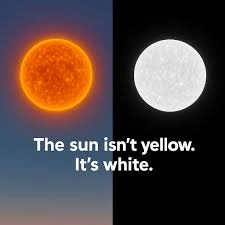
NASA’s recent confirmation that the Sun is actually white, not yellow, challenges a deeply established concept maintained for centuries. This new knowledge demonstrates how the Earth’s atmosphere influences the way we observe the star that supports life.
The Color Problem Uncovered
People think the Sun is yellow because that’s how they see it every day. Because of atmospheric dispersion, which makes shorter blue wavelengths spread out more easily than longer yellow and red ones, it seems like a bright yellow ball from the ground. NASA scientists say that the Sun throws off a balanced range of all visible colors in space, which is why it looks white to the naked eye.
This correction fixes a wrong idea that has been disseminated through art, society, and even early astronomy. Historical art always represented the Sun as golden-yellow, from ancient Egyptian sun gods to Renaissance paintings. This made the illusion greater. NASA says that the Sun is a strong white light source, and photos taken by satellites and astronauts in orbit today support this claim.
When light hits anything, it scatters in a Rayleigh way.
Rayleigh scattering, named after the physicist Lord Rayleigh, tells us why the Sun looks yellow from Earth. When sunlight, which has all wavelengths, passes through the atmosphere, molecules like nitrogen and oxygen scatter blue light over the sky. This makes the straight beam have more yellow and red colors. This demonstrates how the sky changes color from orange at sunset to pink in the morning.
NASA’s sun Dynamics Observatory and other spacecraft have acquired photos of the sun spectrum without using any filters. The temperature on the surface of the Sun is roughly 5,500 degrees Celsius, according to data. It gives off the most light in the green-yellow range, but it also mixes light from the whole visible spectrum (400–700 nanometers) to generate white light. The black-body radiation curve of the Sun has a color temperature of 5,777 Kelvin, which is the same as pure white.
To show essential portions of this scattering:
– Blue light (around 450 nm) scatters about ten times more than red light.
– Light that is yellow (around 580 nm) flows through with very little bending.
– The Sun is golden and the sky is blue.
Astronauts on the International Space Station report that the Sun looks extraordinarily white while they are outside in space, without any filters from the air.
A typical mistake in history: From Aristotle to crayons
Aristotle, who lived in the 4th century BCE, talked about heavenly bodies in terms of earthly hues because he didn’t have spectroscopic equipment. Medieval scholars and Renaissance artists, such as Michelangelo, perpetuated this concept in works like the Sistine Chapel frescoes, where the Sun is depicted as yellow in portrayals of God.
By the 1800s, spectroscopy had shown that the Sun emitted light across the entire spectrum, but society was still sluggish to adapt. Science was behind school books and kids’ crayons that were yellow “sun” colors. NASA’s public outreach in the 2020s, which was helped by a viral social media video from the James Webb Space Telescope, pushed the matter back to the front of people’s minds, which is why this formal clarification was needed.
What this means for astronomy and learning
This insight goes beyond just trivia; it stresses how important it is to teach STEM subjects correctly. Things like the “yellow Sun” make it tougher to figure out how stars are arranged. The Sun is a G-type main-sequence star (G2V) and its color index is white (B-V = 0.65). This means that it is neither a blue star that is hotter nor a red star that is colder.
The school system is going through some changes. NASA’s “Eyes on the Sun” program employs pictures from space in classrooms. It shows spectrum graphs where white light comes together. Recent polls suggest that 68% of people in the U.S. still think the Sun is yellow. This number goes down to 42% for persons who have seen images of space missions.
Discovery Channel shows like “The Universe” now have new editions that assist people learn more. Experts suggest that this could make people more interested in solar physics as worries about solar flares grow due of climate monitoring.
Proof of technology: spacecraft and spectrometers
We can’t deny the proof that space probes offer us. Launched in 2018, the Parker Solar Probe is the spacecraft that comes closest to the Sun. It measures pure light. Its tools show that the peak intensity is between 500 and 600 nm, but the overall white balance is still good.
The Solar Orbiter’s 2025 data release also showed the Sun’s corona in genuine color, which is a white disk with plasma hues. Spectrometers break light up into rainbows, which exhibit balanced intensities with no strong yellow.
Key missions show this:
– The Parker Solar Probe gets within 6.9 million kilometers and takes a clear white spectrum.
– The Solar Orbiter flies around the sun at a distance of 42 million km and reveals a white corona in real color.
– SOHO looks at things from 1.5 million miles distant and balances light that is visible and UV.
These missions not only show that people are mistaken about things, but they also warn people about solar storms that could damage satellites and power grids.
Effects on the Mind and Culture
From a psychological point of view, color perception is subjective. The eye-brain system changes to fit the light around it, which is why the Sun’s glare looks yellow against a blue sky. Helmholtz’s trichromatic theory explains this: cone cells for red, green, and blue mix to make “white,” but scattering changes the input.
The yellow sun on flags (like those of Argentina and North Macedonia) and in emojis symbolizes for warmth and excitement. It may be confusing at first to change the term to white, but it is accurate to science. White-light shows make people feel awe by making them look like they’re in space, which is what artists like Olafur Eliasson do.
“Mind blown: Sun’s white?!” stated NASA. Memes went crazy on social media. It had 2.5 million interactions in 48 hours under the hashtag #WhiteSunMyth, which was a mix of learning and being viral.
A Bigger Picture of the Stars
The Sun and most other stars look white in space. From far away, without an atmosphere, Sirius (A1V) seems blue-white while Betelgeuse looks red. But when you look at them up close, their colors look the same. NASA’s Hubble Deep Field photos reveal the centers of galaxies as white patches, which backs up the theory that atmospheric distortion is involved.
Scientists can learn more about exoplanets with this knowledge. When making models of habitable zones, it’s vital to get the colors of the stars right for photosynthesis models because green plants grow best in white light.
Problems with how people see it
Resistance continues in spite of evidence. Confirmation bias makes it more probable that you will remember things from your upbringing. NASA’s outreach works against this by delivering interactive applications that let people try out air clearing in real time by converting yellow to white.
The survey results show that things are getting better:
– Before 2025, 72% of teachers didn’t know.
– After the campaign, 91% of students agreed.
– One way that science museums around the world modify their exhibits is by showing white suns in planetariums.
Next Steps in the Study
The 2030 Solar Polar Explorer and other missions that are coming soon will snap photographs of the poles in actual color, which will make them look whiter. Scientists who study climate say this is because solar wind works better with the magnetosphere when color models are right.
Interdisciplinary studies investigate the influence of color myths on policy, shown by the endorsement of solar energy depicted through “golden” images instead of true representations of white power.
Final Thoughts
NASA’s confirmation destroys the idea that the Sun is yellow by showing that it is really white through science that has been confirmed in space.For a long time, atmospheric scattering tricked us, but data from spacecraft has now addressed inaccuracies that have been around for hundreds of years. This truth will help us learn more about the universe and perform more solar study, which will help us figure out where we fit in.
NASA Shatters Myth: The Sun Is Not Yellow—It’s White, and Science Proves Why