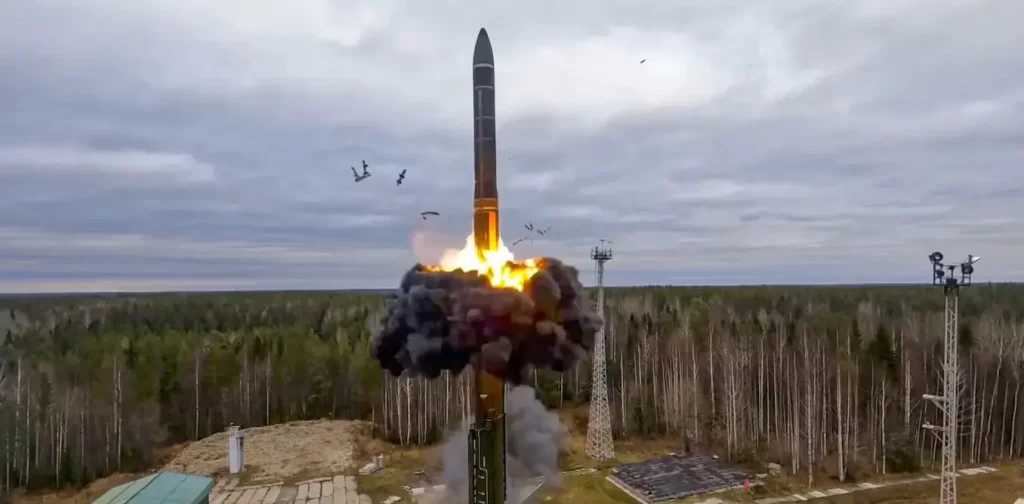
Russia has publicly urged Donald Trump’s administration in the United States to clarify ambiguous remarks about the possible resumption of nuclear weapons testing, a move that has stirred fresh concerns over global strategic stability. Moscow described the signals as “confusing and alarming,” warning that any return to full-scale nuclear tests could trigger a renewed arms race.
The controversy began when President Trump stated that the U.S. military should “immediately restart the process” for testing nuclear weapons. The remarks created uncertainty about whether “testing” referred to explosive nuclear warhead tests or simply flight tests of nuclear-capable missiles. In response, Russia’s foreign ministry said that the messages from Washington were “contradictory” and urgently needed clarification.
In Moscow, President Vladimir Putin instructed senior officials to draw up proposals for possible Russian nuclear tests “if the U.S. acts first.” The Kremlin emphasized that Russia has not conducted an explosive nuclear test since the end of the Soviet era, and its readiness to re-activate test sites such as those on the Novaya Zemlya archipelago underscores the seriousness of the current situation. Analysts have warned that a genuine return to nuclear testing by either country could dismantle decades of arms-control norms and encourage other nuclear states to follow suit.
The uncertainty surrounding Washington’s position comes at a time when the last major U.S.–Russia treaty limiting strategic nuclear warheads is nearing expiry. The decline of formal arms-control mechanisms increases the risk that testing could once again become the standard practice rather than a rare exception. Observers note that the stability of global non-proliferation depends heavily on clarity and restraint from the world’s leading nuclear powers; mixed messages risk eroding that balance and inviting escalation.
If the United States were to resume explosive nuclear testing, Russia has indicated that it would regard such an act as a dangerous provocation demanding a response. Experts warn that the move could set off a domino effect, prompting other nuclear-armed nations to accelerate the development of new warheads and delivery systems. This could reignite a 21st-century arms race and further strain the global non-proliferation regime.
The potential fallout extends beyond Washington and Moscow. Allies and non-nuclear states are watching closely, concerned that renewed testing could undermine decades of progress toward arms control and disarmament. The Comprehensive Nuclear-Test-Ban Treaty (CTBT), which bans all nuclear explosions, has yet to enter into force, and any U.S. or Russian test would deal a severe blow to its credibility.
Russia’s demand for clarification from the U.S. underscores a critical moment in global nuclear diplomacy. Should Washington proceed with explosive tests, Moscow’s visible preparations suggest that it could respond in kind, leading to a new cycle of strategic confrontation. The situation highlights the fragile nature of global security, where a few words from world leaders can shift the balance between restraint and escalation. As tensions rise, the world waits for clarity that could determine whether the coming years bring renewed arms control—or a dangerous new arms race.