
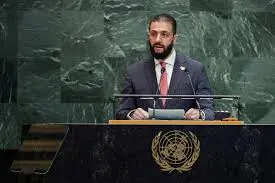
On November 6, 2025, the United Nations Security Council (UNSC) approved a resolution to lift long-standing sanctions on Ahmed al-Sharaa, transitional President of Syria, and Interior Minister Anas Khattab. The decision, championed by the United States and supported by 14 of the 15 council members with China abstaining, marks a watershed moment in Syria’s diplomatic rehabilitation.
The resolution received overwhelming support, reflecting a rare moment of consensus within the Security Council over Syria’s future. Sanctions that had been in place under the UN’s ISIL (Da’esh) and Al-Qaeda sanctions regime were formally lifted for both al-Sharaa and Khattab. This move follows a broader policy shift by the United States earlier in 2025 that eased many Syria-related restrictions, aiming to support the country’s political transition and humanitarian recovery.
President al-Sharaa, who led the transitional government after the fall of Bashar al-Assad in December 2024, is scheduled to meet the US President in Washington next week. His visit will mark the first time a Syrian head of state has been officially received at the White House since Syria’s independence, highlighting the significant diplomatic thaw between the two nations.
For Syria, the lifting of sanctions represents more than just relief from financial and travel restrictions. It opens doors to reconstruction funding, regional reintegration, and renewed global partnerships. Many regional analysts view this development as a turning point that could accelerate efforts to rebuild war-shattered infrastructure and resume international commerce. However, the decision is not without critics. China’s UN ambassador expressed concerns that the resolution did not sufficiently address the issue of foreign terrorist fighters or clarify mechanisms to ensure Syria’s compliance with counter-terrorism obligations.
Experts note that while the practical impact of the sanctions removal may be limited—since many restrictions were already eased—it carries immense symbolic value. The decision signals that the international community, led by the US and its allies, is prepared to recognize and support Syria’s new leadership. It also reflects a shift in global strategy from isolation to engagement, focusing on stabilizing the Middle East through diplomatic and economic means rather than punitive measures.
For the Syrian administration, this development legitimizes its authority and may help attract much-needed foreign investment and reconstruction capital. Yet challenges remain. The government must prove its commitment to national reconciliation, rebuilding essential infrastructure, and ensuring that human rights and democratic reforms are prioritized in the post-war landscape.
From a regional perspective, the UNSC resolution could ease diplomatic tensions between Syria and neighboring countries, paving the way for renewed engagement with Gulf states and other regional actors. It also opens the possibility of Syria rejoining broader regional security discussions and economic frameworks. However, questions remain about whether accountability for wartime abuses and governance challenges will be adequately addressed as part of Syria’s reintegration.
The Security Council’s decision to remove sanctions on President Ahmed al-Sharaa and Interior Minister Anas Khattab marks a pivotal moment in Syria’s post-Assad chapter. It underscores a shift from punitive diplomacy toward reconstruction and reconciliation. As al-Sharaa prepares for high-level talks in Washington, the coming months will be critical in determining whether this diplomatic breakthrough leads to real progress on the ground or remains largely symbolic.

