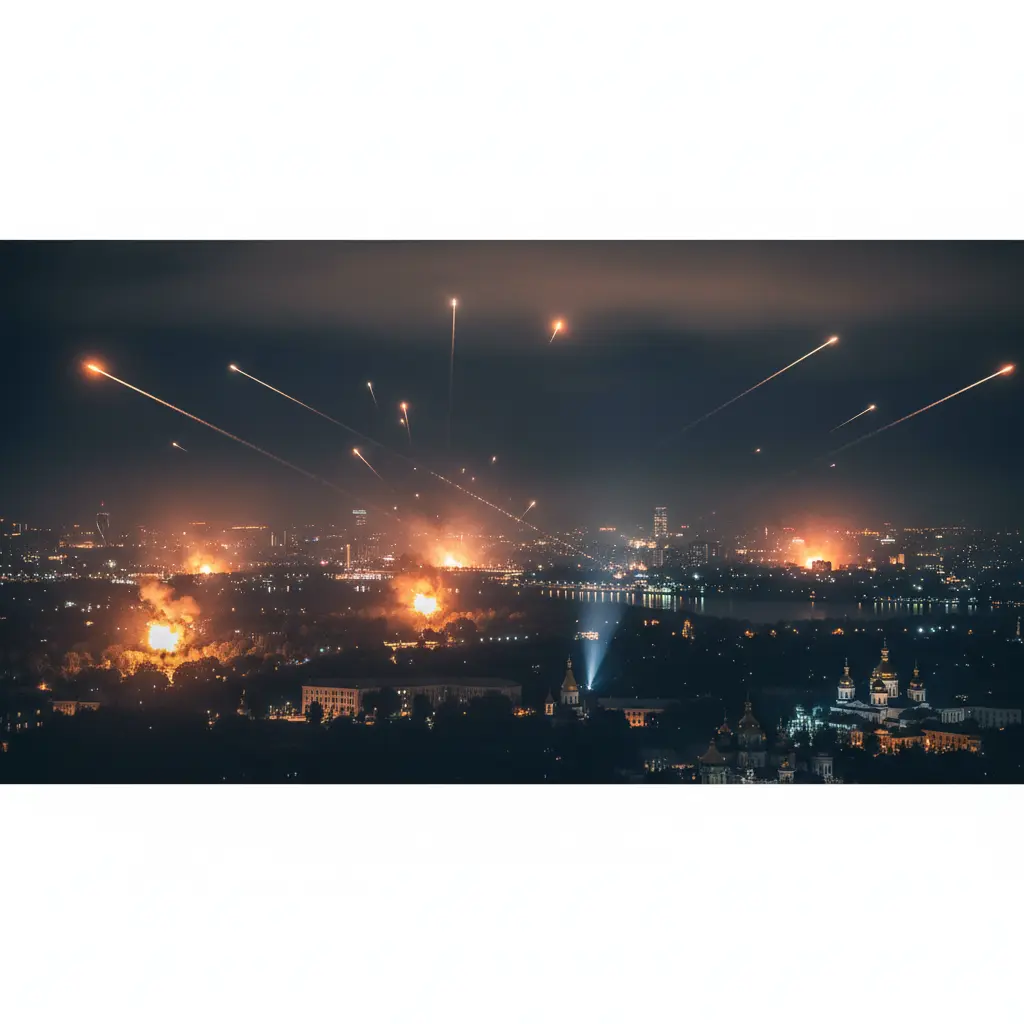
Kyiv woke up to smoke, rubble, and grief this week after Russia unleashed one of the largest air assaults of the entire war on Ukraine’s capital. The overnight barrage of missiles and drones tore through residential neighborhoods, government buildings, and civilian infrastructure, leaving a trail of destruction that officials are calling one of the deadliest strikes on the city since the conflict began.
According to Ukraine’s State Emergency Service, at least 25 people were killed and more than 90 others injured in the attack, with rescue crews still combing through collapsed buildings for survivors as this article goes to press. Ukrainian officials warned that the final death toll could climb further as search operations continue in the hardest-hit districts.
A Night of Terror in the Capital
The assault began just before midnight, when explosions started ripping across Kyiv’s historic center. Air raid sirens wailed for hours as residents scrambled into basements, underground parking garages, and metro stations to wait out the barrage. According to Kyiv’s metro authority, a record number of people — including thousands of children — sheltered underground overnight as the attack unfolded.
Ukrainian President Volodymyr Zelensky said Russia fired more than 70 missiles and close to 500 drones at the capital in a single night, an unusually high number of ballistic missiles that overwhelmed parts of Ukraine’s air defense network. Officials noted that the interception rate for these missiles was lower than usual, a worrying sign as Ukraine continues to face shortages of Patriot interceptors months into the conflict’s fifth year.
More than 30 locations across every district of Kyiv sustained damage. Residential apartment blocks partially collapsed, a hotel caught fire, an ambulance station was hit, and a scientific research institute was left in ruins. Ukraine’s largest private energy provider reported damage to power infrastructure, cutting electricity to parts of the city just as emergency crews were racing to reach survivors trapped under debris.
Eyewitnesses described scenes of chaos and fear. One Kyiv resident, who had just stepped out of an underground shelter when a missile struck nearby, told local reporters that the explosion felt powerful enough to bring the entire structure down. Panic sent people running back underground as fires spread through nearby buildings.
Zelensky Cuts Trip Short as Warnings Prove True
Zelensky had been on a diplomatic visit to Ireland when intelligence indicated Moscow was preparing a large-scale strike. He cut the trip short and urged Ukrainians to stay in shelters, a warning that proved tragically accurate hours later. Following the attack, he visited one of the damaged sites in Kyiv and thanked European partners for their continued support, while pressing the United States to speed up the delivery of additional air defense systems.
Ukraine’s Foreign Minister described the assault as a “night of horror” and accused Russian President Vladimir Putin of deliberately targeting civilians rather than achieving battlefield gains against Ukrainian forces. The Kremlin, for its part, said the strikes were retaliation for Ukraine’s escalating drone campaign against Russian oil refineries and energy infrastructure, insisting the targets were military and energy-related facilities rather than civilian ones. Ukrainian officials strongly dispute that framing, pointing to the dozens of residential buildings hit in the assault.
International Condemnation and Renewed Support
The scale of the attack sent ripples far beyond Ukraine’s borders. Poland scrambled fighter jets and placed its air defense systems on alert as a precaution, while Finland briefly restricted airspace in the eastern Gulf of Finland. Western leaders swiftly condemned the strikes, with several European officials calling the attack a deliberate escalation that undercuts any prospects for peace talks.
The European Union, which recently disbursed the first installment of a multibillion-euro defense package to support Ukraine’s drone and air defense procurement, reiterated its commitment to helping Kyiv defend itself. Officials also pointed to Ukraine’s ongoing negotiations to join the EU as evidence that Western backing for the country isn’t wavering, even as the war grinds into its fifth year with no resolution in sight.
Meanwhile, diplomatic efforts to end the broader Russia-Ukraine war remain stalled. Fighting continues not just around Kyiv but across multiple front-line regions, and both sides have shown little appetite for compromise. Ukraine has intensified its own long-range drone strikes on Russian oil refineries and energy facilities in recent weeks, a campaign officials say is aimed at raising the economic cost of the war for Moscow. Russian officials have acknowledged that these strikes are straining the country’s fuel supply, even as Moscow continues to escalate its own bombardments of Ukrainian cities.
What Comes Next
As rescue teams continue digging through the wreckage in Kyiv, the attack has reignited urgent conversations among Western allies about accelerating air defense shipments to Ukraine. But for those living in the capital the immediate reality is more bleak as they mourn the dead, clear rubble and brace for what many fear could be the next wave of strikes in a war showing no signs of slowing down.
The mayor of Kyiv has announced a day of mourning for the victims, with flags lowered to half-mast throughout the city. It is a painfully familiar ritual for a population that has suffered more than four years of war – one more marker of loss in a conflict that continues to frustrate diplomatic solutions.
Russia Launches Massive Air Attack on Kyiv, Killing Dozens in “Night of Horror”.